The title of the book is " The third wave of democratization in Latin America- advances and challenges"
edited by Frances Hagopian and Scott Mainwaring
It starts with the third wave of democratisation since 1978 and analyses the transition upto 2005, when the book was published. It has concluded that the Latin American democracies have become stable,durable and sustainable. It has pointed out the challenges to some of the democracies by some demogogic leaders, who use the tools and framework of democracy to impose their authoritarianism. But these setbacks are temporary, since even these leaders have to go back to the electorate which has the ultimate power to change their rulers.
The authors have identified three kinds of democratic trends and made individual analysis of sample countries. These are: (1) democratic giants with authoritarian past - Brazil, Mexico and Argentina, (2) unexpected democracies in unlikely countries -Guatemala, El salvador and Bolivia and (3) Democratic erosion in the third wave in Venezuela, Peru and Colombia.
The point which comes across clearly is that in most cases, democracies were disrupted in the past by the oligarchs, whenever their interests were challenged or affected by the rules of the democratic game. The generals and colonels were just the instruments of the elite. The second point is the loss of credibility of the traditional political parties and the entry of outsiders like Fujimori and others. But this did not happen in Argentina despite the call " se vayan los todos" ( out with everyone- meaning all political leaders ) by the people of Argentina at the height of the political and economic crisis which touched a historical low point in 2001. The civil war in El Salvador and Guatemala had devastated the societies but they have made a remarkable transition to democracy after the peace accords.
The authors have brought out the complications of the ethnic factor in countries such as Bolivia and Guatemala. But the Bolivian anamoly has been corrected with the election of native Indian Evo morales for the first time in the history of Bolivia. There could be a similiar historical change if Rigoberta Menchu also become President of Guatemala.
The approach of the authors in the book becomes very academic and theoretical sometimes. But overall they have given a sense of the political transition and process of the selected countries and the trends in the region.
But the classification and some theories need review after the elctions in 2006, which have brought to power more outsiders and leftist Presidents.
Tuesday, May 01, 2007


Friday, April 27, 2007
Malinche - novel by Laura Esquivel
The book was a gift from the Mexican Ambassador Rogelio.
This is the first book of the Mexican author Laura Esquivel, I have read.
I found that she is the same author of the story" Like water for chocolate" which I have seen as a movie and liked it.
Malinche is a historical novel about the Malinalli, the mistress and interpreter of Hernan Cortez, the Spanish conqueror of Mexico. Born to the native Mexican tribe, she ends up as a slave to Cortez the conquistador. She takes him for the reincarnation of her god Quetzalcoatl and serves him loyally.But she realises that Cortez is just a human, greedy for gold and conquest. Moctezuma, the Aztec emperor also mistakes Cortez for reincarnation of his god and hands over the throne to him. Cortez marries off Malinalli to his loyal deputy Jaramillo alter. She gets one a son from Cortez, said to be the first mestizio of Mexico.
Laura has done deep research on Indian history and religion and has given an authentic Indian flavour to the book. She gives a vivid, objective and respectful account of the beliefs, customs and thought process of the native Indians. The book is full of Indian names of gods, people and cities such as Quetzalcoatl, Axayacatl, Tenochtitlan, Huitzilopochtli, Tetlepanquetzal,Tlazolteotl, Cuitlahuac,Cuauhtemoc and other such tongue twisters.
Malinalli who is brought up to believe in life and worship live forces such as wind, water and butterflies is at a loss to understand the opposite approach of christianity symbolised by cross and death. Malinalli talks to water, wind and butterlfies and through these Laura has brought out out the harmony of life of the natives with nature.When Cortez conquers, kills and destroys the Indian idols, the natives lose faith in their own gods who were powerless to protect them
The native Indians consider Malinalli as a traitor. But this has to be seen in perspective. While she helped the conquest of Cortes, she was simply a poor girl sold twice as slave as a child and later to Cortez.
Malinche was originally the name given to Cortez by the natives in their language Nahuatl. Today Malinche is a pejorative term to describe someone who denies his heritage, valuing other cultures above his own. Malinchismo means betrayal.
This is the first book of the Mexican author Laura Esquivel, I have read.
I found that she is the same author of the story" Like water for chocolate" which I have seen as a movie and liked it.
Malinche is a historical novel about the Malinalli, the mistress and interpreter of Hernan Cortez, the Spanish conqueror of Mexico. Born to the native Mexican tribe, she ends up as a slave to Cortez the conquistador. She takes him for the reincarnation of her god Quetzalcoatl and serves him loyally.But she realises that Cortez is just a human, greedy for gold and conquest. Moctezuma, the Aztec emperor also mistakes Cortez for reincarnation of his god and hands over the throne to him. Cortez marries off Malinalli to his loyal deputy Jaramillo alter. She gets one a son from Cortez, said to be the first mestizio of Mexico.
Laura has done deep research on Indian history and religion and has given an authentic Indian flavour to the book. She gives a vivid, objective and respectful account of the beliefs, customs and thought process of the native Indians. The book is full of Indian names of gods, people and cities such as Quetzalcoatl, Axayacatl, Tenochtitlan, Huitzilopochtli, Tetlepanquetzal,Tlazolteotl, Cuitlahuac,Cuauhtemoc and other such tongue twisters.
Malinalli who is brought up to believe in life and worship live forces such as wind, water and butterflies is at a loss to understand the opposite approach of christianity symbolised by cross and death. Malinalli talks to water, wind and butterlfies and through these Laura has brought out out the harmony of life of the natives with nature.When Cortez conquers, kills and destroys the Indian idols, the natives lose faith in their own gods who were powerless to protect them
The native Indians consider Malinalli as a traitor. But this has to be seen in perspective. While she helped the conquest of Cortes, she was simply a poor girl sold twice as slave as a child and later to Cortez.
Malinche was originally the name given to Cortez by the natives in their language Nahuatl. Today Malinche is a pejorative term to describe someone who denies his heritage, valuing other cultures above his own. Malinchismo means betrayal.
El Huerfanito - Peruvian film
This is the first film about native Indians of Andean region I have seen.
It narrates the life of poor native Indians in the Andean region. It is about two kids, Juanito and Luchito, who face harsh realities when they come out of their village and interact with the world outside. And love blooms in the village and the hero elopes with the girl on a horseback. The lover boys turns into a drunken husband and the family is ruined.
simple story.. uncomplicated flow and not very sophisticated in direction or filmshots
It is explained by the provincial nature of its origin
What is important is ..it is true to the native Indians, showing them as they are.
This film is in Quechua language and Spanish.
Directed by Flaviano Quispe Chaiña
with the cast of Vladimir Estofanera, Kenji Hilsaca, Laureano Mamani, Asunción Uscamayta, Elizabeth Borda, Julian Miranda and Percy Paco..
It narrates the life of poor native Indians in the Andean region. It is about two kids, Juanito and Luchito, who face harsh realities when they come out of their village and interact with the world outside. And love blooms in the village and the hero elopes with the girl on a horseback. The lover boys turns into a drunken husband and the family is ruined.
simple story.. uncomplicated flow and not very sophisticated in direction or filmshots
It is explained by the provincial nature of its origin
What is important is ..it is true to the native Indians, showing them as they are.
This film is in Quechua language and Spanish.
Directed by Flaviano Quispe Chaiña
with the cast of Vladimir Estofanera, Kenji Hilsaca, Laureano Mamani, Asunción Uscamayta, Elizabeth Borda, Julian Miranda and Percy Paco..
Wednesday, April 25, 2007
Ten reasons why Latinas like older men
Hold on...this is not my cooking up. I found it in a blog written by a Chilean woman.
Let me mention something.. old men are called as having reached " metallic age" in latin america. why? they have silver in the hair, gold in the teeth and lead ...u know where.
here is the write up
"The reasons range from the physical to the emotional and end up in the intellectual realm. There are positive traits of course, like a Latin man’s warmth of character and their very physical nature, which involves public demonstrations of affection (and private ones as well). Nothing makes a woman feel better than to know she is wanted and that her mate is not afraid to show it. Latin men are usually tender, romantic, and very sweet.But sadly, these traits don’t seem that amazing when we begin to think about all the other things that turn us off.First of all, the “kangaroo syndrome” thrives in Latin America (men and women who live with their parents well into their early thirties). This is mainly due to the fact that in Latin America, colleges and universities are located inside the cities, so very few people have to move out when they’re 18. So much for maturing away from home. Secondly, it is very difficult to work and study at the same time. Salaries in Latin America are low and the working hours long. So actually holding an 8-to-7 job and on top of that studying nights becomes quite a feat. And the possibility of a part-time job is scarce. I live in Chile, the country with the best economy in all of South America, and over here, very few people can handle working and studying. And the salaries in this “country on the road to development” are, well, you guessed it, low. Just imagine what the rest of Latin America is like. So the above entails getting your first job at 24 and until that time, living off your parents. There goes maturity gained through hard work and financial independence.
So, topping the list at number one :
1. We like older men because they are more mature, their lives having been shaped by their previous experience of living on their own and holding a steady job.
2. We like the wrinkles around their eyes and the gray hair at the temples. It gives them character.
3. We love the fact that they can actually invite us out because now they can afford to.
4. We like their cultural baggage, that they have more knowledge gained through a longer life span (more books read, more movies watched, etc).
5. We like how they protect us, instead of us mothering them.
6. We like their anecdotes. When you’re 40+ years old you must have a lot of anecdotes.7. We dig their car. And are thankful they actually own a car.
8. We like the fact that they are gentle, and usually know how to properly treat a woman.
9. We like that they are quieter, less of the party animals they used to be when younger.
10. We like that they have lived long enough to realize that appreciating women for who they really are is of the utmost importance.
Of course, finding an eligible older man who isn’t married or divorced is a whole other story. But we can always dream. And keep our fingers crossed."
Let me mention something.. old men are called as having reached " metallic age" in latin america. why? they have silver in the hair, gold in the teeth and lead ...u know where.
here is the write up
"The reasons range from the physical to the emotional and end up in the intellectual realm. There are positive traits of course, like a Latin man’s warmth of character and their very physical nature, which involves public demonstrations of affection (and private ones as well). Nothing makes a woman feel better than to know she is wanted and that her mate is not afraid to show it. Latin men are usually tender, romantic, and very sweet.But sadly, these traits don’t seem that amazing when we begin to think about all the other things that turn us off.First of all, the “kangaroo syndrome” thrives in Latin America (men and women who live with their parents well into their early thirties). This is mainly due to the fact that in Latin America, colleges and universities are located inside the cities, so very few people have to move out when they’re 18. So much for maturing away from home. Secondly, it is very difficult to work and study at the same time. Salaries in Latin America are low and the working hours long. So actually holding an 8-to-7 job and on top of that studying nights becomes quite a feat. And the possibility of a part-time job is scarce. I live in Chile, the country with the best economy in all of South America, and over here, very few people can handle working and studying. And the salaries in this “country on the road to development” are, well, you guessed it, low. Just imagine what the rest of Latin America is like. So the above entails getting your first job at 24 and until that time, living off your parents. There goes maturity gained through hard work and financial independence.
So, topping the list at number one :
1. We like older men because they are more mature, their lives having been shaped by their previous experience of living on their own and holding a steady job.
2. We like the wrinkles around their eyes and the gray hair at the temples. It gives them character.
3. We love the fact that they can actually invite us out because now they can afford to.
4. We like their cultural baggage, that they have more knowledge gained through a longer life span (more books read, more movies watched, etc).
5. We like how they protect us, instead of us mothering them.
6. We like their anecdotes. When you’re 40+ years old you must have a lot of anecdotes.7. We dig their car. And are thankful they actually own a car.
8. We like the fact that they are gentle, and usually know how to properly treat a woman.
9. We like that they are quieter, less of the party animals they used to be when younger.
10. We like that they have lived long enough to realize that appreciating women for who they really are is of the utmost importance.
Of course, finding an eligible older man who isn’t married or divorced is a whole other story. But we can always dream. And keep our fingers crossed."
Tuesday, April 24, 2007
The years with Laura Diaz - novel by Carlos Fuentes
"The best novelists in the world are our grandmothers, and it is to them I owe the first memory, on which this novel is based". This is how Carlos Fuentes, the Mexican author, describes his inspiration to write this novel.
It is a story of six generations, starting with the grandmother of Laura Diaz, the heroine and ending with her greagrandson. The six generations are affected by the political turbulence of Mexico, the civil war in Spain,the Nazi Germany, dilemma of Marxists in Europe, McCarthyism and the story of Diego Rivera and Frida Kahlo. Fuentes has used every opportunity to comment and analyse the political developments and let his characters speak on the issues. One gets a overall perspective of the evolution of the Mexican society, through the political changes internally and externally.
It starts with Cosima Kelsen, the grandmother who is robbed at gunpoint by a bandit while travelling in a stagecoach. The bandit asks for the wedding ring but the young Cosima tells him" you have to cut my finger to take the ring". Without a hesitation, the bandit chops the finger and takes away the ring.
Cosima's family of German immigrants settle down in preindependent Mexico with a coffee plantation. Laura's brother,Santiago, a revolutionary is executed by the regime when he is in his twenties. Laura marries Juan Francisco, a trade union leader who compromises with the governments in power to safeguard the interests of the workers. But he loses the respect of the wife when he turns over a nun to the regime who executes her for rebel ideology. Laura walks out of the house and become a freelancer. She has an affair with someone and then goes to work as asssistant to Frida and Diego Rivera. Later she falls in love with Jorge Maura, a Spanish republican in exile in Mexico. When Maura leaves her she comes back home and confesses to the husband and two teenage sons.The elder son Santiago becomes an artist and dies a premature death. After the death of her husband Laura goes to live with an American in Mexico, exiled by McCarthyism who also dies. Then she takes up photography and become a professional and gets a new career and life. Her younger son joins the rich and powerful of the Mexican elite but his son Santiago rebels and comes back to grandmother. He paticipates in the 1968 student agitation against the government and is shot to death along with hundreds of other students. His daughter gives birth to the fourth Santiago. Laura ends her life by going back to her grandmother's house and disappearing in the surrounding forest.
This is one of the best books of Carlos Fuentes I have read so far. I am impressed by the depth and range of Fuentes' s perspectives on politics and society. I am looking forward to reading his other books.
It is a story of six generations, starting with the grandmother of Laura Diaz, the heroine and ending with her greagrandson. The six generations are affected by the political turbulence of Mexico, the civil war in Spain,the Nazi Germany, dilemma of Marxists in Europe, McCarthyism and the story of Diego Rivera and Frida Kahlo. Fuentes has used every opportunity to comment and analyse the political developments and let his characters speak on the issues. One gets a overall perspective of the evolution of the Mexican society, through the political changes internally and externally.
It starts with Cosima Kelsen, the grandmother who is robbed at gunpoint by a bandit while travelling in a stagecoach. The bandit asks for the wedding ring but the young Cosima tells him" you have to cut my finger to take the ring". Without a hesitation, the bandit chops the finger and takes away the ring.
Cosima's family of German immigrants settle down in preindependent Mexico with a coffee plantation. Laura's brother,Santiago, a revolutionary is executed by the regime when he is in his twenties. Laura marries Juan Francisco, a trade union leader who compromises with the governments in power to safeguard the interests of the workers. But he loses the respect of the wife when he turns over a nun to the regime who executes her for rebel ideology. Laura walks out of the house and become a freelancer. She has an affair with someone and then goes to work as asssistant to Frida and Diego Rivera. Later she falls in love with Jorge Maura, a Spanish republican in exile in Mexico. When Maura leaves her she comes back home and confesses to the husband and two teenage sons.The elder son Santiago becomes an artist and dies a premature death. After the death of her husband Laura goes to live with an American in Mexico, exiled by McCarthyism who also dies. Then she takes up photography and become a professional and gets a new career and life. Her younger son joins the rich and powerful of the Mexican elite but his son Santiago rebels and comes back to grandmother. He paticipates in the 1968 student agitation against the government and is shot to death along with hundreds of other students. His daughter gives birth to the fourth Santiago. Laura ends her life by going back to her grandmother's house and disappearing in the surrounding forest.
This is one of the best books of Carlos Fuentes I have read so far. I am impressed by the depth and range of Fuentes' s perspectives on politics and society. I am looking forward to reading his other books.
Tuesday, April 17, 2007
coming and going to and from Latin America
A group of ten Spanish speaking journalists from latin america will be in India from 20 to 29 April, at the invitation of the Ministry of External affairs. They will be in Agra 20-21 april, in Delhi 23-24, Hyderabad 25-26 april and pune 27-28 april.
These are
Bolivia-Mr. Jorge Leopoldo Arias Banegas
Chile-Ms. Paula Escobar,El Mercurio
Colombia-Ms. Angelica Lagos, El Espectador
Dominican Republic- Mr. Hector Martinez, Listin Diario
Mexico- Mr. Jorge Villalobos, Poder y Negocios
Mr. Jose Eseverri
Reforma
Nicaragua- Mr. Francisco Xavier Chamorro Garcia, El Nuevo Diario
Peru- Mr. Marco Zileri Dougall,Caretas
Panama - Mr. Dustin Enrique Guerra Guitierrez, La Prensa
Venezuela- Ms. Rosanna Espinel,El Universal
who is going to Latin America?
These are
Bolivia-Mr. Jorge Leopoldo Arias Banegas
Chile-Ms. Paula Escobar,El Mercurio
Colombia-Ms. Angelica Lagos, El Espectador
Dominican Republic- Mr. Hector Martinez, Listin Diario
Mexico- Mr. Jorge Villalobos, Poder y Negocios
Mr. Jose Eseverri
Reforma
Nicaragua- Mr. Francisco Xavier Chamorro Garcia, El Nuevo Diario
Peru- Mr. Marco Zileri Dougall,Caretas
Panama - Mr. Dustin Enrique Guerra Guitierrez, La Prensa
Venezuela- Ms. Rosanna Espinel,El Universal
who is going to Latin America?
Vikram Seth, one of my favourite Indian writers. He is going to travel to Brazil, Chile, Paraguay, Bolivia and other countries. I guess a novel will come out of this or atleast a travelogue.
The other writer who has been there is Salman Rushdie of the Indian magical realism. he wrote a travelogue on Nicaragua, after his trip there during the previous sandinista regime.
Friday, April 06, 2007
La boca del lobo - Peruvian film
I saw this Peruvian film yesterday. La boca del lobo means mouth of the wolf.
For me this is yet another discovery of a serious and powerful film from Peru.
It is about the dirty war between the "Shining Path" ( senderos luminosos) Maoist guerillas and the armed forces of Peru in the eighties. The villagers, mostly the local Indians, are caught between the killings of the guerillas and the brutal retaliation of the antiterrorist army.The army lieutenant Roca is excessivly patriotic at the cost of lives of innocent people. The invisible but ruthless guerilla group strikes at will, killing soldiers and informants. In a rage to retaliate against the guerilla killing of his soldiers, Capt Roca marches the whole village and massacres them in cold blood. When Vitin Luna, the soldier who resists this mindless cruelty and refuses to fire, he is put under detention. Unable to tolerate the brutalities, Luna deserts the army in disgust.
The movie is not far from the reality witnessed in Peru. It could have been a documentary. The story is based on true incidents that took place in the mountain town of Chuspi between 1980 and 1983, where a small unit of soldiers was garrisoned to defend the town from attack by the Shining Path. The movie not only documents the reality of the Peruvian civil war but also the racism against Indian people in general.
President Fujimori put an end to the guerillas with his ruthless campaign. Now there is no more war between the two sides, except for occasional minor incidents.
The movie, released in 1988 has been directed by Francisco Lombardi of Peru. He is also a writer and producer. He directed the other film " captain pantoja and the visitadoras" based on the novel of Mario Vargas Llosa.
For me this is yet another discovery of a serious and powerful film from Peru.
It is about the dirty war between the "Shining Path" ( senderos luminosos) Maoist guerillas and the armed forces of Peru in the eighties. The villagers, mostly the local Indians, are caught between the killings of the guerillas and the brutal retaliation of the antiterrorist army.The army lieutenant Roca is excessivly patriotic at the cost of lives of innocent people. The invisible but ruthless guerilla group strikes at will, killing soldiers and informants. In a rage to retaliate against the guerilla killing of his soldiers, Capt Roca marches the whole village and massacres them in cold blood. When Vitin Luna, the soldier who resists this mindless cruelty and refuses to fire, he is put under detention. Unable to tolerate the brutalities, Luna deserts the army in disgust.
The movie is not far from the reality witnessed in Peru. It could have been a documentary. The story is based on true incidents that took place in the mountain town of Chuspi between 1980 and 1983, where a small unit of soldiers was garrisoned to defend the town from attack by the Shining Path. The movie not only documents the reality of the Peruvian civil war but also the racism against Indian people in general.
President Fujimori put an end to the guerillas with his ruthless campaign. Now there is no more war between the two sides, except for occasional minor incidents.
The movie, released in 1988 has been directed by Francisco Lombardi of Peru. He is also a writer and producer. He directed the other film " captain pantoja and the visitadoras" based on the novel of Mario Vargas Llosa.
Thursday, March 29, 2007
El Aura - Argentinian film
I saw this film directed by Argentinian director Fabian Bielinsky.
It is the story of a taxidermist who gets bored with his drab work and life and fantasies about robbing a bank or museum. He has a phenomenal memory for details with which he plans imaginative robberies. When he accepts the invitation of his coworker to go for hunting, he gets a chance to put into action his fantasy.
A film different from the normal latino films. of course it is Argentinian.. it has to be.
I liked it though.. the characters are unusual and ..interesting.
It is the story of a taxidermist who gets bored with his drab work and life and fantasies about robbing a bank or museum. He has a phenomenal memory for details with which he plans imaginative robberies. When he accepts the invitation of his coworker to go for hunting, he gets a chance to put into action his fantasy.
A film different from the normal latino films. of course it is Argentinian.. it has to be.
I liked it though.. the characters are unusual and ..interesting.
Tuesday, March 27, 2007
Auto da Compadecida - Brazilian film
I saw this comedy at the Brazilian embassy, who have revived their friday movie evenings.
The story is about two poor guys João Grilo, the compulsive liar and Chicó, the crook. They make a living by bluffing and cheating in a small Northeast Brazil town. Joao the liar uses his smartness even in his encounter with Christ, the Devil and the Virgin Mary. The art of Joao is called as " jeitinho" a term which the Brazilians use for smartness to get things done through shortcuts.
The story reminded me of the many jeitinho characters of Jorge Amado, my all time favourite Brazilian writer.
The movie, made in 2000, is based on the play by the Pernambucano writer Ariano Suassuna.
The story is about two poor guys João Grilo, the compulsive liar and Chicó, the crook. They make a living by bluffing and cheating in a small Northeast Brazil town. Joao the liar uses his smartness even in his encounter with Christ, the Devil and the Virgin Mary. The art of Joao is called as " jeitinho" a term which the Brazilians use for smartness to get things done through shortcuts.
The story reminded me of the many jeitinho characters of Jorge Amado, my all time favourite Brazilian writer.
The movie, made in 2000, is based on the play by the Pernambucano writer Ariano Suassuna.
Friday, March 23, 2007
Talk at the JNU on " Latin Americans - a sociological perspective"


The talk was at the Latin America studies centre of Jawaharlal Nehru University at 1100 hrs today
Highlights of the talk:
- While creating the world, God distributed the wealth and resources between regions unequally because he did not have the benefit of JNU education !
-God had endowed Latin America with beautiful beaches,perfect climate and abundant mineral, land and water resources. When other regions complained, God said" wait till you see the Latin Americans! ". They made a mess.
-part of the reason is the colonial heritage. while north america was colonised by non-conformists seeking a new life and familes and trademen went to settle down there, latin america was colonised by the royalists and catholics of spain at the high point of their military spirit and militant faith. The soldiers and bachelors of Spain went there for a quick fortune and establish a status quo.
-Latin American priorities are different from those of Indians. For them night is more important than day, weekend more important than weekday and today has priority over tomorrow. Even in love they sing
no te prometo amor eterno
porque no puedo
soy un casador de mariposas
y tripulante de navio
means
i dont promise you etrnal love
because I cannot
I am a hunter of butterflies
and crew of ship
.. ships go from port to port !
- Political power has irreversibly shifted from Caudillos to Colonels to Oligarchs and now finally to the masses, who drive the political and economic agenda of the region.
-Extremism and radicalism which had polarised the societies have now given way to Moderation and pragmatism as the guiding forces of politics and societies these days.
-Businessmen who made quick fortunes on the misery of hyperinflation and exchange and currency crises of the past have also undergone a change in their mindset.
-Diplomats of the region have succeeded in regional integration and and diversification and gained collective clout.
- Intellectuals and writers were initially oriented towards madrid and paris. Later they looked upto Machu Pichu for pride and inspiration. There was the culture of exile during military dictatorship. Magical Realism is their contribution to world literature.
- The Latin Americans of the new and emerging region are looking to the future with a new mindset, confidence, pride and optimism. And they sing,..
No me preguntas mas
dejanos imaginar
que no existe el pasado
que nacimos en el mismo instante en que conocimos
means
dont ask me more
let us imagine
that there was no past
that we were born
at the time we met
I join the latin Americans in singing this song.
Wednesday, March 21, 2007
An Argentinian who has become amigo through email
I am reproducing below the mail from Jose Agote from Argentina, with his permission.
The mail is self-explanatory
seems we are like-minded souls
Dear Rengaraj,
I read Andres Oppenheimer`s article in the Argentine La Nacion newspaper (mid January 2007).
Fully agree with his view regarding India’s projected growth on an ordered manner (rather than China’s boom), and drew my attention (reading the article) your profile, especially regarding your "Latin America passion", which made me feel friendly to you.
I am a 52 year old Argentinean, who lived for 12 years in Brazil (1978/90), thereafter moved back to Buenos Aires where I spent about 6/7 years traveling all around Latin-American, Mexico, Venezuela, Central America, Ecuador, Brazil, etc.etc. I have both Argentinean and Brazilian citizenships, I was raised in a traditional home (well not so traditional because of the fact that we are twelve brothers and sisters) in the northern neighbors of Buenos Aires, went to an English boarding school (even played cricket....!!), and worked for the Bunge Group in Brazil and Argentina, thereafter I was employed for some time in the software business, and I`m actually in the agribusiness industry, developing some projects in Argentina and Brazil.
I apologize for this kind of “blablabla” presentation, but I read your profile in http://www.blogger.com/profile/9064659 and believe that we could do some kind of brainstorming regarding developing Indian businesses in Latin America and viceversa, having fun at the same time.
By the way, Frida was an excellent film, I play golf (although most of the time I hate it), love skiing, love Latin music (especially Bossa Nova and Samba).
Hoping you write to me soon.
Best Regards
Jose Agote
Dear Rengaraj,
Yes sir, you can put my mail in your blog, it’s a great honor to me.
Whenever you come to Argentina or Brazil, let me know, I spend half of my time in each country. I love both countries. By the way, in Argentina I live in the “Argentino Golf Club” a kind of “clube de campo” with a lovely golf course where we can have some fun.
In Brazil, we can have lots of fun drinking caipirinhas, eating feijoada, listening bossa nova and samba, sharing (may be) these pleasures with nice Brazilian women.
My background and experience both are related to agribusiness, therefore I am sure we will find opportunities for business for Latin America and India.
Hope to meet you soon.
Best regards
Jose Agote
The mail is self-explanatory
seems we are like-minded souls
Dear Rengaraj,
I read Andres Oppenheimer`s article in the Argentine La Nacion newspaper (mid January 2007).
Fully agree with his view regarding India’s projected growth on an ordered manner (rather than China’s boom), and drew my attention (reading the article) your profile, especially regarding your "Latin America passion", which made me feel friendly to you.
I am a 52 year old Argentinean, who lived for 12 years in Brazil (1978/90), thereafter moved back to Buenos Aires where I spent about 6/7 years traveling all around Latin-American, Mexico, Venezuela, Central America, Ecuador, Brazil, etc.etc. I have both Argentinean and Brazilian citizenships, I was raised in a traditional home (well not so traditional because of the fact that we are twelve brothers and sisters) in the northern neighbors of Buenos Aires, went to an English boarding school (even played cricket....!!), and worked for the Bunge Group in Brazil and Argentina, thereafter I was employed for some time in the software business, and I`m actually in the agribusiness industry, developing some projects in Argentina and Brazil.
I apologize for this kind of “blablabla” presentation, but I read your profile in http://www.blogger.com/profile/9064659 and believe that we could do some kind of brainstorming regarding developing Indian businesses in Latin America and viceversa, having fun at the same time.
By the way, Frida was an excellent film, I play golf (although most of the time I hate it), love skiing, love Latin music (especially Bossa Nova and Samba).
Hoping you write to me soon.
Best Regards
Jose Agote
Dear Rengaraj,
Yes sir, you can put my mail in your blog, it’s a great honor to me.
Whenever you come to Argentina or Brazil, let me know, I spend half of my time in each country. I love both countries. By the way, in Argentina I live in the “Argentino Golf Club” a kind of “clube de campo” with a lovely golf course where we can have some fun.
In Brazil, we can have lots of fun drinking caipirinhas, eating feijoada, listening bossa nova and samba, sharing (may be) these pleasures with nice Brazilian women.
My background and experience both are related to agribusiness, therefore I am sure we will find opportunities for business for Latin America and India.
Hope to meet you soon.
Best regards
Jose Agote
Monday, March 19, 2007
Speech on IBSA at the Institute of Social Sciences, New Delhi on 19 March


I was invited to give the inagural address at the two-day seminar on " IBSA and the human security challenges" at the Institute of Social Sciences New Delhi. This "cafe com laite ( coffee with milk) alliance" of India, Brazil and South Africa fascinates me.
I gave an overview of the experience and experiments and success and failures of India, Brazil and South Africa in dealing with various human security issues.
political security- India's democracy is vibrant and mature and . South African democracy, the youngest, has the luxury of a kind of one party rule, while coalition governments and politics has come to stay in India and Brazil. While India is a role model for success of democracy amidst the linguistic, religious and other diversities it has to pay a price in terms of separatist and insurgent tendencies and terrorism. But the other two dont have this problem.
security of life- better in india, while South Africa witnesses crime and violence. Brazil has the worst problem, aggravated by drugs and guns.
Economic security-Indians and South Africans have enjoyed macroeconomic stabilty but Brazilians had to face uncertainty because of hyper inflation, change of currencies and volatile exchange rates. But now Brazil has also become economically stable, secure and predictable.
Poverty- India's poverty in terms of scale and depth is the worst.
food security - Brazil, with its vast fertile land and water resources could be useful for India's food security.
energy security- Brazil's ethanol initiative should be emulated by india for energy security.
health security- all three countries face HIV/AIDS crisis. They can collaborate in the search for new medicines and make use of the core competence of India in pharma industry and technology.
cultural and mental security- Indians had to carry excess baggage of 5000 yr old civilisation, caste and the complex created by foreign invasions, conquests and colonisation. Indians are now becoming confident, proud and assertive. South Africa is also emerging from its apartheid past. Brazilians are free spirited and fun loving and proud people.
regional security- India is surrounded by instability but the other two have no regional problems. Brazil has succeded in neutralising Argentina through mercosur.
global security- The three countries have been successful in G-20 issues and are aspiring to become UNSC permanent members and contribute to global security.
Prof George Mathew Director of the Institue welcomed the guests and Prof Ash Narain Roy conducted the proceedings. The building of the Institute is impressive. The Instt is planning to do more IBSA related activities.
Delegates from Brazil and South Africa had come for the seminar.
Thursday, March 15, 2007
Article on Dominican Republic in Business Line of 13 March 07
Opinion - Foreign TradeDominican Republic: The business-pleasure tango
R. Viswanathan
For those Indian businessmen who raise their eyebrows at the mention of business with the Dominican Republic, here is a fact that should make them take notice. At $11 billion in 2006, the Dominican Republic is the largest importer among the 21 countries in the Central American and Caribbean region. Even a one per cent share of this $11 billion amounts to $110 million, and Indian exporters can easily exceed this target if they take this market seriously.
DR, as the Dominicans call their country, has a population of 9 million and a GDP of $30 billion. The country's macro-economic fundamentals are strong and healthy. The economy has been growing at over 8 per cent in the last two years — among the highest in the entire Latin American and Caribbean region.
The Government has put in place an investor-friendly policy framework and is keen to attract foreign investment. The economy, which was earlier dependent on sugar, coffee and tobacco exports, has now diversified with the growth of industries and tourism.
Light engineering goods and textiles exports from the free trade zones have surpassed traditional exports of primary commodities. The DR's total exports in 2006 were $6 billion. Tourism revenue accounted for $4 billion and remittances from the Dominicans settled in the US accounted for $3 billion.
Access to US market
DR offers a port of entry to the US market because of its free trade agreement (FTA) with the latter and its closeness and good connectivity. There are 13 daily flights to US cities and Miami is just 90 minutes away. DR is an associate member of SICA, the Central American Regional Economic Group, which is moving towards a Customs union. The strategic location of DR — bridging the Caribbean and Central American regions — makes it an ideal hub for doing business in the two regions.
The Government of DR has been bitten by the IT bug. It is keen to develop DR as a near-shore IT service and delivery centre. It has set up a large cyberpark complex, which offers infrastructure and world-class telecom facilities. BPOs and call-centres in English and Spanish have started operating from there.
The demography of DR is perfect for IT business, since much of the population is young with an average age of 24. Although Spanish is the official language, English is popular, thanks to the influence of the large Dominican community in the US. Dominicans have come to work in India too! There are 30 of them working in a BPO in Hyderabad.
Stable polity
What about political stability? After having gone through military dictatorship and instability, like many other Latin American countries, DR is now a stable democracy with established institutions and practices. DR is free from the crime and violence that characterise some of the countries in the region.
The Government of DR is seriously courting Indian business. The IT and Investment Minister, Mr Eddy Martinez, visited India four times in the last two years. The DR's Foreign Minister was in India in 2006 with a large business delegation. DR has had an embassy in Delhi since 2006. The embassy issues one-year multiple-entry business visas on the same day of application and is proactively promoting business between the countries.
In the last two years, many Indian companies have started entering the DR market.
A pharmaceutical delegation visited DR in 2006 and has come back with several orders and optimism. Some IT companies are exploring the possibility of setting up BPOs and delivery centres.
Looking beyond business
Besides business opportunities, DR offers other attractions too. Golf is the first among them. Some of the golf courses in the country are among the best in the world. For instance, the `Teeth of the Dog' golf course at the La Romana resort is among the top 50 in the world. Six fairways curve into the Caribbean Sea with the greens guarded by waves, wind and rocks. While this could be intimidating for beginners, good golfers enjoy the thrill of these challenges. The other three top courses are the Dye Fore, Capcana and Playa Grande, considered the Pebble Beach of the Caribbean.
La Romana, Punta Cana and Puerta Plata are the popular beach resorts. Also on the islands are the holiday homes of celebrities such as Brad Pitt, Angelina Jolie and Shakira. Another luxury resort for the rich and famous is being developed by Donald Trump.
DR is a favourite destination for honeymooners, who are drawn by the romantic and invigorating ambience of shining silver beaches, greenish blue Caribbean waters, lush tropical greenery, delicious sea-food and the hospitality of the local people.
DR is where Merengue music and dance, a vigorous variation of Salsa, was born. The Dominicans drop everything and start dancing when they hear this lively and joyful music. Juan Luis Guerra and Mily Quezada are famous Merengue singers.
For those interested in literature, writer Julia Alvarez gives a vivid description and flavour of Dominican society in her novels, essays, children's books and poems. Her philosophy sums up the DR way of life: "You go where your life takes you and the song comes out of that adventure".
The Dominican Republic was one of the countries where Columbus landed on his first voyage in 1492. He christened it Hispaniola and promptly claimed it for the Spanish crown. He returned to the island the following year and established a European settlement, the first-ever in the Americas. Hispaniola became the springboard for the subsequent Spanish conquest of Caribbean and the Americas. Just the inspiration for Indian business?
(The author is with the Ministry of External Affairs. The views are personal. E-mail: rv@rviswanathan.com)
More Stories on : Foreign Trade
Article E-Mail :: Comment :: Syndication :: Printer Friendly Page
R. Viswanathan
For those Indian businessmen who raise their eyebrows at the mention of business with the Dominican Republic, here is a fact that should make them take notice. At $11 billion in 2006, the Dominican Republic is the largest importer among the 21 countries in the Central American and Caribbean region. Even a one per cent share of this $11 billion amounts to $110 million, and Indian exporters can easily exceed this target if they take this market seriously.
DR, as the Dominicans call their country, has a population of 9 million and a GDP of $30 billion. The country's macro-economic fundamentals are strong and healthy. The economy has been growing at over 8 per cent in the last two years — among the highest in the entire Latin American and Caribbean region.
The Government has put in place an investor-friendly policy framework and is keen to attract foreign investment. The economy, which was earlier dependent on sugar, coffee and tobacco exports, has now diversified with the growth of industries and tourism.
Light engineering goods and textiles exports from the free trade zones have surpassed traditional exports of primary commodities. The DR's total exports in 2006 were $6 billion. Tourism revenue accounted for $4 billion and remittances from the Dominicans settled in the US accounted for $3 billion.
Access to US market
DR offers a port of entry to the US market because of its free trade agreement (FTA) with the latter and its closeness and good connectivity. There are 13 daily flights to US cities and Miami is just 90 minutes away. DR is an associate member of SICA, the Central American Regional Economic Group, which is moving towards a Customs union. The strategic location of DR — bridging the Caribbean and Central American regions — makes it an ideal hub for doing business in the two regions.
The Government of DR has been bitten by the IT bug. It is keen to develop DR as a near-shore IT service and delivery centre. It has set up a large cyberpark complex, which offers infrastructure and world-class telecom facilities. BPOs and call-centres in English and Spanish have started operating from there.
The demography of DR is perfect for IT business, since much of the population is young with an average age of 24. Although Spanish is the official language, English is popular, thanks to the influence of the large Dominican community in the US. Dominicans have come to work in India too! There are 30 of them working in a BPO in Hyderabad.
Stable polity
What about political stability? After having gone through military dictatorship and instability, like many other Latin American countries, DR is now a stable democracy with established institutions and practices. DR is free from the crime and violence that characterise some of the countries in the region.
The Government of DR is seriously courting Indian business. The IT and Investment Minister, Mr Eddy Martinez, visited India four times in the last two years. The DR's Foreign Minister was in India in 2006 with a large business delegation. DR has had an embassy in Delhi since 2006. The embassy issues one-year multiple-entry business visas on the same day of application and is proactively promoting business between the countries.
In the last two years, many Indian companies have started entering the DR market.
A pharmaceutical delegation visited DR in 2006 and has come back with several orders and optimism. Some IT companies are exploring the possibility of setting up BPOs and delivery centres.
Looking beyond business
Besides business opportunities, DR offers other attractions too. Golf is the first among them. Some of the golf courses in the country are among the best in the world. For instance, the `Teeth of the Dog' golf course at the La Romana resort is among the top 50 in the world. Six fairways curve into the Caribbean Sea with the greens guarded by waves, wind and rocks. While this could be intimidating for beginners, good golfers enjoy the thrill of these challenges. The other three top courses are the Dye Fore, Capcana and Playa Grande, considered the Pebble Beach of the Caribbean.
La Romana, Punta Cana and Puerta Plata are the popular beach resorts. Also on the islands are the holiday homes of celebrities such as Brad Pitt, Angelina Jolie and Shakira. Another luxury resort for the rich and famous is being developed by Donald Trump.
DR is a favourite destination for honeymooners, who are drawn by the romantic and invigorating ambience of shining silver beaches, greenish blue Caribbean waters, lush tropical greenery, delicious sea-food and the hospitality of the local people.
DR is where Merengue music and dance, a vigorous variation of Salsa, was born. The Dominicans drop everything and start dancing when they hear this lively and joyful music. Juan Luis Guerra and Mily Quezada are famous Merengue singers.
For those interested in literature, writer Julia Alvarez gives a vivid description and flavour of Dominican society in her novels, essays, children's books and poems. Her philosophy sums up the DR way of life: "You go where your life takes you and the song comes out of that adventure".
The Dominican Republic was one of the countries where Columbus landed on his first voyage in 1492. He christened it Hispaniola and promptly claimed it for the Spanish crown. He returned to the island the following year and established a European settlement, the first-ever in the Americas. Hispaniola became the springboard for the subsequent Spanish conquest of Caribbean and the Americas. Just the inspiration for Indian business?
(The author is with the Ministry of External Affairs. The views are personal. E-mail: rv@rviswanathan.com)
More Stories on : Foreign Trade
Article E-Mail :: Comment :: Syndication :: Printer Friendly Page
Wednesday, February 14, 2007
Good Conscience - novel by Carlos Fuentes
The Good Conscience is the novel I finished in the Delhi-London-Havana trip.
Author is Carlos Fuentes of Mexico.This is his third novel for me.
While the previous two were political, this one is about religion. It is the story of a boy Jaime Ceballos, who is brought up by his uncle and aunt with an excessive dose of religion, scriptures and moral lectures. Uncle Balcarcel prepares him for life with stern authority, controlling every aspect of the boy's growth. His aunt Dona Asuncion conspired successfully to separate the boy and his father from mother Adelina who was from a lower class. Rodolfo, his father is weak, confused and indecisive and is controlled totally by his sister Asuncion and her husband Balcarcel. The boy and his father are scolded and given moral lectures by Balcarcel from breakfast to dinner, day in and day out. The aunt, who cannot get a child from her impotent husband, clings on to Jaime and exercises a moral control over the boy using religious rituals and the church. But when Jaime announces his intention to become a priest,as the logical extension of his upbringing, there is consternation in the family. Balcarcel changes the direction of the boy and lets him go out and read books other than religious ones. But when Jaime goes around with his native Indian friend and reads revolutionary books, again Balcarcel intervenes harshly. Jaime discovers that his mother, after being thrown out of the family, becomes a sex worker. He is repelled by his weak father who let this happened. Indignation caused by the injustice and hypocrisy makes him resort to self flagellation. He thinks that his inflction of pain for himself would be atonement for the sins of others. But when this is also censured by the family and priests and when his father dies, he is driven to the wall. He goes to a bordello, where he encounters his uncle , who was preaching him all the time about the need to be chaste and pure. The next day his ashamed uncle stops bothering him and stops his moral exhortations. Left free to choose his direction of life, Jaime opts to a life of Good Conscience and keep up up family honour and tradition by becoming a lawyer and living like the other society people.
Carlos Fuentes has handled this religious theme as interestingly and delicately as he does with political ones. He brings out the value system of the Mexican family in the early twentieth century, when revolution was sweeping across the country. Church and religious rituals and beliefs were the refuge and anchor for the society in those turbulent days. Caught in this confusing period of transition, the children became the victims. Fuentes has vividly portrayed the range of emotions, fears and complexes of children growing up confused by the hypocrisy of adults. Father Obregon, who attends to the confessions of Jaime is sympathetic but he himself does not know any other solution other than what is prescribed in the Bible.
Fuentes is very subtle and circumspect in handling the sensitive religious issue. While he sprinkles scriptures and the doctrines of Catholic faith throughout the book, he has let the readers draw the conclusions. But in his polital novels, Fuentes relishes commenting and exposing the hypocrisy and degeneration of politicians, with satire and punch lines.
Pity.. Fuentes cut the novel short with just 148 pages. It would have been more interesting if he had stretched it to a longer one.
Author is Carlos Fuentes of Mexico.This is his third novel for me.
While the previous two were political, this one is about religion. It is the story of a boy Jaime Ceballos, who is brought up by his uncle and aunt with an excessive dose of religion, scriptures and moral lectures. Uncle Balcarcel prepares him for life with stern authority, controlling every aspect of the boy's growth. His aunt Dona Asuncion conspired successfully to separate the boy and his father from mother Adelina who was from a lower class. Rodolfo, his father is weak, confused and indecisive and is controlled totally by his sister Asuncion and her husband Balcarcel. The boy and his father are scolded and given moral lectures by Balcarcel from breakfast to dinner, day in and day out. The aunt, who cannot get a child from her impotent husband, clings on to Jaime and exercises a moral control over the boy using religious rituals and the church. But when Jaime announces his intention to become a priest,as the logical extension of his upbringing, there is consternation in the family. Balcarcel changes the direction of the boy and lets him go out and read books other than religious ones. But when Jaime goes around with his native Indian friend and reads revolutionary books, again Balcarcel intervenes harshly. Jaime discovers that his mother, after being thrown out of the family, becomes a sex worker. He is repelled by his weak father who let this happened. Indignation caused by the injustice and hypocrisy makes him resort to self flagellation. He thinks that his inflction of pain for himself would be atonement for the sins of others. But when this is also censured by the family and priests and when his father dies, he is driven to the wall. He goes to a bordello, where he encounters his uncle , who was preaching him all the time about the need to be chaste and pure. The next day his ashamed uncle stops bothering him and stops his moral exhortations. Left free to choose his direction of life, Jaime opts to a life of Good Conscience and keep up up family honour and tradition by becoming a lawyer and living like the other society people.
Carlos Fuentes has handled this religious theme as interestingly and delicately as he does with political ones. He brings out the value system of the Mexican family in the early twentieth century, when revolution was sweeping across the country. Church and religious rituals and beliefs were the refuge and anchor for the society in those turbulent days. Caught in this confusing period of transition, the children became the victims. Fuentes has vividly portrayed the range of emotions, fears and complexes of children growing up confused by the hypocrisy of adults. Father Obregon, who attends to the confessions of Jaime is sympathetic but he himself does not know any other solution other than what is prescribed in the Bible.
Fuentes is very subtle and circumspect in handling the sensitive religious issue. While he sprinkles scriptures and the doctrines of Catholic faith throughout the book, he has let the readers draw the conclusions. But in his polital novels, Fuentes relishes commenting and exposing the hypocrisy and degeneration of politicians, with satire and punch lines.
Pity.. Fuentes cut the novel short with just 148 pages. It would have been more interesting if he had stretched it to a longer one.
Wednesday, February 07, 2007
talk on Latin America to young diplomats 7 february
 I gave a "miniskirt" introduction to Latin America to the 2006 batch of Indian Foreign Service officers. I gave an overview of the people, history, politics, markets, regional integration,foreign policy and culture. How latin america is becoming politically stable, economically healthy and culturally vibrant. Political power has passed decisively to the masses who have now started driving the political and economic agenda. It is said Left has come to power in most countries. But I say that it is the new empowered masses who have decided to change the colour of their governments.
Through the collective strength acquired through integration, the new Latin America has become confident and assertive and an autonomous player in the global scene. They cannot be taken for granted anymore.
On Indo- Latin American relations i spoke about the four stages of relations. At present we are in the third stage- romantic. And we are building the next stage of partnership.
I quoted the Mexican bolero
No me preguntas mas
dejanos imaginar que no existe el pasado
que nacimos al mismo instante en que conocimos
means- dont ask me more
let us imagine that we were born at that moment when we met each other
In our relations with latin america we dont look at the past
we look to the future.
I injected the usual doses of jokes and some poems. But I noticed that that the young diplomats were a bit restrained in laughing. Were they caught unprepared for the Latino jokes? ...cultural shock? ...I had used some of the same spicy jokes in my talk in Portuguese language at the Catholic University in Sao Paulo in 1999. The audience of undergraduate students erupted in laughter and hit the ceiling . That is Brazilian spirit..free, uninhibited and spontaneous expression to feelings.
Colleagues ask me when am i flying to latin America on the trip (10-22 February) to cuba, Dominican Republic and jamaica. I tell them, " my heart has already flown. I am waiting till saturday morning to carry my body to follow the heart"
Wednesday, January 31, 2007
Brazilian football team in India
A team from Sao Paulo Football club is in India these days. They have already played two games in Assam and calcutta.
They will play in Delhi on 11 February at the Ambedkar stadium against East Bengal club.
what a pity.. I will be away on tour at this time.
Sao Paulo Club is one of the premier clubs of Brazil. They have been national and international champions in club tournaments. Of course, the team which has come to India does not have the star players. Still, they can teach the Indian teams a few lessons and the artistry of Brazilian football. Unsurprisingly they have won the two matches they played already.
Sao Paulo was my favourite team when I was in Brazil. I lived near the Morumbi stadium, the home turf of sao paulo team.
Their rival is Corinthians team. There is an amusing Brazilian movie called as " Romeo and Juliet" about the rivalry betwen the Sao paulinos and Corinthians. The story is about the family , supporter of sao paulo team, which refuse to accept the marriage of their daughter to a Corinthian fan.
They will play in Delhi on 11 February at the Ambedkar stadium against East Bengal club.
what a pity.. I will be away on tour at this time.
Sao Paulo Club is one of the premier clubs of Brazil. They have been national and international champions in club tournaments. Of course, the team which has come to India does not have the star players. Still, they can teach the Indian teams a few lessons and the artistry of Brazilian football. Unsurprisingly they have won the two matches they played already.
Sao Paulo was my favourite team when I was in Brazil. I lived near the Morumbi stadium, the home turf of sao paulo team.
Their rival is Corinthians team. There is an amusing Brazilian movie called as " Romeo and Juliet" about the rivalry betwen the Sao paulinos and Corinthians. The story is about the family , supporter of sao paulo team, which refuse to accept the marriage of their daughter to a Corinthian fan.
Tuesday, January 09, 2007
Visit of Andres Oppenheimer- Latin America columnist of Miami Herald
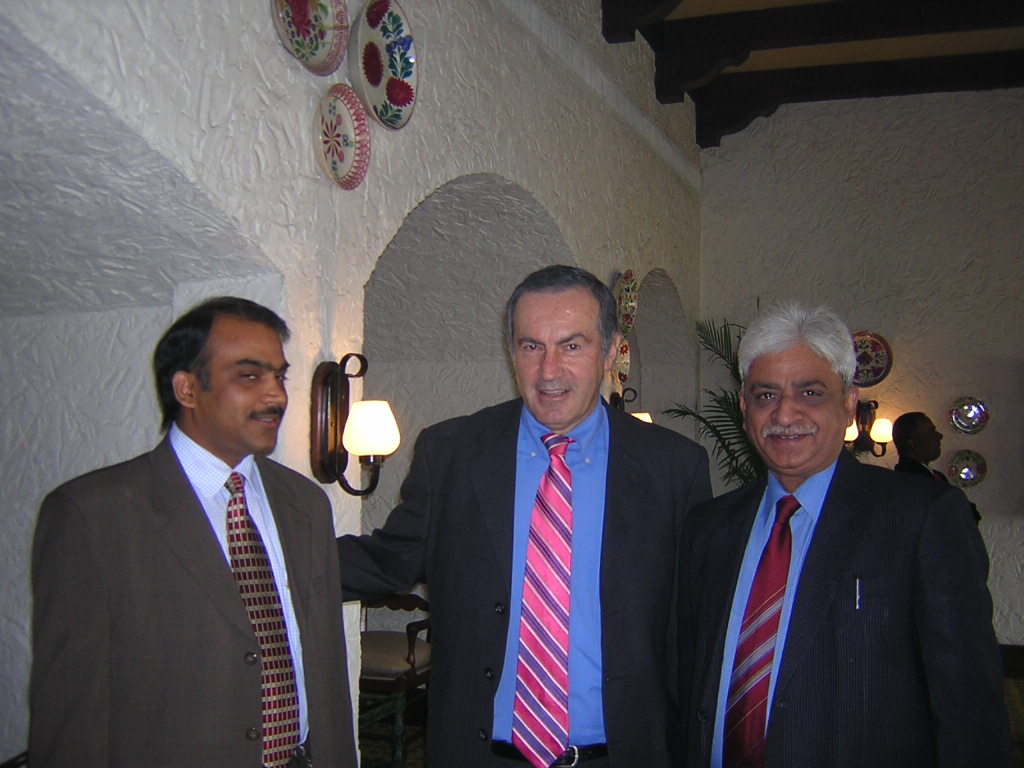

Andres Oppenheimer( in the middle of the foto on top) is the latest Latin American visitor to understand and study the India story for its relevance to Latin America. He is going to write about India's education system and scientific and technological developments and business with Latin America in his columns in Miami Herald and his syndicated columns which appear in newspapers of Latin America.
He has visited China and written a book called as " cuentos chinos"- tales of china). He now wants to compare India vis-a -vis China from the Latin American point of view.
His visit is from 5 to 13 January. He has interviewed Ministers and visited IIT Delhi and JNU. He will be in bangalore on 11-12 january to see for himself the IT development there.
I hosted a lunch for him at Taj Mansingh Hotel on 5 january and introduced him to media persons, academics, businessmen and Latin American ambassadors.
Andres is an Argentinian settled in USA for the last thirty years. He has lots of jokes on Argentinians and other Latinos ! He is the key person in the organisation of the annual Latin America conference by Miami Herald in September. He has a vantage position from Miami, the other capital of Latin America, to watch and interact with the Latin American business, political and thought leaders.
Monday, January 01, 2007
The campaign - novel by Carlos Fuentes
This is the story of Baltazar Bustos, an Argentinian from the pampas, the land of gauchos who goes to live in Buenos Aires and is inspired by the ideals of Rousseau and Voltaire. He gets sucked into the independence fever of Latin America, after the Spanish kingdom is overtaken by Napoleon, in the period 1810-20. He is given a miltary rank and sent to fight in Peru and later to Chile. He is caught in the conflicts between the local Creole leaders and the impracticality of his ideals of equality and justice. His political story takes on romantic wings when he falls in love with Ofelia Salamanca, a Chilean femme fatale, married to the governor of Buenos Aires. She changes husbands, lovers and countries and goes from Argentina to Peru, Chile, Venezuela and Mexico. And he is on her trail through all the countries and finally encounters her in Mexico.
Carlos Fuentes has given a fictionalised version of Latin American history of independence in this novel. He has brought in Latin American heroes such as San Martin of Argentina and Simon Bolivar of Venezuela. He has highlighted how the Latin Americans were unprepared for the sudden and unexpected independence and the confusion and conflicts between the local Creole leaders, the situation of native Indians and the African slaves. He has brought out the point that the instability of the continent was inbuilt in the foundation of the new republics who were not ready or equipped for nation building.
Carlos Fuentes, who had raised my expectations after his other novel" the eagle's throne" has captured me as a fan after this novel. He has helped me in understanding Latin America as he did with the other book about mexican politics. His Mexican character Father Quintana calls the Argentinians as the children of Latin America, contrasting with the old civilisation inherited by Mexico. Fuentes has brought out vividly the Latin American characters such as the merchants of the port city of Buenos Aires, the free-spirited gauchos of the pampas, the high society salons of Lima, the brothels of Maracaibo and the revolutionary priests of Mexico.
The love story in this novel is as enigmatic and profund as in the Eagle's Throne novel. In both, the heroines are free spirited Latinas, who make use of the men for fun and politics.
The novel reminded me of the film " The motor cyclist's diaries " which tells the story of Che Guevara, the other Argentinian who travelled to Chile, Peru and other countries of Latin America for fun to start with and later to spread leftist revolution.
I am looking forward to the three more books of Fuentes i have just bought.
Carlos Fuentes has given a fictionalised version of Latin American history of independence in this novel. He has brought in Latin American heroes such as San Martin of Argentina and Simon Bolivar of Venezuela. He has highlighted how the Latin Americans were unprepared for the sudden and unexpected independence and the confusion and conflicts between the local Creole leaders, the situation of native Indians and the African slaves. He has brought out the point that the instability of the continent was inbuilt in the foundation of the new republics who were not ready or equipped for nation building.
Carlos Fuentes, who had raised my expectations after his other novel" the eagle's throne" has captured me as a fan after this novel. He has helped me in understanding Latin America as he did with the other book about mexican politics. His Mexican character Father Quintana calls the Argentinians as the children of Latin America, contrasting with the old civilisation inherited by Mexico. Fuentes has brought out vividly the Latin American characters such as the merchants of the port city of Buenos Aires, the free-spirited gauchos of the pampas, the high society salons of Lima, the brothels of Maracaibo and the revolutionary priests of Mexico.
The love story in this novel is as enigmatic and profund as in the Eagle's Throne novel. In both, the heroines are free spirited Latinas, who make use of the men for fun and politics.
The novel reminded me of the film " The motor cyclist's diaries " which tells the story of Che Guevara, the other Argentinian who travelled to Chile, Peru and other countries of Latin America for fun to start with and later to spread leftist revolution.
I am looking forward to the three more books of Fuentes i have just bought.
Wednesday, December 13, 2006
The West on Trial - autobiography of Cheddi Jagan
I read most of this book during the long trip to Guyana last month and I have just completed it.
Cheddi Jagan was Guyana's most important freedom fighter. Born in a modest peasant family, Jagan went to study medicine in USA. During the stay there, he had done all kinds of odd jobs to sustain himself. After his return, he plunged into politics in Guyana. He started defending workers' rights and joined the trade union movement and then joined full time politics working for the independence from Britain.He won the elections in the pre-independance period. But the British conspired to keep him out of power. Firstly, they used their standard divide and rule policy by encouraging divisions and rivalries between the Afro-Guyanese and the Indo-Guyanese. Secondly they branded him as a communist threat to Guyana and the region. This way they got the support of the Americans to prevent communism taking hold in the region particularly after the experience of Cuba. The British and Americans imposed a proportional representation system on Guyana to prevent Jagan and his party from getting majority. Jagan asked them why did they not have the same system if it was good for Guyana.
Eventually Jagan managed to overcome all the internal and external challenges and become the President of Guyana in 1992 for five years till his death in 1997.
Jagan's struggle is similiar in many ways to the Indian struggle for independence from the same British. The only difference was that Guyana being a smaller and weaker country, suffered more.
It is true, Jagan was a fellow traveller. But anyone in his position had to be one, given the Guyanese situation. Most of the Guyanese were poor and exploited under the colonial rule. The population of Guyana consists of AfroGuyanese who were former slaves and the indians who were former bonded labourers. With this kind of electorate, it was logical to seek social justice through leftist path.On top of it, Guyana's natural and mineral resources and the sugar and mining industry were controlled by British, American and foreign companies for whom their profit was more important than Guyanese development.It was the job of the political leaders to demand a fair share of their earnings. Even today, Guyana remains as one of the poorest countries in the region, despite vast land, water, natural and mineral resources.
Janet Jagan, the American wife of Cheddi Jagan had also worked shoulder to shoulder at all levels of Guyanese politics. She shared the same ideology and commitment of her husband to the upliftment of the Guyanese.
Jagan has published other books covering regional and global issues.
But the title of this autobiography " The west on trial" does not seem to be appropriate. It was the west which put him on trial. But at the bottom of the cover page it is written " My fight for Guyana's freedom" . This should have been the title.
While Jagan has been understandably extra critical of his political opponents, his book gives a vivid account of the struggle of Guyana and the manipulation of the external forces.
Cheddi Jagan was Guyana's most important freedom fighter. Born in a modest peasant family, Jagan went to study medicine in USA. During the stay there, he had done all kinds of odd jobs to sustain himself. After his return, he plunged into politics in Guyana. He started defending workers' rights and joined the trade union movement and then joined full time politics working for the independence from Britain.He won the elections in the pre-independance period. But the British conspired to keep him out of power. Firstly, they used their standard divide and rule policy by encouraging divisions and rivalries between the Afro-Guyanese and the Indo-Guyanese. Secondly they branded him as a communist threat to Guyana and the region. This way they got the support of the Americans to prevent communism taking hold in the region particularly after the experience of Cuba. The British and Americans imposed a proportional representation system on Guyana to prevent Jagan and his party from getting majority. Jagan asked them why did they not have the same system if it was good for Guyana.
Eventually Jagan managed to overcome all the internal and external challenges and become the President of Guyana in 1992 for five years till his death in 1997.
Jagan's struggle is similiar in many ways to the Indian struggle for independence from the same British. The only difference was that Guyana being a smaller and weaker country, suffered more.
It is true, Jagan was a fellow traveller. But anyone in his position had to be one, given the Guyanese situation. Most of the Guyanese were poor and exploited under the colonial rule. The population of Guyana consists of AfroGuyanese who were former slaves and the indians who were former bonded labourers. With this kind of electorate, it was logical to seek social justice through leftist path.On top of it, Guyana's natural and mineral resources and the sugar and mining industry were controlled by British, American and foreign companies for whom their profit was more important than Guyanese development.It was the job of the political leaders to demand a fair share of their earnings. Even today, Guyana remains as one of the poorest countries in the region, despite vast land, water, natural and mineral resources.
Janet Jagan, the American wife of Cheddi Jagan had also worked shoulder to shoulder at all levels of Guyanese politics. She shared the same ideology and commitment of her husband to the upliftment of the Guyanese.
Jagan has published other books covering regional and global issues.
But the title of this autobiography " The west on trial" does not seem to be appropriate. It was the west which put him on trial. But at the bottom of the cover page it is written " My fight for Guyana's freedom" . This should have been the title.
While Jagan has been understandably extra critical of his political opponents, his book gives a vivid account of the struggle of Guyana and the manipulation of the external forces.
Sunday, December 10, 2006
Voces Inocentes - Film on El Salvador
Voces Inocentes means Innocent Voices.
This Mexican film in Spanish ( released in 2004 ) is about the cruel and bloody civil war in El Salvador and is based on a real life story.
Chava, the eleven year old boy is caught in the crossfires of bullets, killings and destruction. After his father escapes to USA, little Chava is designated by his mother as the Man of the House. He has to dodge bullets everyday in the streets, school and has to be back home before the curfew. His friends, when they reach the age of 12 are snatched away by the soldiers for conscription. No one is safe. The soldiers kidnap young girls from the streets and kick and kill parish priest. The little sweetheart of Chava, whom he describes as the only girlfriend is also killed by the soldiers. After having seen so much of death and inhumanity Chava, alongwith his friends join the guerillas. They get caught and all his friends are shot and killed, while he escapes miraculously. His mother and the rest of the family who are on the run from the soldiers and guerillas finds him back in the old house which has been set on fire and destroyed. Chava is sent to USA to escape the violence of El Salvador.
Carlos Padillo who has acted as Chava and Leonor Varela, the Chilean actress who acts as the mother of Chava have given their heart and soul to their characters.
Luis Mandoki, the Mexican director of the film has made the film as poignant and profundly moving. He has handled the brutal violence and loss of innocence of children delcately. It is a serious film, without any distraction. No comedy or sex scenes. The film is focussed solely on the theme and brings alive the sufferings of the people of El Salvador.
One of the best Latino films i have seen so far.
This Mexican film in Spanish ( released in 2004 ) is about the cruel and bloody civil war in El Salvador and is based on a real life story.
Chava, the eleven year old boy is caught in the crossfires of bullets, killings and destruction. After his father escapes to USA, little Chava is designated by his mother as the Man of the House. He has to dodge bullets everyday in the streets, school and has to be back home before the curfew. His friends, when they reach the age of 12 are snatched away by the soldiers for conscription. No one is safe. The soldiers kidnap young girls from the streets and kick and kill parish priest. The little sweetheart of Chava, whom he describes as the only girlfriend is also killed by the soldiers. After having seen so much of death and inhumanity Chava, alongwith his friends join the guerillas. They get caught and all his friends are shot and killed, while he escapes miraculously. His mother and the rest of the family who are on the run from the soldiers and guerillas finds him back in the old house which has been set on fire and destroyed. Chava is sent to USA to escape the violence of El Salvador.
Carlos Padillo who has acted as Chava and Leonor Varela, the Chilean actress who acts as the mother of Chava have given their heart and soul to their characters.
Luis Mandoki, the Mexican director of the film has made the film as poignant and profundly moving. He has handled the brutal violence and loss of innocence of children delcately. It is a serious film, without any distraction. No comedy or sex scenes. The film is focussed solely on the theme and brings alive the sufferings of the people of El Salvador.
One of the best Latino films i have seen so far.
Subscribe to:
Posts (Atom)


