Friday, September 18, 2020

Nothing by Accident : Brazil On The Edge – book by Damian Platt

Brazil excites one’s mind with images of football, carnival, samba and copacabana. The world sees Brazilians as cheerful, lively and joyous people. The tourists are swept off their feet by the picturesque beaches and the spectacular sugarloaf mountain view of the marvellous city of Rio. But, later in the night when they switch on the TV channels, they are shocked by the gruesome images of violence, gang wars, police and ambulance sirens and pile of dead bodies in the favelas (slums), which are not far from the hotels and beaches. More shock follows with the statistics of murders and deaths in police encounters which make Rio as one of the most dangerous cities in the world. According to the Brazilian Forum for Public Security, there were 65,602 violent killings in the country during 2017. In 2018, killings by police in Brazil stood at 6,220—in Rio alone that year. Brazil has one of the highest murder rates with firearms in the world.

So one starts wondering how so much violence has come to coexist with the carioca (resident of Rio) happy- go- lucky spirit. According to Damian Platt, the author of the book (published in August 2020), the crime and violence are not accidental but are designed and perpetuated by the deadly combination of criminal gangs, rogue police and military officials and their political patrons.


Platt explains the origin and evolution of the violence in Rio and Brazil. He traces the origin to the illegal lottery sytem called as ‘jogos de bichos’ (animal games) run by bicheiros (lottery operators). It is based on a sequence of 25 numbers with pictures of animals which allows you to bet as much or as little as you wish on any combination of numbers you choose. This lottery system was invented by a flamboyant entrepreneur Baron de Drummond in 1892 . He had opened a zoo in a new residential neighbourhood ‘Vila Isabel’ he had developed on the northern edges of Rio. In order to attract visitors to the zoo, he started a raffle with the entrance tickets which carried the pictures of animals. Winners earned a cash prize twenty times the value of the entrance fee. Visitors to the zoo multiplied and Vila Isabel flourished. Police were deployed to maintain order on the overcrowded trams transporting the public to the zoo. People visited the zoo to bet on the jogo de bicho, rather than look at animals. With a view to save gamblers from the trip, the Baron organised ticket sales in the centre of town. The innocent raffle had quickly outstripped its original purpose and became wildly popular. The government imposed ban on the jogo as an anti-gambling moral policy. This forced the lottery to go underground. Individual entrepreneurs got into the operation of the illegal lottery which became even more popular. The law considered the illegal lottery as a simple misdemeanour and there was no serious prosecution or punishment. The lottery operators resorted to bribery, favours and alliances with political leaders and security forces, to guarantee their business. Newspapers published daily results, both explicitly and covertly, while individuals within the police force and the local authorities developed an interest in maintaining the lottery for their illicit personal financial gain. The bicheiros became the patrons of samba groups participating in the carnival. In their VIP boxes, they entertained presidents, ministers, governors, generals, chiefs of police, celebrities and television stars. Later in the seventies, the bicheiros got into drug distribution when cocaine arrived at Rio on transit to Europe. The bicheiros used their underground lottery network for drug distribution to the thrill-seeking local jetset. They took the help of off-duty and retired police and military men for protection. In Rio de Janeiro and across Brazil, most military police work on a shift basis, often with 48 hour breaks between police duties. Consequently, it is standard practice to take second jobs as security guards, as they have the right to carry weapons. Most of the private security firms are owned and staffed by off-duty or former police and military officers. 


The military dictatorship from 1964 to 1983 added a new dimension to the illegal lottery racket. The military intelligence used the bicheiro network to collect information and infiltrate the underground leftist groups. As a quid pro quo, the military officers gave protection and immunity to the bicheiros. Some of the officers joined the illegal lottery network and made personal fortunes. 


The criminal military and police elements who flourished during the dictatorship did not like the return to democracy in 1985. Some of them formed secret groups and tried to sabotage democratization through terrorist actions, but without success. Some others formed militias which ran rackets of protection, extortion and contract killings. The militias succeeded in finding new patrons among civilian politicians such as Jair Bolsonaro and his sons. The militias finance election campaigns and help politicians to get votes. In return, the elected leaders provide political cover to the militias. Fabricio Queiroz , a militia member on the run from prosecution was arrested eventually from the beach house of the family lawyer of Bolsonaro. When a journalist asked Bolsonaro why Queiroz paid money into the personal accounts of the wife of Bolsonaro, the president threatened to punch the face of the journalist. Queiroz was chief of staff of Flavio Bolsonaro from 2007 to 2018. The alleged assassins of Marielle Franco, a popular political activist of Rio were reported to have had links to the Bolsonaro family. The Justice Minister Sergio Moro resigned earlier this year protesting against the interference of President Bolsonaro in these investigations to protect his family. 


In 2008, a then-obscure Rio politician and former army captain, Jair Bolsonaro, defended militias in a BBC interview, claiming they provided security, order and discipline for poor communities. In 2005, Flavio Bolsonaro successfully petitioned to award a police officer turned militiaman Adriano da Nobrega the state of Rio’s highest honour, the Tiradentes medal, which he delivered personally to the disgraced policeman – inside prison. 


In other Latin American countries, the military men who committed atrocities during dictatorships were brought before justice and convicted. But the Brazilian military torturers and killers got away  with their crimes. The impunity has encouraged the criminal captains and colonels to continue to undermine democracy even now. Bolsonaro had dedicated his vote for impeachment of President Dilma Rouseff to the notorious Colonel Ustra who tortured her when she was caught as a leftwing guerilla fighter. He called Ustra as a national hero. During his first official visit to Chile, President Bolsonaro praised Pinochet dictatorship causing embarrassment to the democratic citizens and politicians of Chile. Bolsonaro keeps repeating his statements for killing of communists and maintains that not enough were killed during the dictatorship. In a TV interview in 1999, Congress member Bolsonaro said that the only way of "changing" Brazil was by "killing thirty thousand people, beginning with Fernando Henrique Cardoso, the President of Brazil at that time.  These have encouraged right wing extremists to  demonstrate in front of the army headquarters calling for the return of military dictatorship and closure of the Congress and Supreme Court while President Bolsonaro, their patron smiles and cheers the crowds. Flavio Bolsonaro made a statement threatening that the supreme court could be closed just with a soldier and a corporal. In July 2019 a Brazilian Air Force Sergeant, on a special flight accompanying President Bolsonaro to a G20 meeting, tried to wheel a suitcase containing 39kg of cocaine through Spanish customs. He told officials who opened his suitcase that he was bringing cheese to a cousin. The Sergeant, Manoel Silva Rodrigues, had made 30 national and international trips for the Brazilian Air Force in five years. This is just an example of how the criminals are feeling free to commit crimes with impunity since the election of the extremist Bolsonaro. 


The security forces make money by selling weapons illegally to the criminals. Theft and “losses” of registered police, military and private security arms are routine. A 2011 state legislative enquiry into weapons found that 8,912 guns were “lost” or stolen from police stocks between 2000–2010. A follow-up enquiry in 2016 found that that 17.662 weapons (30 per cent of these companies’ total supply) were “lost” or stolen in the period 2005-15 from Rio’s private security firms most of which are owned by active and retired police and military personnel. 


The security forces conduct raids and make drug busts in the favelas in front of TV cameras basically as a show to divert attention and stigmatise the poor black residents of favelas. This is done to generate and sustain the atmosphere of fear and hate. The violence is used to generate insecurity which means money for the private security companies owned by high-ranking police and their political patrons. President Bolsonaro is openly encouraging the police to shoot first and ask questions later. He said criminals should “die in the streets like cockroaches”. He wants the killer cops to be decorated and not investigated for killing suspects. 


President Bolsonaro has loosened gun control to make more firearms available easily to more people. More guns mean more crime and more business for the militias which run protectionist rackets. Gun ownership rocketed by 98% during Bolsonaro’s first year as President. Sale of guns increased to 105,603 in the first eight months of 2020. This is more than the 94,000 sold in the whole year of 2019.  Weapons newly available to the public now include semi-automatic rifles, previously only available to the army. In April 2020, Bolsonaro revoked decrees that existed to facilitate the tracing and identification of weapons and ammunition. One week later, he tripled the quantity of ammunition available for purchase by civilians, saying on record in a ministerial meeting, that he wanted “everyone” to carry guns. His political philosophy, wrote Fernando de Barros e Silva, editor of the respected Piauí current affairs magazine, represented “the victory of the militia model of management of Brazilian violence”. 


Bolsonaro's signature favorite pose is shooting gesture with the thumb combined with the index and middle finger, mimicking a gun as in the picture below


This gun gesture has spread among his supporters across the country who show it in every pro-Bolsonaro street demonstrationDuring a campaign rally in the northwestern state of Acre, Bolsonaro picked up a tripod, put it on his chest to simulate a machine gun, and yelled: “let’s shoot this petralhada (a derogative nickname that the right wing created to their opponents, the workers’ party’s supporters) here in Acre!”


President Jair Bolsonaro has galvanized a new gun culture in Brazil. His three oldest  sons, politicians themselves, have been fierce proponents of expanding gun ownership through policy proposals and social media posts. Eduardo Bolsonaro has spoken admiringly of the Second Amendment in the United States. He has lobbied to make the Brazilian market more attractive to foreign arms manufacturers, which he says would lower prices and provide gun enthusiasts with more choices. Flávio Bolsonaro, a senator, made the promotion of gun manufacturing in Brazil the focus of his first project in the legislature last year. 


The rule of Bolsonaro and bullets condemns Brazil to suffer more violence and bloodshed in the coming years.


Saturday, September 12, 2020

The Divine Boys – Colombian novel by Laura Restrepo

The Divine Boys (Los Divinos in Spanish) is the story of five boys who form a brotherhood gang called as Tutti Frutti in school. These are Muñeco, Tarabeo, Duque, Pildora and Hobbo. They are into pranks, games, alcohol, drugs, girls, and the night life of Bogota. Inspired by “One for all and all for one” they have a pact “ One for Tutti and Tutti for Frutti”. Their common code: worship of drink, dominance of females and scorn for the weak. They carry on their boyhood bonding even in their thirties by getting together to relive the nostalgia and push the social boundaries.


The hero of the gang is Muñeco, also known as Mi-Lindo, Ken and Baby-Boy. He is handsome, wealthy, athletic, stylish, charmer, talker and party animal. He is short fused, prone to rages and gets into brawls ending up sometimes with black eyes and broken bones. His appetites grow wild and twisted. After having exhausted a vast repertoire of sexual deviations and perversions, he goes after a little girl, rapes and kills her. He seeks the help of his brotherhood to help him out after the crime. But he is caught and convicted. 


The other four members of the brotherhood are: Tarabeo (aka Dino-rex, Rexona, Taras Bulba) is a playboy and master of the art of seduction. He makes plans and decisions for the group. He and Muñeco  are known as the Divine boys; Duque (aka Nobleza, Dux) is a perfectionist. He is the wealthiest and has a country home where the Tutti Frutis meet for poker and drinking binges; Pildora (aka Pildo, Pilulo, Dorila) is the errand boy. He does whatever he is asked to do: shopping, driving, picking up things for others and supplying party drugs to the gang from his mother’s pharmacy; Hobbit (aka Hobbo, Bobbi and Job) is an introvert who is into literature and has a phobia against physical touch by others. He does not belong to the rich class of the other four. But the others take him in for his complementary qualities missing among themselves.There is a girl who joins the boys group occasionally. She is Alicia (aka Malicia), the girl friend of Duque but she has a secret affair with Tarebeo and flirts with Hobbit.


Laura Restrepo, the author makes the characters come alive with her graphic descriptions and elaborate narratives. She develops each character with their own phobias and fetishes, craziness and creative talents, inner demons and outer appearances. She describes how an individual is shaped as a monster in brotherhood gangs. She gives a glimpse of the Colombian society through the adventures and circumstances of the charactersHobbit exclaims, “This country of ours has had so much war—so very much, borne for too long a time—that we the living have grown inured to it”. Colombia has suffered so much violence and death from ideological conflicts, guerilla wars and drug trafficking. Much more than any other Latin American country.


The only disappointment is that after building up the characters and the story so steadily and elaborately, the author finishes the novel fast at the end.  The reader who is settled in for a long journey is woken up and asked to get off the train before the imagined destination. But I had enjoyed long fantastic journeys in her other novels such as “ Leopard in the Sun” “Delirium”, “ The angel of Galilea”, “ The dark bride” and “Too many  heroes”.


Laura Restrepo is a gifted writer and guide to Colombian and Latin American society. Her works are not just pure imagination. Some of them are based on her own political experience and personal witness to violence, crime and wars. She combines the facts and fiction seamlessly and creatively in her novels. Her life is as interesting as her fiction. She has seen life from different angles as an academic, journalist, political leader, member of guerrilla movement, writer and novelist. As a journalist, she was in the frontlines covering the US invasion of Grenada and the Contra war in Nicaragua. 


When she was working for a Colombian TV channel, she wrote script for a miniseries on the theme of a deadly feud between two families involved in drug trafficking. But the Channel did not air it since they received the visit of a lawyer who " mentioned about blowing up the office building of the TV channel"


In1982, President Betancur of Colombia nominated Restrepo as member of the commission to negotiate peace with the M-19 guerrillas. She received death threats after voicing her loud opinions and comments on the peace negotiations and the guerrillas. She was forced to go on exile to Mexico for six years. During this time she wrote the novel " Isle of Passion" about Mexican revolution after which an army group is stuck in an island off Mexico.


She started her career as a professor of literature at the National University of Colombia. She worked as editor of the popular magazine " Semana" for twelve years. Later she got involved in the politics of Colombia and was a member of the Trotskyite party. She became a member of the Socialist Workers Party of Spain where she lived for three years. She was in Argentina for four years as part of the underground resistance fighting against the military dictatorship. This experience comes out in her novel,"No place for heroes". She was briefly married to an Argentine politician with whom she had a son. 


Monday, August 17, 2020

Malgudi to Macondo to Mallgudi

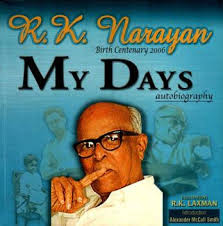
I have just read “My Days”, the autobiography of R K Narayan who has created the fictional town Malgudi in his stories. I could not help the temptation of comparing it with “Living to tell the tale” the memoirs of Gabriel Garcia Marquez whose imaginary town in his novels is Macondo. Both Malgudi and Macondo are emblematic of the culture of South India and South America.


 The titles of the memoirs of Narayan and Garcia give clear clues to their lives, novels and characters. 


“My days” of Narayan is simple, clear and short.  It gives details of his life as it happened from the beginning to the end chronologically. “Living to tell the tale” (Vivir para contarla) of Marquez holds suspense, mystery and excitement. There is a quote attributed to Marquez, “ Men have three lives: a public life, a private life and a secret one”. There is a Latino macho saying, ‘A man without stories is no man’.  So one’s curiosity is raised as to what next would come out from his ‘story telling’. In South India life is just a life. It starts with birth, childhood, education, employment, marriage, children, grandchildren and the end with philosophical reflections. In South America it is a story. Marquez’s book starts with the visit to sell his ancestral village accompanying his mother when he was twenty three. The following chapters go back and forth with whatever stories Marquez feels like telling. 


Narayan writes in simple and unpretentious prose narrating the story and describing the characters without delving deep into any analysis. He adds touches of humour, irony and satire but in a subtle manner. Marquez’s writing is graphic and filled with rich images. He weaves fantasies and realities one after another and blurs the line between them in the same style of Magical Realism he uses in his novels. While Narayan’s narratives flow smoothly like the calm Cauvery river in the flat delta area of Tamilnadu, Marquez’s writings are like the Magdalena river of Colombia which is turbulent and unpredictable. The river journey by boat could last for a few days or weeks depending on the formation of sandbars, variation of water depth and accidents on the way. 


Marquez wrote in his mother tongue about the people who spoke Spanish like him. But Narayan wrote in a language foreign to his characters. The ordinary men and women of Malgudi speak Tamil or Kannadiga and do not understand English. It is amazing that he has made the natives to come alive in a foreign language. I could feel the emotions, characters and moments as naturally as I felt when I read such stories in Tamil with familiar local expressions. 


Narayan is a writer of few words. But within his short descriptions and phrases, he evokes vividly a whole lot of emotions and feelings around the events and characters. Marquez, on the other hand, is given to overwhelm and mesmerize the reader with long, lyrical and effervescent expressions which flow tumultuously like a mountain stream. Narayan takes us through the short village roads. With Marquez it is a long journey through mountainous roads overlooking jungles, valleys, peaks and precipices. 


Narayan gives details of his life one after another in a direct and linear way: his childhood in Chennai with a monkey and a peacock as his pets; his college days in Mysore; his choice of career as a writer; his short married life and the death of his wife; his struggles to make both ends meet; his experience as being part of a typical joint family; the challenges he faced in renting houses and building his own home eventually; his interactions with neighbours, relatives and friends; his success as a writer with money and fame; and the happy ending when he sees his grandson’s attempt at a short story on his next door uncle.  


Maquez tells us tales of his adventures and misadventures in his signature style of his novels. His life story is dense with details, twists, turns and many labyrinths. His memoirs mesmerizes and surprises the readers. He opens his life boxes randomly and one does not know what will come out of each box. One is filled with anticipation and excitement. Marquez ends his book with this last sentence, “ On Thursday of the following week, when I walked into the hotel in Geneva at the end of another useless day of international disagreemnts, I found her letter of reply”. Later we come to know that the letter was from his childhood sweetheart Mercedes Bachart. He had proposed to her when she was thirteen and she took her time to say yes. They were married when she reached the age of twenty six. 


Narayan’s autobiography avoids the larger issues of politics and history. He is apolitical and holds no ideological beliefs or associations. He does not touch issues of the day such as freedom struggle, Mahatma Gandhi, British colonialism, Marxist theories or the world warsof his timeThe Malgudians are insular and somewhat disconnected from the issues of the world outside. They do not try anything revolutionary. Nor do they expect any dramatic changes. They are tied deeply to their millennial traditions, horoscope, rituals and practices. 


Márquez relates his life to the issues of violence, wars, repressions, revolts, dictatorship, revolutions, exile, politics and history of Colombia, Latin America and the worldHe refers to heroes and villains who achieve greatness and face tragic ends. Marquez was a leftist and remained as a personal friend of Fidel Castro, even after many other writers distanced themselves from the Cuban dictatorship which stifled freedom of expression. His anti-imperialist statements were labelled as subversive by US which denied him visa for many years. 


Narayan lived his entire life in Chennai-Mysore area except for his travel to US, Australia and UK. He lived in the traditional Indian joint family system of grandparents, parents, brothers and sisters. Although he chooses an unconventional career of writing Indian stories in English, he follows the tradition of his Brahmin caste and works within the framework of south Indian culture in his personal life. He is austere, straightforward and modest in his style of life. He chose an auspicious day (Vijayadashami) to create his imaginary town of Malgudi for his novel. Horoscopes and astrologers played important part in his family life. After his wife dies within a few years of marriage, he refuses to remarry and continues his life as a widower. His daughter is brought up in his joint family. He never set his eyes on other women or sought sex outside. He was a teetotaller. His only sin was smoking.


Marquez’s life is colourful and adventurous. He is a typical Latino mujeriego (womaniser), just as his father was. Besides affairs and romances, he was a regular visitor to the brothels. He claims that he was a veteran of two bouts of gonorrhea by the age of twenty three.


While Marquez chose a young whore as protagonist for his last novel, Narayan’s last book is about his grand mother. Both the books are considered as autobiographical. The title of Narayan’s last book is “Grandmother’s tale”. One does not have to guess. It is simply the story of his grandmother and what she had told him in his childhood. Marquez’s last novel is “Memories of my melancholy whores (Memoria de mis putas tristes). It is about the romance of a 90 year-old man with a young and almost adolescent whore. But the word ‘whore’ does not appear in Narayan’s autobiography or his novels. Nor is there any descriptions or narrations of sex in his novels. 


Here are a few commonalities between the two writers. Both were brought up by their grand parents in their childhood. Both worked as news reporters to earn a living to start with before becoming professional writers. Both had struggled with financial insecurity during the initial phase of their carreer.


Coffee was the common stimulant for both. Narayan gulped cups of the steaming hot filter coffee made in traditional Tamil Brahmin way. In South India, you ask for coffee and you get only one kind, coffee and milk premixed with plenty of sugar. But in Colombia, there are many coffees and one has to specify what one wants.  Tinto is sweetened black coffee from leftover beans and the most popular. Perico is Tinto in which half the coffee has been replaced with warm milk. Perico escuro has less milk while Perico claro has more milk. Pintadito is black coffee with milk without foam.  Carajillo will make one tipsy because it has the alcohol of aguardiente/rum. 


The Colombians describe the complexion of people through coffee. Whites are milk, blacks are coffee and the mulattos are coffee with milk (café on leche). In some cases there is more milk and in others less. There are a number of Colombians who look like Indians with their coffee with milk complexion. There is a delightful Colombian comedy film “Ambassador of India” (Embajador de la India) in which a crook from the city pretends in a rural part of Colombia as the Indian Ambassador of India and manages to fool the people and take them for a ride. This is based on a true story. The Colombian was able to do it because of his coffee with milk skin colour.  


Marquez spent hours together in the cafes filled with the aroma of the famous Arabic coffee of Colombia. Sometimes the coffee had the aroma of women. True.. There is a popular Colombian Television serial called as “Café con aroma de mujer” (Coffee with the scent of a woman), produced in the nineties. It is the story of romance between a coffee plantation worker with the son of the owner of the estate. There is a song in the serial which goes like this 

Dame un beso que me sepa a café

Café y tu lo estas con mi aroma de mujer


Give me a kiss that tastes like coffee

Coffee.. you are with the scent of my woman


Both the writers have said that their invented towns of Malgudi and Macondo are not so much as places but they are essentially states of the mind, which allow you to see what you want, and how you want to see them. But they have a personal resonance for me.


“Malgudi to Macondo: the journey of an innocent Indian through the seductive Latin America” is the title of my book published in 2012. Caution: It is not autobiographical. It is a collection of real life stories of Latin American people, their culture, history, politics and business as well as their encounters with India. 


 I was born in a village fifteen km from the nearest town called as Lalgudi in Trichy district of Tamilnadu. Lalgudi rhymes with Malgudi. I had spent the first twenty years of my life in the village. Lalgudi has a railway station like in Malgudi and Macondo. When I travel by train from Chennai to my village, I get down at Lalgudi station. While approaching the station, I always look out for the dense green plantations of bananas on either side of the railway, a scene similar to the Macondo station. 


I was like one of the simple Malgudian characters in the stories of Narayan. But when I reached Brazil in 1996, a new world opened. My Latino friends tease me saying that I lost my South Indian innocence in the South American magical realism. The twelve years of my stay in Latin America was full of discoveries, exploration and excitement.


The third chapter of my life started since my retirement in 2012 and settling down in a place which I call it as Mallgudi. Malls surround me on all sides with their bluish green glass and grey steel. It is a millennium city of  malls, money and multinational corporations.


It was called as Gurgaon and now changed to Gurugram. Here, Cows walk leisurely between the BMWs speeding on the roads.  Villages can be seen through the glass windows of the Malls. Migrant workers from other states are helpers in the mansions of MNC executives from other countries. Young English-speaking professionals share seats in the metro with Oriya speaking plumbers.  Mustard farms are lurking behind the mighty high walls of the multistory apartment buildings. Amidst the arid Aravalli hills, there are lush green luxury golf courses with blue water ponds. A new kind of magical realism?


I am on the lookout for a book whose title will fit the chapter of my Mallgudi life.


Tuesday, August 11, 2020

Latin America’s exports forecast to decline by 23% and imports by 25% in 2020

Latin America’s exports and imports of goods are estimated to have fallen in value by 17% and 18%, respectively in the first half of 2020, according to the August report of the Economic Commission for Latin America and the Caribbean (ECLAC)

Worsening growth prospects for several of the region’s main markets and uncertainty over how the pandemic will evolve mean that a recovery in regional foreign trade in the second half of the year is unlikely. 


So ECLAC projects a 23% contraction in the value of the region’s goods exports in 2020, as a result of declines in both prices (-11%) and volumes (-12%) 


The largest contractions in exports in 2020 are expected in those to the United States (-32%) and to the region itself (-28%), while shipments to China are projected to fall by just 4%


In keeping with the trend in exports by destination, the sharpest falls in value are projected for mining and oil, and manufacturing shipments. In the case of mining and oil, this is partly a result of a steep drop in prices, while in manufacturing it is mainly because of smaller export volumes. Agricultural and livestock shipments look set to be the most resilient, with a projected increase in value of 2%. 


In 2020, oil prices are projected to fall by 40%, minerals and metals by 6.1% and agroproducts by 5.9%. The only exceptions are: gold whose prices are likely to increase by 14.9% and iron ore by 10.1%.


For the value of imports, the expected fall is even larger (-25%). Imports are expected to fall across the board, but the largest contraction will be in fuel purchases, owing to the fall in prices. 


As imports are forecast to fall more than exports, the region is expected to record a trade surplus of just over US$ 45 billion in 2020, concentrated in the countries of the Southern Common Market (MERCOSUR), Chile and Mexico. For the Andean Community, whose members have been hit hard by tumbling oil and mineral prices, a trade deficit of just over US$ 4.5 billion is projected. The Central American and Caribbean countries are expected to see their deficits shrink significantly compared to 2019.


Impact on India


India's import bill from Latin America will decrease in 2020 since the prices of three of its main imports from the region namely oil, copper and soy oil will decline by 40%, 12.6% and 7.8% respectively. However, the gold imports bill which were about 4 billion dollars in 2019 would go up since gold prices are predicted to go up by 15.9%.


India's exports are logically expected to go down with the general decline of 25% of the total imports of the region. However, the decrease in exports could be much less than the 25% since the region is expected to increase imports from less expensive sources such as India at this time of austerity.


More in the ECLAC report  https://repositorio.cepal.org/bitstream/handle/11362/45878/1/S2000496_en.pdf


Friday, July 31, 2020

The admirable and unusual story of the abolition of army in Costa Rica

 Costa Rica abolished its army in 1948 and created history in the post-cold war era of the world. The country proclaims proudly that it spends its money on education and healthcare instead of arms. Oscar Arias, the former president and Nobel Peace Prize winner said ¨ Our children walk with books under their arms rather than guns on their shoulders. We are an unarmed people, whose children have never seen a fighter or a tank or a warship. We are a people without arms and we are fighting to continue to be a people without hunger ". 
It is, indeed, a civilizational advance. The country has managed to survive and flourish as a unique, vibrant and peaceful democracy in Central America, a politically unstable region known for military dictatorships and civil wars.

The abolition of the army was not done by an apostle of peace like Buddha or Gandhi. The man behind the idea of abolition of the army was Jose Figueres, called as Don Pepe, who lead a rebel force and defeated the government army. Even after abolishing the army in his country, he had actively supported armed revolutionary movements against the military dictators of Latin America and Caribbean.

Pepe came into politics accidentally. He was a progressive coffee grower in the interior of Costa Rica (CR), after his education in the United States. During one of his visits to the capital San Jose in July 1942, he was angry when his property in the city was damaged by a public protest and the government did not take take adequate steps to prevent or minimize the damages caused by the protestors. Figures went on a local radio and strongly criticized the government for letting the protestors go out of control. The government headed by President Rafael Calderon arrested him and a few days after detention let him go on exile to Mexico. During his exile, the angry Figueres started planning to overthrow Calderon’s government through force of arms. He collected funds and arms. But the Mexican authorities seized the weapons. Then he went to Guatemala and sought the help of the Caribbean Legion, which was a group formed by revolutionaries of the region including Guatemala and Nicaragua who wanted to overthrow the dictatorships in their countries. Pepe returned to CR in May 1944 and got into the politics of the country.

In the elections held on 8 February 1948, the opposition candidate Otilio Ulate of the Democratic Liberal Party won with 54% votes. The ruling party PRN accused that the results were falsified. Hmm ..one among the many paradoxes of Costa Rican politics. Normally it is the opposition parties who make such allegations against the ruling party. On 1 March, the Congress dominated by the ruling party decided to annul the elections. The opposition took to the streets. A few days later civil war began. This gave the opportunity for Don Pepe who was waiting to overthrow the government and take revenge on ex-president Calderon. Pepe formed a National Liberation Army and became its commander in chief. He took the support of the Caribbean Legion with revolutionaries from Nicaragua, Honduras, El Salvador and Dominican republic. His army captured three aircrafts and used them to bomb the presidential palace in the capital and also bring arms from Guatemala. Pepe’s liberation army defeated the ill prepared and poorly trained army of the government in the war which lasted for 40 days in which 2000 were killed. The national army was disarmed and dismissed.  In the Agreement signed between the warring parties on 1 May, Ulate was recognized as the winner of the elections but he would take power after a new constitution was ready. A revolutionary Junta was formed on 8 May with Pepe as its head to govern the country in the interim period. 

On1 December 1948, the interim Junta authority of Costa Rica headed by Pepe, decreed the dissolution of the National Army, declaring that a well-trained body of police was adequate for nation’s security.  Pepe  said,“ It is time for Costa Rica to return to her traditional position of having more teachers than soldiers”. He took a sledge hammer and smashed one of the walls of the Fortress Bella Vista, the barracks, as seen in the picture below: 


He handed over the key to the minister of public education with instructions to make the barracks into a national museum. The decree was incorporated in the New constitution of the country, proclaimed on 7 November 1949. Article 12 has proscribed the Army as a permanent institution.

Pepe said he was inspired to disarm Costa Rica after reading "Outline of History"by HG Wells' in 1920 while at MIT. 

The Junta nationalized the banks for democratization of credit, imposed a 10% tax on wealth, established an independent supreme electoral tribunal, removed the legal discrimination against black people, guaranteed public education for all, established a system of proper civil service for the government, gave voting rights to women and outlawed communism. These were the major reformist actions taken by the Junta besides the abolition of the army. The Junta handed over power to the President-elect Ulate in November 1949. This peaceful and graceful relinquishment of power by interim Junta is unique in the history of Latin America which is filled with dictators holding on to power by any means.

Within two weeks after the abolition of the army, the country faced its first external threat. On 12 December, a small armed force of 800 men of Calderon (ex-president of CR whose party lost the civil war) attacked a border town of CR from Nicaragua.  The Nicaraguan dictator Somoza had given asylum to Calderon and supported his venture. Somoza was furious that CR had given refuge to Nicaraguan revolutionaries fighting against his regime. Without the army, CR was defenceless. The Junta sought the intervention of the newly formed Organisation of American States (OAS), whose charter was signed in April 1948. After ratification by member governments OAS officially came into existence only in1951. Despite this situation of its formative stage, OAS sent a commission to visit CR from 17 to 22 December. Based on the commission’s findings, OAS condemned Nicaragua for help to the invaders and also rebuked CR for hosting anti-Somoza guerillas. It forced CR to disband the Caribbean Legion, who then moved over to Guatemala. The rebel army withdrew and a Pact of Amity was brokered between CR and Nicaragua on 21 February.

The second threat to the armyless CR was on 2 april 1949 when there was a coup attempt by the Junta’s Minister of Public Security himself. But the coup did not get support and fizzled out. The situation was brought under control in 12 hours after six people were killed in the skirmishes.

CR faced threat for the third time on 11 Jan 1955 when an army of 500 men lead by the son of an ex-president of CR Picado invaded from Nicaragua. This invading force even had a small airforce with which they bombed some Costa Rican cities. The Venezuelan airforce planes also joined in the attack. The Venezuelan and Nicaraguan dictators were upset with the presence of revolutionaries from their countries in CR. Again, OAS intervened and asked the invading forces to vacate the territory of CR. The OAS authorized the sale of US fighter planes to CR for the defence. US sold 4 F-51 Mustang fighter aircrafts for a dollar each to CR. With the entry of the American planes for the defence of CR, the Nicaraguan and Venezulan air attacks stopped. It is interesting to note that the CIA was helping Somoza while the State Department came to the rescue of Pepe, who was the president of CR at that time.

After relinquishment as head of the Junta in November 1949, Pepe founded National Liberation Party (PLN). He was elected as president for two terms in 1953 and later in 1970.

Don Pepe from the small defenceless country of Costa Rica was a big  defender of democracy and economic justice in Latin America. He spoke for the democratic left in the May 1950 Conference in Havana to promote democracy and freedom in the region. He actively supported armed revolutionary movements against dictatorships in the region. 

Pepe’s approach to US was ambiguous. He did not share the anti-imperialist rhetoric of the Latin American leftists. In fact, he supported US in their anti-communist agenda and had collaborated even with the CIA. Both his wives were from US. He had many friends in the US Congress and influential circles. However, he was critical of US support to military dictators. He criticized the American companies which were exploiting Latin America by paying low prices for commodities and with their large monopoly investment and land holdings in the region. But he did not believe in head-on fight with  United Fruit Corporation, the powerful American corporation which owned the largest banana plantation in CR. He negotiated a new contract with UFC in June 1954 with 30% tax on profits, minimum wage and other benefits for the labour.

Don Pepe died in 1990 but he is fondly remembered and revered although he had attracted much criticism for many of his controversial actions and a few corruption cases too. 

Costa Rica is not isolating itself passively into its own peace cocoon. The country had taken the initiative and helped its neighbours to end their civil wars with peace agreements in 1987. President Arias of Costa Rica won the Nobel Prize for this. 

While many countries have war colleges, Costa Rica has established a University of Peace to educate and train students from around the world for conflict prevention and mediation through peaceful means. 

Costa Rica had abolished death penalty in 1882, very much before many other countries in the history of the world.

The country celebrates 1 December as the Day of Abolition of the Army. The world will be a better place if more countries follow the noble and bold example of Costa Rica.  


Tuesday, July 28, 2020

São Bernardo – Brazilian novel translated by Padma Viswanathan


São Bernardo is a novel by Graciliano Ramos (1895-1953), a famous writer from Alagoas state in the remote northeast corner of Brazil. Padma Viswanathan has translated this into English and got it published by New York Review Books in May 2020.  


It is the story of Paulo Honório, a poor farm worker who becomes landlord of the farm São Bernardo but finally loses everything and writes his memoirs. Paulo,the illiterate and rough man, goes to jail for knifing a guy over a girl. In the prison, he he learns basic reading and writing. After the release from jail, he becomes an itinerant trader and makes some money. With that he buys the farm where he used to work as a daily wage labourer. He transforms the farm into a productive one with irrigation, dams, cotton crops, orchards, cattle ranch, lumber mill and a cotton gin. He becomes a wealthy landlord and gives job to others. Along the way, he manages to put down jealous and murderous rivals and makes it known that he cannot be messed with. He is a hard task master and expects productive outcome for his payment of wages. He comes to the attention of newspapers and politicians of the area. 
After having achieved a respectable status, he looks for a suitable woman to marry and get children who will inherit his property. He marries Madalena, a poor school teacher from a nearby town. Madalena is kind, gentle and generous to the families who work in her husband’s farm. She pleads with her husband to be less harsh and more humane in his treatment of the labourers. But Paulo finds it as a nuisance and interference with his farm management. With his limited vocabulary and knowledge, he does not understand the literary and political conversations of his wife with the newspaper editor, school teacher, lawyer and priest who visit his house. He is wary of their ideas of communism and revolution. He starts suspecting his wife of infidelity and is jealous of her interactions with other men. He becomes paranoid and mistreats her harshly. Eventually he talks to her openly about his suspicion. Unable to bear the suffering, the innocent Madalena commits suicide. Thereafter, the educated people who were friendly to Madalena move away from Paulo. 

Becoming a landlord with enough wealth and respected status with an educated city girl as a wife does not give Paulo peace and contentment. His success has ironically isolated him and made his life lonely and impossible. He disdains both the labour class from which he came and the wealthy elite to which he belongs now. He is harsh on the workers and always complain that they are lazy and shirk responsibilities. He is suspicious of the educated and wily city folks as exploiters.  When a city newspaper carries articles critical of him, he confronts the editor and beats him with a horsewhip. When Madalena gives birth to a son, he does not have any tender feelings even to the child which is weak and sickly. Love and affection are absent in Paulo's vocabulary.

At the end, Paulo looks back at the ‘fifty years senselessly squandered, mistreating myself and mistreating others, with the result that I’ve grown hard, so callous that no scratch could penetrate this thick hide and hurt the blunted soul inside. If I see myself in a mirror, I’m upset by my own hard mouth and hard eyes. I bet I have a tiny heart, gaps in the brain, nerves different from other men’s. Not to mention an enormous nose, enormous mouth, and enormous fingers. If this is how Madalena saw me, she must have found me unbelievably ugly”.

Reflecting on his mistakes and achievements, Paulo starts writing his story with the title “São Bernardo”, which is the name of his farm. He tells his story in the language of the class he has left behind but for the benefit of the educated class he does not like. He writes the story the way he talks. It is a simple, plain, dry and linear story without any twists, turns or suspense. There is no mention of football, carnival, samba or beaches to remind readers of the lively Brazilian culture.  There is no Latin American Magical Realism. There is no Borgesian verbal acrobatics, labyrinthian plots or intellectual inventions. There are no quotable passages or pearls of wisdom. There is no need to check wikepedia. 

The language used in the novel by Ramos is typical of the rural areas of the Alagoas state northeastern Brazil. Alagoas is one of the smallest and poorest among the twenty seven states of Brazil. In the translator’s note, Padma Viswanathan has talked about the challenges she faced in translating the local expressions used in the novel. She had to take the linguistic help of native Brazilians. 

I found this novel of Ramos similar in some respects to the those of Jorge Amado, my favourite Brazilian author. Amado is also from the northeast part of Brazil but from the culturally richer state of Bahia. Amado uses a similar style of direct narration of stories and portrayal of characters.  But Amado’s characters are more colourful, playful and lively. Amado’s novels are encyclopedias of the expressions, traditions, festivals, food and rituals of the AfroBrasilians dominant in the Bahia region.

São Bernardo was originally published in 1934. Padma’s translation in English has just been released in May 2020. 

Graciliano Ramos is called as “the Faulkner of Brazil”. While William Faulkner became world famous and won Nobel prize, Ramos is not known outside Brazil. Faulkner had sympathy for such Latin American authors and established the Ibero-American Novel Project to find and publish the best novels from every South American country. Ramos’ other novel “ Vidas Secas” (dry lives) was chosen as Brazil’s representative for the Faulkner prize in 1962.
  
Padma Viswanathan herself is a well known author of two novels: The Toss of a Lemon and The Ever After of Ashwin Rao. She is an associate professor of creative writing at the University of Arkansas in Fayetteville, US.

Padma and I share the name Viswanathan. In her case it is a surname but for me it is first name. Viswanathan is a common urban South Indian name but rare in my Tamilnadu village, which has some similiarities with the interior of Alagoas state. Having been brought up amidst farms and cattle by an illiterate uncle, I could fully understand and share the rough and dry feelings of Paulo, the farmer character of the novel. Like Paulo, my uncle was suspicious of educated people. He was against my high school and college studies based on his firm belief that a little reading was enough to manage the lands and the cattle. The only guy who had a MA degree in our village became mad. His shouts and screams used to disturb our street in the nights. This was confirmation of my uncle’s fear that too much of reading could turn the head. Every time my uncle saw a book in my hands he would remind me of the mad man.

Like Paulo, my uncle never expressed any affection or uttered a  kind, encouraging or complimentary word to me. He never asked me what I liked or needed. I had to route my requests through my aunt, the proper channel. But he was very particular about the grassy area to which I should take the cattle for grazing and the type of grass I should cut and bring for the cows. I can never forget the public thrashing he gave me one day for taking the cattle for grazing to an area different from the one which he had indicated. Of course, he himself did not seek any pleasures or comforts or luxuries for himself. He lived an austere and simple life and was confined completely to the village for his whole life. He earnestly hoped that I would follow in his footsteps. But the books really turned my head but positively. I fought after every summer vacation to get back to the studies. The education helped me to escape from the village and to experience not only the cities in India but even Brazil for a few years. 

In her translator’s note Padma says “Paulo’s actions, attitudes and language lure us into uncomfortable regions of simultaneous sympathy and disidentification”. But with my origin from a village and the experience of my uncle, I found comfortable identification and resonance in the story of São Bernardo, which brought back my own saudade (nostalgia in Portuguese language) for my village and Brazil.  


Friday, July 24, 2020

Latin America, a victim of the supply-driven debt business and demand-driven drug business of US


The Latin American debt crisis caused by the supply-side debt business of US is the theme of the book “Debt and Crisis in Latin America: The Supply Side of the Story” by  Robert Devlin.

The author blames the predatory US bankers as equally responsible for the Latin American debt crisis as much as the reckless and corrupt Latin American governments which were willing victims and had mismanaged their economies. Devlin, an American economist, who works in the Economic Commission for Latin America and Caribbean, has extensive knowledge of both the creditors and debtors. He has done in depth case studies of Peru and Bolivia. His study is focused on the decades of seventies and eighties when large debts had accumulated and lead to crises. The debt crisis combined with the impact of neoliberalistic policies forced on Latin America by the US had made eighties as a “Lost decade” with increase in poverty and inequality.  The governments of the region had to cut down the budget for education, health and poverty alleviation and they were forced to use the export earnings for repayment of external debt. 


According to Devlin, the US bankers had taken the initiative in most cases to lend indiscriminately to some Latin American countries even when there was no clear need for borrowing. The banks went on a spree of loan marketing after they received large petrodollar deposits from OPEC countries in the seventies. The banks sought the markets of developing countries since the profitability in the  domestic US market was generally flat and the depressed  OECD economies had little demand for credit after the oil shock. Also the banks found that they had more freedom in the financing of foreign governments and corporations than in the domestic market which had tight regulations. The bankers proactively encouraged the Latin American countries to issue bonds and marketed them enthusiastically to gullible investors.

The banks chose their victims carefully. They went after those Latin American countries (Brazil, Argentina, Peru, Bolivia, Venezuela, Nicaragua, Chile and Mexico) which were misgoverned by illegitimate military dictators and corrupt caudillo presidents. These characters knew that they were in power only for a short time till the next coup or election and wanted to make the most money in the least time. They borrowed huge amounts knowing that they would not be there when the time for repayment would be due.

One country where the bankers did not succeed until 1980, was Colombia, which had a responsible policy of resisting the  bankers' overtures. The country had gained a reputation in financial circles as the "prickliest" borrower  in the developing world. The frustration of the banks to break into the Colombian market was so much that  the banks made the rare concession of not insisting on the waiver of sovereign immunity  by the government.

Bankers, by profession, are expected to be conservative, risk-conscious and prudent. They are supposed to do rigorous due diligence about the capacity of the borrower to repay. But the big brash US bankers did not care for such professional and traditional norms. They lent money freely for non-productive purposes. For example, in the case of Peru, 49 percent of the lending was to refinance old loans, 28 percent was of free disposition (totally untied), and  only 15 percent was directly linked to projects or capital goods imports.  In Bolivia, 18 percent of the lending went to refinance loans, 43 percent  were of free disposition, and 33 percent were linked to projects or capital goods imports.  The free-disposition loans  gave the freedom for the corrupt rulers to fill their Swiss Bank accounts or use it for personal and family business. 

Questioned on the environment in Lima during the development of the credit cycle in the early 1970s, one local banker remarked, "Foreign bankers wanted to give us the money  before we asked for it." An official from COFIDE, the Peruvian state development bank mandated to contract foreign loans for the public sector, has commented that during the 1970s, "the banks were  eager to lend and would lend for anything." 

Foreign borrowing was the way the Peruvian dictator Velasco maintained his position.  Ministries were the fiefdoms of the generals who headed them. Each  general did whatever he wanted. There was a lot of borrowing for corruption's sake: the generals wanted their kickbacks. They received their percentage from the contract regardless of the merits of  the project, so they borrowed for anything. Generals got rich from  the projects and banks wanted to lend; the merits of the project were  unimportant.

Some banks trapped the debtor countries in ponzi schemes. They made the countries dependent desperately on new loans to pay interest on the old ones and repay the instalment of the principal. 

The big bankers were careful not to take the risk by putting up their own money. They preferred to raise syndicated loans with contributions from dozens of other banks including a number of smaller banks from Europe and Japan. Big banks such as Citibank and Bank of America, who had presence and networking in the debtor countries, took the lead in raising syndicated loans. Typically they would put up ten percent or even less and raise the rest from other banks. The smaller banks in the consortium had less knowledge of the debtor countries and relied on the expertise and contacts of the lead banks. True to the herd mentality, banks did not want to be left out and rushed to join the big syndicated loans.

One immediate advantage for the lead bank was that one-fifth of its own return on the loan came from fees that were paid up front and risk free.  This provided an incentive to churn large loan volumes. Bigger the loan, larger was the fees. In 1973 to 1974 Peru's loan syndications were frequently oversubscribed, meaning that more money was generated and pumped into the country than the government needed.

Secondly, syndication spread the risk among so many other banks. If the client did not behave, the banks would gang up and use their collective strength to bully and bargain. It was also a clever way of political insurance. If the debtor country were to default, the governments of Europe and Japan whose banks were part of the consortium, could be counted on to put political pressure on the debtors. The lenders could also count on the clout of these countries in IMF and World Bank to turn the screws on the debtor country. So, the debtor is trapped and faces punishment and isolation from the entire western capital market. This actually happened in the case of Argentina after the country restructured its debt in 2002 on its own terms defying IMF and the governments of US and Europe. Argentina was thereafter shut from access to all bilateral, multilateral and private finances in the western world.

After the Wall Street bankers killed and took the best part of the meat of the hunt, the vulture funds from US descended on the left over corpses to feast on the left overs. They bought the Latin American bonds for pennies and forced the governments to pay the full value plus interest and made obscenely enormous profits. They did this with help from the US Congress, government and judiciary. For example, NML capital of New York paid 49 million dollars for Argentine bonds worth 832 million dollars. They harassed and blackmailed Argentine government and forced them to pay over a billion dollars as settlement. More on this https://latinamericanaffairs.blogspot.com/search?q=vulture+funds

Many Latin American governments had learnt lessons from the past debt experience and have now become more prudent in taking external debts. But a few continue to repeat the past mistakes. Argentina has been trapped yet again in a debt crisis now, after having come out victorious in the fight against the greedy bank creditors and vulture funds in 2002. 

Drug business

In contrast to the supply-driven debt business, the drug business is demand-driven by the US consumers. Millions of Americans pay billions of dollars for the Latin American supply of cocaine. According to a study by Rand Corporation the business of Cocaine was valued at 28 billion dollars in 2012. This is part of the total US business of over 100 billion dollars Including heroine and other drugs. Here is the share of the stake holders in the drug business according to the Netflix documentary “The business of Drugs”: 


The Colombian coca leaf producer gets 500 dollars for a ton of leaves from which 1 kg of cocaine is made. The Cartels which process them into cocaine get 5000 dollars for a kilo. When it reaches Mexico its value increases to 12,000 dollars. And finally, the American consumer pays 100,000 dollars for a kilo or 100 dollars per gram. This means out of every 100 dollars of cocaine business, the Colombian farmers get just 50 cents while the Colombian cartels get 5 dollars and their Mexican counterparts 7 dollarsThis means that 88 dollars out of 100 dollars in cocaine business is within the US itself. So, if the US wants to stop the use of cocaine it has to cut off the 88 dollar link. But the US government covers up this reality and maligns the Colombians and Mexicans. This is not just unfair but egregiously wicked. The US has changed the narrative and mislead the world with its so-called drug war in which Latin America is portrayed as villain, as in the Netflix serial “Narcos”. My blog post on this https://latinamericanaffairs.blogspot.com/search?q=narcos

In any case, if Latin America stops supply, it is not such a big deal for the US consumers. They have other options: heroine, synthetic drugs and opioids from other external as well as internal sources.  

The drug war spawns yet another business for USThe counterdrug funding is $35.7 billion in the US 2021 budgetThe US Drug Enforcement Authority (DEA) gives billions of dollars of contracts for supply of surveillance helicopters, aircrafts, patrol boats, x-ray and other equipments to detect cocaine shipments in airports and ports. Besides selling to US ports, airports and DEA, the US government forces these items down the throat of the Latin American governments in the name of drug war cooperation. There is a huge US business lobby with a vested interest in the continuation of the multibillion dollar drug war.

While the drugs come into US from Latin America, there is a reverse trafficking of guns worth millions of dollars into Latin America from US. According to a study of University of San Diego, over 200,000 guns are smuggled from US to Mexico every year. On average, there are more than three US gun dealers for every mile of the 1,970-mile border between the countries. A significant proportion of the US gun sellers depend on the illegal demand from Mexico. It has been reported that over three fourth of the guns used in the fights between the gangs in El Salvador are of US origin. The illegal American guns kill more Latin Americans than the number of Americans killed by cocaine. 

Also there is illegal transfer of billions of cash dollars from US to Latin America in exchange for the drugs. American banks have been caught in the drug money laundering of the Latin Americans

The US government does nothing much about the trafficking of guns and dollars and makes noise only about the drug trafficking. 

Addiction to drugs and debt

Both the drug and debt businesses have resulted in addiction. The Americans have got addicted to Latin American drugs and the US bankers have made the Latin Americans get addicted to debt. 

While there are prospects for the Latin Americans to come out of the debt addiction, there does not seem to be any hope for end of the US addiction to drugs in the near future.