Wednesday, April 19, 2006

Laura Restrepo and visitors from Brazil


Brazilian economists

A group of 20 economists were in delhi last week to understand the new economy of India which is causing a global buzz. They were briefed by CII, FICCI , academics and government officials. I gave a talk to them on the paradigm shift in India and the change in the mindset of Indians. we had a lively interaction after the talk. They were impressed that in India the business and the government work together with common vision and objectives in many areas of economic and industrial development. They lamented that this is not the case in Brasil. I advised them to organise a seminar focussing on a comparison of the two countries in economy, business and society. I told them the new Indians who are becoming confident, ambitious, rich and successful should learn from brazilians how to have fun and enjoy life to the fullest.

Laura Restrepo

I have just finished reading the book The Angel of Galilea by Laura Restrepo This favourite colombian author of mine has lived upto my expectations in this novel also. This is the story of an abandoned boy who becomes an angel. Laura has used magical realism in weaving this story. She has , as always, made the readers have a feel of the violence, poverty, drugs and guerillas of colombia. She has used humour subtley to describe the fears and complexes of women. I wish she writes longer novels....

Roberta Paduan

This journalist from Exame, a popular business magazine of brazil was in India for a week last month and interviewed Ministers and bzmen. her articles hv appeared in the latest issue of the magazine. her title is interesting" How can Brasilian companies make money doing bz with the new economic star" India".

Saturday, April 15, 2006

salsa festival in delhi

I went to the salsa festival in Vasant continental hotel on thursday night.
caramba... i could not believe what i saw
Indian boys and girls were dancing like the latinos and latinas
Some of them have mastered it professionally
They can take on the original latinos any time

The spirit and vibration in the dance hall was purissima latina
The Indians were transformed into the joyful and fun-filled latinos
There was unlimited abundance of joy, excitement and exuberance
although many of them may not know know spanish, they were one with the music
Their bodies swung and rhymed so beautifully and artistically

The organiser of the Fiesta is Kaytee Namgyal
He runs dance studios and is like a salsa king
his website
www.salsa-india.com

Wednesday, April 12, 2006

Bruna Surfistinha

Bruna Surfistinha is a garota da programa ( call girl ). Her book " the sweet poison of scorpion " in portuguese is a bestseller in Brazil these days. She has become a celebrity and appears in talk shows. The book has been translated in spanish and soon the English edition is expected.

Out of curiosity, i bought a copy and finished reading it in two sittings. It is mostly about sex and is rather explicit. It is also an autobiography of Bruna. She describes her experience with her clients and gets into titilating details.

She has a website and blog
www.brunasurfistinha.com

In this , she writes her diary describing her dreams, activities, problems and life in general. She gives advice to the blog readers sometimes. No great cerebral stuff as one would have guessed. She talks about her parents and her new found namorado ( boy friend) with whom she plans to settle down. She expresses the struggle ( weak one ) between her dual personality of Raquel, her original name and her new personlity as a professional Bruna.

Outsiders and even some Brazilians are prone to making moral judgements. But this is part of Brazil.

Monday, April 03, 2006

Copacabana beach

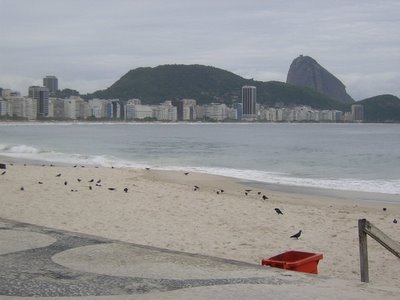
I spent three unforgettable days and nights in Rio 28-30 March while attending the IBSA ( India Brasil South Africa- alliance) meeting. I stayed in my favourite Meridian Hotel on the legendary beach of Copacabana. It is not just the sea or the sand. It is the brasilian spirit which makes this place vibrant and unique. Two rituals i follow at the beach; early morning walk from Meridien hotel to the copacabana fort ; and drinking chopp( draft beer) at the pavement kiosk on the beach after midnight listening to the sentimental songs of Brazilian FM radio and the music of the waves of Eemanja the sea goddess.

The copabana beach is in full bloom on new year eve with a million brasilians in white tee shirts( white for good luck in the new yr), drinking beer and dancing to live music in 4-5 different stages set on the beach itself.


The third ritual outside Copacabana is the visit to the bar called as Garota da Ipanema ( girl from ipanema ) made famous by the poet vinicius de moraes. yet another indulgence is the churasscaria rodizio ( barbecue restaurant typical of brasil) and unlimited eating of all kinds of meat. Someone commented" how can a Hindu eat meat of the cow which is sacred?"I responded
" yes.. the Indian cow is sacred.. not the Brasilian one "

Copacabana makes me feel at home and drives me crazy . Posted by Picasa

books of Laura Restrepo and Mario Vargas Llosa

As usual books of Latin American writers accompanied my journey to Chile and Brasil from 24 march to 3 april. I was experiencing the real Latin America while my mind was haunted by the stories, characters and magic of these two favourite authors.

"Leopard in the sun" by Laura Restrepo

This is the story of two families which fight with each other to the fatal end and is typical of the violence and crime which has come to characterise Colombia. The Barragans and Monsalves of the story continue to traumatise the contemporary Colombia. The honour code of the fighters, their passions and weaknesses and the role of women in the family are same like the mafia stories.

This powerful and gripping story and magical realism is what i expected of Laura Restrepo. Her characters in the book are unforgettable: Arcangel the boy treasure of the Barragan family, La Muda the aunt said to be wearing chastity belt, El Lyrico the poet in the midst of Crime, Mendez the lawyer who walks the tight rope advising both the warring familes and Mani Monsalves whose criminal mind is overcome by his love for Alina.

"The way to Paradise" by Mario Vargas Llosa

As in the case of " war of the end of the world" and " Feast of the Goat" this story happens outside Peru. It originates in France and ends in Tahiti. Flora Tristan the illegitimate daughter of a peruvian father carries on a courageous and relentless fight for the rights of workers and women in the post- revolutionary France which was not ready for the new ideas. She was ahead of the times and had to face the wrath of the the church and skepticism of the male dominated society. Flora is like the Joan of Arc with her fierce,fanatic and blind pursuit of her mission undaunted by challenges and obstacles. Flora's brief stay in Peru gives a glimpse of the oligarchy of Lima which was one of the most advanced in latin America at that time.
The other part of the story is about her grandson Paul. He starts of life as a stockbroker, takes up painting as hobby and becomes an artist in the true sense of the term; bohemian, anarchist, poor and reckless. He goes to Tahiti in search of the natural way of life seeking liberation from civilisation and culture. He abandons himself to all kinds of experience without any inhibition or control. Predictably he pays for it with diseases and pain at the end. Like Beethoven composed music even when he became deaf, Paul also had to paint after losing his eye sight.

Biography of Che Guevara

" Companero" ( the companion )- a biography of Che Guevara by Jorge Castanada

It was the film " Diary of a Motorcyclist " which i saw last year which had stimulated my interest in knowing more about Che. His story is extraordinary, inspiring and moving. Once I started reading i got absorbed completely and could not stop until i finished.

What is striking is that Che who became a hero of Latin America and a global icon and symbol for social uprisings for idealists and leftists was an Argentinian. Unbelievable... utterly different from the popular perception of Argentinian character.


Che was a restless soul relentlessly seeking new experience and adventures. His motorcycle tour of south america opened his mind to a panamerican and later global vision. After this, he was destined to go out and seek out adventures wherever he could. This destiny took him to Guatemala, cuba , Congo and Bolivia. His beliefs and vision evolved and matured as he encountered new situations . He made his mark as a guerilla fighter and eminently succeeded in Cuba. He tried to repeat his ventures in Congo but failed. He tried in Bolivia and planned to carry the revolution back to Argentina. This was a mistake for which he paid for it with his life.


One cannot help the impression that Che had the deathwish. He plunged into risky ventures carried away by his noble principles, blind pursuit and his restless urge for action. On the other hand, his companion and mentor Fidel Castro always had larger and balanced political and global perspectives and has obviously survived for so long.

Che had become a minister in Fidel's cabinet and applied himself with equal idealism and altruism to bring about a brave new socialistic world. It was of course inevitable that a guerilla fighter of his nature could not be confined to a cosy position of power. He was more at home in the battlefield.

Che had visited India leading a Cuban goodwill and study delegation, as part of his tour of many other countries. I was keen to know his impressions of India and how he viewed India. Unfortunately the author has not elaborated this visit in this book.( I will appreciate if someone could give me some lead).


Castanada has given a balanced profile of Che navigating between the propaganda of the left and the critical approach of the right. Besides quoting many sources, he has himself done a lot of research and interviewed people associated with Che.

The conditions of Latin America which inspired Che to fight for justice in those days continue to be present in most parts of Latin America. No wonder Che's glory is being revived by leftists such as Chavez and Evo Morales, who are the elected creations of the same situation.

Wednesday, March 01, 2006

From Poondi to Punta Arenas and Malgudi to Maconde


Punta Arenas in Chile is the southern-most city in the world close to Antarctica. I was there in April 2005 with a delegation. When I was cruising in the Magellan straits, reflecting on its maritime history, a thought struck me about my own. How did I reach Punta Arenas and from where ? How did a poor country kid reach the farthest part of the world!. The answer was Poondi Pushpam College. It proved to be my magic carpet. Not having travelled beyond Trichy and Thanjavur until the age of twenty, I had dreamt of non-stop journey to the farthest corners of the world. That dream for distant destinations materialised because the Pushpam college was so near. If there was no college in Poondi, I would not have become a globe-trotting diplomat, visiting exotic places like Punta Arenas.

Another trip which made me to look back at my root was the trip upstream in the river Orinoco to Colombia in the Amazon region in 2003. It was like a journey from ‘Malgudi’ to ‘Maconde’. R.K Narayan’s imaginary Indian town of Malgudi embodies the value system of simple folk pursuing traditional life. My place of birth, Alangudi Mahajanam, is close to Lalgudi, which is almost like Malgudi.


On the other hand, Maconde is the mythical town in the novel “One Hundred Years of Solitude” by the Colombian Nobel-laureate Gabriel Garcia Marquez. The spirit of Maconde is ‘Magical realism’, the literary genre, popular in Latin America. Malgudi and Maconde are contrasting in cultures. Salsa and Samba, Carnival and Football, Beaches and Bikinis, fun and enjoyment are Latin American cultural manifestations. In contrast, Malgudi culture is simple living and self-denial of comfort, enjoyment and wealth. While the old Indian renounces life and looks at Kasi or the Himalayas as his next and final destination, the Latin American does not give up. He sings

“We don’t stop having fun when we grow old
We grow old only when we stop having fun.”

Latin America has become my passion. I feel at home in the beaches of Copacabana and bars of Ipanema. I am fascinated by the Latin American literature and culture. I follow avidly the political and economic developments of the region. I express my emotions and feelings spontaneously in Spanish and Portuguese. Brazil beckons me, (in Portuguese)

Amor da minha vida, luz de meu querer
Vem..vem fica comigo
Sou quem sou ... so por voce
Means
Love of my life, light of love
Come.. come to be with me
I am what I am … just for you

The loud Latin America murmurs softly in the ears of this quiet and introspective Indian,

Quisera oir tu silencio
Quisera callar mis palabras

This poem (Spanish) means
I want to listen to your silence
I wish to silence my words

Every time I visit Raramuthiraikottai, the village three kiolmeters west of Poondi, I heave a sigh of relief. In this village, where I spent my life from the age of four to twenty, most of my schoolmates are still mired in poverty struggling with subsistent agriculture. I was lucky to escape and join the diplomatic glitterati and move seamlessly between the worlds of “Cheers!” and “Your Excellency”

My uncle who brought me up did not believe that education would lead to a viable livelihood. He would, therefore, ask me to stop the studies at the beginning of every summer holidays of school. I managed to finish the schooling in the Government Higher Secondary School in Mariammankovil. After this, my uncle put his foot down and said with a finality in his voice, “ Enough of your studies. We cannot afford to send you to college. Get ready to look after the land and cattle” That is when, Poondi College came to my rescue. I told him that the college was just three kms from the village. I promised to him that I would do the farm work in the morning and during weekend. I convinced him that the amount of scholarship I would get with my high marks would be more than the college fees. Reluctantly, he agreed. And my escape thereafter, was unstoppable.

If there was no college in Poondi, I would have still been cutting grass for the cattle on the side of the railroad, waving to to the passengers of Thanjavur and Nagore train.I was reminded of my grass cutting work in a rather jealous way, when I found in Brazil that each cow has eight hectares of land to graze in this large and lucky country. Reference to cows leads me to another incident. A Brazilian friend pulled my leg in a Steak restaurant saying that I was not to touch beef as a Hindu. I told him he was perfectly right since the Indian cows are sacred, but the Brasilian cows are not.

I am delighted to see that the college has grown bigger and added more courses and has started giving opportunities even for girls. My greatest thrill now is to see my niece Anita from the same village going to the same college. If not for this college, her mother would not have allowed her to go to distant places. The only difference between me and my niece is that I had to walk to the college while she has the luxury of going by cycle. But walking proved to be a blessing for me. I could review my lessons twice a day during the walk to the college and back.

The second advantage of the college was that since many students were from similar rural background and from Tamil medium schools, I was in the comfort zone. Later when I went to Chennai for higher studies and Delhi for joining the Foreign Service I was intimidated by the high-flying rich kids with Don Bosco and Doon School accents. It took a while for me to overcome this challenge, regain confidence and eventually beat many of them in show as well as substance. I was more hungry to catch up and prove myself.

I take this opportunity to express my profound gratitude to the founders of the college and the visionary Thiru Tulasi Ayya Vandayar, with whom I had the opportunity to interact and get inspired a few times. I am also grateful to the faculty of the college and especially Chemistry professor Srinivasan and Tamil professor Kannaiyan, who inspired me to aspire.

My best wishes for the success of the college and its noble role as the hope and promise for the rural youth around Poondi.
-------------------------------------------------------------------------------------
This article was written for the magazine of the College on the occasion of Golden jubilee celebrations in 2006.
___________________________________________________________________________

Tuesday, February 28, 2006

Latin Americanist

I heard this word yesterday
author of this is Mr Om Gupta
He described himself as a Latin Americanist

I asked him how he became one
Here is his story

As a professional journalist, he was working in Times of India.
He had told Mr KM Meena, the then JS(LAC) that he was looking for something outside his routine. Meena introduced him to the Colombian Ambassador to delhi in 1992 Mr David Sanchez Juliao. The Ambassador who was also an accomplished writer, introduced him to Latin America.
Mr OmGupta found latin america fascinating. he started writing articles on latin america in newspapers. Then he started publishing a magazine called as " Indo- Latin American File". He joined JNU for a M.Phil programme and later started a Ph.D thesis on Rigoberta menchu tum, the Guatemalan indigenous leader and nobel prize winner. He translated One hundred years of solitude of gabriel Garcia Marquez and published in 200 installments in a Hindi newspaper Dainik bhaskar
he has published a book containing his articles
- travelled to chile , Argentina and Trinidad and Tobago.
- interviewed the presidents of Argentina, peru and Guyana
He had organised 12 seminars on latin america at the India International centre in 1993-2000.

Now he is the Director of mass Communication at the jagannath Inst of communication and design at delhi

he is keen to revive his romance with latin america
you can imagine the electricity that was generated when he and i met !

Sunday, February 26, 2006

Visit of Latin American writers to India

Last week, Sahitya Academy organised a workshop on
" Myth, magic, History : contemporary fiction in India and Latin America "

Five Latin American writers attended this workshop.
Jorge Volpi and Montmeyer of Mexico, Jaime Collier of Chile
Gregory Zembrano of Venezuela and Rodrigo Montoya Rojas of Peru.

Jorge Volpi was the guest of honour in the Academy event. he belongs to the new generation of writers ( crack generation !), moving consciously away from the magical realism for which latino writers became famous. Volpi's discourse was lively.

What impressed me was the knowledge and interest of Mr Satchidanandan of the Sahitya Academy in Latin American literature. Prof Ganguli of JNU spoke eloquently displaying his profound expertise on latin American literature. He is the most authentic and knowledgeable expert on Latino literature in India, to my knowledge.

The Academy proposes to translate some of the works of Latino writers directly into Indian languages. In 2005,they published an anthology of latin american and caribbean poems in Hindi in collaboration with the embassies in delhi.

Pity ... i could not attend more sessions or interact with the writers.

In the same week, we had the visit of a Chilean Senator Jaime Gazmouri at the invitation of the Indian parliament.
During this visit I discovered that Mr Shahid Siddiqui Rajya Sabha MP from Samajwadi party has read many Latin American authors and is knowledgeable and interested in this exotic region.

Monday, February 20, 2006

Miss Canela from Dominican Republic

Last week was the week of Dominican Republic
A delegation of 25 officials and businessmen lead by the foreign minister was in delhi.

The visit went smoothly and successfully,thanks to a young and charming diplomat called as Gabriela. She came in advance and tied up the arrangements.

I could not resist saying... Clavo y Canela after she mentioned her name
Gabriela, Clavo y Canela is the title of one of the famous books of Jorge Amado of Brazil. I started calling her as Miss Canela.
She has gracefully accepted this.
Gabriela has now become Miss Canela...
Canela means cinnamon.

She is Counsellor in the DR embassy in paris.
super intelligent, efficient, energetic, articulate and hardworking....oops

DR is one of my favourite countries in latin america.three reasons: Julia Alvarez (the novelist), Golf resorts and Merengue.

My favourite novels of Julia are
-Yo
-In the time of the butterflies
And her story based on real life called as
-A cafecito story.

I had played in the “ Teeth of the Dog” course in la Romana. Later, when I visited the new course “ Dye Fore” I found it equally attractive. They say that “ Playa Grande” is even better than these two.

Merengue music and dance originates from DR.

DR has a BBB rating - Business, Beaches and Beauties


DR is going to open their embassy in delhi by April.
The Ambassador-designate Mr Danenburg is young, dynamic and enthusiastic.
He is going to open up India with "merengue" music,dance and parties.

The Foreign Minister described the DR economy as a " Dessert Economy"
since DR produces sugar, coffee, coco, banana and cigar...

On saturday the diplomatic interaction moved to the Delhi Golf Club.
We played with the Foreign Minister and the IT Minister as well as two other delegates.

India's exports which were 20 million dollars in 2004-5 can easily be taken to 200 million dollars in the next three years if the Indian cos take interest. The business and political leaders of DR are very keen for bz with India.
Pharmaceuticals, engg products, consumer items, IT are areas of opportunity. DR's FTA and proximity to USA are advantageous for those who want access to US mkt.

Imports of DR in 2005 were 9.7 billion dollars !!!

Indian bzmen should not take DR lightly. A DR pharma co has discovered a new drug molecule and has patented it in USA and many other countries.

Friday, February 10, 2006

Roberto Bolano

This is the new Chilean author, i discovered last week. I read his novel " A distant Star"(Estrella distante).The story is about the turbulence in the literary world of Chile during the days of military dictatorship. A number of authors like Mario Vargas Llosa, Julia alvarez, Augusto Roa bastos and Migues Angel Asturias have written about dictatorships and the trauma suffered by the society in latin America. But the " distant star" focusses exclusively on the literary scenario, covering ,of course, the murders and disappearances. Bolano himself was a victim and was put in jail and thereafter in exile.
Carlos Wieder, the main character in the novel, is an enigmatic and cruel force moving between the deadly oppressive apparatus of the state and the vulnerable groups of writers.Bolano has made it more interesting with some suspense and thrill.His humour is subtle. His erudition shows in the numerous references to other writers and ideas.But no romance or magical realism. Bolano disliked magical realism going to the extent of saying " It stinks ". He did not like Isabel Allende, the other famous Chilean writer.

I am looking forward to reading more works by him.

Wednesday, February 08, 2006

Encounter with Eemanja in Copacabana

Eemanja is the name of the sea goddess in the novels of Jorge Amado.
When i dipped my feet in the waters of copacabana on 4 February, I was reminded of Eemanja who saves and sometimes takes away the heroes of Jorge Amado. The afrobrasilians offer flowers to Eemanja on the eve of New Year after a beach ceremeony, wearing white clothes.
I have been in copacabana so many times. But every time it is a renewal, rejuvenation and recharging. I have charged myself sufficently to last till the next trip( march?).My last visit was in feb 2004 and the accumulated nostalgia was unbearable.

I never get tired of two more rituals which I always do in Rio.
-I sat in the beach at 2 am dissolving my nostalgia in Brahma beer, listening to Brazilian music in the cool copacabana breeze.
-I took a window seat to watch the descent of the plane at the santos dumont domestic airport pasing by the side of sugar loaf mountain, almost touching the sea.

I was in the delegation for the joint commission meeting in Brasilia 1-2 February. The meeting covered a large number of areas for cooperation. The Brazilian side showed unprecedented enthusiasm to work with India.They are going to open a consulate in Mumbai.

The Indo-Brazil Business Seminar in SaoPaulo on 3 feb arranged by the Consulate was attended by over 150 businessmen. Again, what was striking was the enthusiasm and keenness shown by Brazilian business.
India's exports reached a record 1.2 billion dollars and imports 1.1 billion in 2005, doubling from 2004. The big boys of the businessworld from both sides have come into play.
Banco Itau is thinking of opening a branch in India and state bank of india is also considering possibility of a branch in Brasil.

There is a proliferation of consultancy companies ( including half a dozen Indians in sao paulo) on both sides to promote bz.

Bollywood too is going to Brazil.In the last week of this month they are going to shoot the film Doom-II in Rio during the greatest show of the world called as carnival. Stars such as Aishwarya and Abishek Bachan will be dancing on top of sugar loaf and getting wet in copacabana waters.

Wednesday, January 18, 2006

Living to tell the tale

This is the title of the autobiography of the Colombian writer Gabriel Garcia Marquez, I have just finished reading. It is as enchanting and fascinating as his novels of magical realism. His large family, adventurous father,tolerant mother( who adopts the children of her husband from other women) his native town of Aracata( which resembles the mythical town of Maconde in his Nobel-prize winning novel " One Hundred Years of solitude) and journey by the River Magdalena are close to what i had experienced reading his various novels. His Bohemian life, poverty and struggles and uncertainties of life and his escapades are what i had imagined from his characters.He has spent lot of his time in Cafes and Bars and the other places more interesting than these two.

The book opens with the appearance of his mother to take him to his native town to sell their ancestral house and their conversations. It is typical Marquez magical realism.

Marquez had decided early in his life to be a writer but became a journalist by force of circumstances. His writngs were based on his own experience and that of others around him.One could relate his grand father, father and mother to the characters of his novels. He talks about an incident which he wanted to write about in one of his novels but his mother prohibited him from writing as a mark of respect for the deceased. Marquez accepted the desire of his mother and desisted.

In the initial period as a writer, he had so much fear that his writing might not be accepted by the publishers and in fact that was what happened to his first work. His writings took time and struggle and he looked upon his fellow writers for encouragement and recognition. And he got into the circle of eminent writers like Alvaro Mutis.

It is a pity that he has covered only upto the fifties and has not touched his later period in which he blossomed as a writer.

One thing which is missing in his life narration is the conspicuos absence of romance. It is surprising that he had not fallen in love deeply and uncontrollably. He has talked casually and matter-of- factly his sexual adventures and some transient affairs.
The other missing thing is his analysis and interpretation of the politics and socio economic situation of Colombia at that time,which sowed the seeds for the current situation of guerilla war and narco-trafficking.

I discovered one of the reasons for the crime and violence in Colombia. While describing an assasination event which was followed by riots and bloodshedding, Marquez says casually that the Colombians need a small or no excuse to kill people.This explains the rampant violence and crime which has come to stigmatise the name of Colombia in the last few decades.

Sunday, December 11, 2005

Dance with me – salsa movie

This Hollywood film (1998)by Chayanne ( Puerto Rican pop singer ) and Vanessa Williams is delicious . No violence, drama or tragedy. Something like Saturday night fever.

Pura Salsa… un poco de samba..
Story of love and romance in latino spirit..
lots of spanish conversations...

Chayanne has played well the part as a typical latino.
The puerto rican origin of vanessa has also added flavour.

songs of Thalia, Gloria Estefan, Ruben Blades
Singing
“Eres todo en mi”
“Tres deseos”
“Adios Santiago”

The duet of Chayanne and Vanessa Williams is the title song
“You are my home
You are the light in my window
When I could not find my way

All of my life
I have been searching for someone
I have been lonely
Waiting for your arms to hold me”

A cuban “Cohiba”, accompanied me with the movie,which starts in Santiago de Cuba and ends in Las Vegas.

Saturday, November 26, 2005

so much interest in learning spanish...

There are 300 students taking the spanish course in the Centre for Foreign languages, Hyderabad. On the day of issue of application, people queued up from 4 am..
The Inst could not take all applicants, since they dont hv enough professors.
Spanish is the most popular language and in great demand.
It is not just the prospects of career ( of course many of those learning are from IT and other bz )motivating this.
There is an upbeat latino spirit in the whole campus of CIEFL.
Even the waiters in the mess prefer to say " Hola " to greet people.
Credit for this goes to prof Sonya Gupta, the dynamic Chairperson of the spanish language dept.
felicitaciones Sonya !

I was there to give a talk on hispanic culture on 23 nov at the conference organised by Institute Hispania, which is doing a commendable professional job in teaching in three cities and has plans to expand.
I was amazed by the enthusiasm and spirit of the students and teachers of spanish there.
I was told there are lots of students in pune also.
madras university has started a course?
BHU runs spanish courses.

The time has come for the policy makers, professors and enterpreneurs in language bz to think big and plan for the growing demand.

last ten days were like a carnaval for me... i was flying high..over pao de azucar, canaima and la romana ...
There were bz delegations from Brasil, mexico, venezuela, panama and dominican republic.
These delegates made me feel nostalgic and I was " at home"
The response from indian bzmen to these delegations were positive and encouraging.

Monday, November 21, 2005

su excellencia

This is the title of the Mexican film i saw yesterday.
It means "your excellency" in spanish.
It is a hilarious comedy.
i was laughing and laughing...
It has unmasked the diplomats, who move high in the clouds, elevated by the high-sounding " your excellency" and all the trappings of old world protocol.
Some of what the movie portrays is true.Diplomacy has its share of talents as well as crackpots.
-like the visa officer, who works from 1030 am to 1045 am..not far from truth in some embassies....
-He sends back visa applicants asking them to bring all kinds of documents, some of them non-sensical and absurd. Height of this is when the visa officer asks for a gurantee so that if the visiter dies, someone takes responsibility to take the body back...
- In the middle of the dinner, ambassador receives a telegram saying that military has taken over the govt and making his military attache as the ambassador. The shaken excellency moves from the head table and asks his attache to sit in his place.
so many such funny things.. some of them close to reality

I recommend this to diplomatic colleagues and those who interact with them.
The DVD of the movie has English subtitles.

Remember.. the other movie recommendation on the same subject
" El Embajador de la India" - the ambassador of India
A colombian movie, based on a real story of a colombian imposter, masquerading as Indian ambassador and is caught...equally hilarious

Thursday, November 17, 2005

Fortnight of Latin American Fiesta

Second fortnight of November is the Quincena of Latin America
I am thrilled, so many came from latin America
- A 65 member business delegation of Brasil and the governor of Sao Paulo
- A Mexican business delegation
- The Vice President of Panama accompanied by an offical and a bz delegation
- A venezuelan business delegation and another delegation to negotiate DTAA
- IT and Investment minister of Dominican Republic and a bz delegation
- Brasilian trade lawyer Durval Noronha
- Chilean naval chief

Understandably the presence of so many latin americans
made me feel nostalgic
at the same time..I felt at home ...

And there was this Latin american voice which keeps calling me

Amor da minha vida
Luz de meu querer
Vem fica comigo
Sou quem sou
So por voce

This poem in portuguese(i recited in the meeting with Brasilians)
means

Love of my life
Light of my love
Come back to me
I am what I am
Just for you

Saturday, October 29, 2005

not only spanish translators but also spanish knowing managers

Anil Sivakumaran was one of the promising young Language Ambassadors i had met in the Translators Meet few months back. He is working with The Bosch Institute of Language and Culture in Bangalore.

I am putting here in public domain, his two emails, which are of interest to Spanish language speakers and business in India.
Those interested are welcome to share their views or do something

His contact
Anilkumar.Sivakumaran@in.bosch.com


Quote
Last week, I had the pleasure of attending a seminar at Pune's Ranade Institute on the subject of Spain-India intereconomics. It is clear that there will be a growing demand for Spanish speaking professionals in our services industries and in MNCs needing Spanish language skills, not only as translators and interpreters but also as project managers and business managers.

However, the supply and quality of supply is not keeping pace with the demand due to past lack of investment in language education countrywide. The proliferating private institutes are too small in vision and ability to meet the need for skilled professionals.

Does the MEA have any initiatives in concert with academia/UGC and chambers of commerce to address this growing gap in our ability to meet the potential for closer interaction with the Spanish speaking world - which will soon also include a critical player like the USA as well?
agree with you that pvt sector is better positioned in terms of resources but it may not have the perspective, skills and long term vision/ patience/indepth understanding to start developing such resources from scratch - despite the fact that industry generates the jobs and needs these resources badly in the long term .

This is because the process of education in language, just as in any other domain, is in years rather than months and even the best of corporate managers don't quite understand this and rarely plan or are able to plan and visualise for timelines longer than the next financial year or financial quarter. By that yardstick, we have already been quite adventurous in terms of our initiative of setting up an inhouse Bosch Institute of Cultures and Languages (BINOCULUS) - which is quite unique in the software/engineering world. Yet even an institute needs many excellent teachers and trainers and academic knowhow and this is not in abundant supply either.

The main drawback in the pvt. sector is that decision makers are engineers or managers from an science and technology background, etc and not those with a professional training and an intellectual/scientific or even common sense understanding of the humanities. In industry, the gap in understanding of the language domain is now too large and too pervasive for the pvt. sector to respond nimbly to the challenges of the supply-demand disparity in this domain. In other words, pvt. sector may be no less a dinosaur than the govt. or academia in such matters. In terms of vision, perhaps the govt. - or at least, individuals in govt. - may even be avant garde compared to academia or the pvt. sector.

The supply-demand mismatch in really well trained language professionals, teachers etc is a major gap in India right now and we are already getting behind in the race that we are running. The majority of economic opportunities are being missed rather than met. Strong skills in communication and language area will have a geometric multiplier effect for the country in terms of the economic opportunities that can be seized and the strategic positions we can occupy in trade, security etc.

At best, visionary companies may function as finishing schools but will not be able to provide the right 'soil' or 'subsoil' for a teaching and learning environment. There need to be more institutions that must take as input the students who are 17-18 and have finished Std XII and then three-four years later turn out sufficient numbers of really well trained highly skilled language professionals with the motivation and desire to pursue careers in this field. Currently each major foreign language has probably no more than 50 or so really effective people joining the professional ranks each year. There are not only far more jobs, but far more companies than this number wanting to employ them. So existing institutions with the academic knowhow like JNU, Ranade, etc also need to increase their capacity effectively, hire/train more teachers, pay competitive compensations, etc. Ultimately, in the next two years we need at least a tenfold increase in the number of effective language specialists we turn out. German, Spanish, Japanese, Chinese, Italian and Korean and to some extent French are the critical languages in this respect.

The broad solution may lie in the direction of upgrading the status, faculty, facilities, programs, infrastructure etc of major national language institutions which provide the comprehensive degrees and programs in this domain. Institutions like JNU's language school, Ranade Institutes in Mumbai and Pune, Delhi Univ., Karnatak Univ. Dharwad, etc need to be really revitalised. They will need to be enabled/encouraged/pushed to start functioning more like the IITs and IIMs in terms of the number, quality and compensation of faculty, program development, industry partnerships and outreach for funding etc. Starting language/linguistics departments as nurseries - and competitors to the JNUs and Ranades - within the cultural environs of the IITs and IIMs may be another way to kickstart this. IIT Mumbai and IIT Kanpur with their strong Comp. Sc. and Humanities depts and IIT Chennai which I believe already has a German language study program inhouse might be good places to begin such initiatives. In fact, with linguistics becoming a recognised technical field in terms of developments in machine translation, speech recognition, character recognition etc, it is already a candidate for inclusion in the list of subjects offered within the IIT curriculum.

I am just sharing some thoughts to begin a discussion. Clarities might come more slowly.
Unquote

Tuesday, October 18, 2005

Salman Rushdie's magical realism

How does salman Rushdie get a place in the blog on latin America?
I consider him as the Indian counterpart of Gabriel Garcia Marquez in employing magical realism.Obviously one should not take this too far. Rushdie will never write an autobiographical novel such as marquez's " memory of my melancholic whores"
His midnight children and Shame have extra doses of this typical Latin American magic.
I have just finished reading
Shalimar, the Clown
by Rushdie
As anticipated, it was a familiar journey through Rushdie world.
but less magic .. and more realism in this novel
Kashmir is the theme.
American ambassador, second world war- hero, comes to india, goes to kashmir, falls in love with a married Kashmiri woman and pays the price with his life.
Kashmiri traditions, political issues and terrorism have been portrayed realistically.
The weak clown, after loss of his wife, becomes a terrorist.
the story line is fantastic and the characters stay with you

There is one more connection of Rushdie to Latin America
he wrote a non fiction about Nicaragua after his visit during the Sandinista rule.

Wednesday, October 12, 2005

Brasilian artistic farmer in Goa

As I am passionate about Latin America, there are some Latin Americans who are into India. I rediscovered one in Goa last week.
Her Indian name is Thairna. She is from saopaulo.
She is an artist, painter and believer of Osho.
She is in Goa for the last seven years.
She has a simple cottage in the beach in Morjim, Goa. No TV.. no modern comforts.
no running water. It is well water like in the villages.
Her current passion is organic farming. She grows rice, vegetables and fruits and flowers. She cares for conservation of nature and the beaches and works with the villagers there.She provides consultancy on gardening.
Name of her company " Florissima "
She says the portuguese had brought some plants from Brasil to india including cashew.

Among her adventures
-living in a yacht in Amazon river for 3 years !
- around the world in the yacht
- 45 days journey by maruthi Gypsy from mumbai to Kanyakumari to bhuvaneshwar to mumbai.

She has a neighbour Paula, an italian and her husband satish, a marwari.
They have one of the most beautiful and simple houses. paula is an architect.
house has italian and rajasthani features.
no fridge.. no running water..no electricity even, for many years in the past.

Interesting and inspiring people !