The reason why Graham Greene is coming into this blog, rather than in my other blog " Floating Weed" is because this novel, "Honorary Consul" is about Latin America. I reread this novel with greater interest and curiosity last week since the location of the story is Argentina and Paraguay. I wanted to experience these countries through the eyes, ears and senses of Graham Greene, who has also spent time here.
The main character is Charley Fortnum the honorary consul of Britain in Paraguay. Although he is of British origin, his character has been tropicalised as a Latino. He imports cars dutyfree every two years and sells in the local market, although he is not entitled as a honorary consul. He is a bachelor in his sixties and floats on scotch whisky to get over his loneliness. One day the sixty year- old Charley falls in love with a twenty one year- old Clara, the girl from the puteria of senora sanchez. After this, his main obsession is to keep her happy and is thrilled when she becomes pregnant. Clara, while enjoying the unexpected affection of Charley, has an affair with her husband´s friend Doctor Eduardo Plarr,also of English origin. Eduardo´s father, a revolutionary, is jailed by the Paraguayan dictator and is killed while trying to escape from the prison.
Eduardo helps the guerillas to kidnap the American ambassador to Argentina while visiting Paraguay. But the amateurish guerillas bungle it and kidnap Charley by mistake. The guerillas do not want to give up even after discovering their mistake. They ask for the release of political prisoners in exchange for freeing Charley. But the British govenrment does not care for the life of an alcoholic and unscrupulous honorary consul. The revolutionary guerillas prefer to die rather than surrender. The Paraguayan police discover the hiding place of the kidnappers and kill them including Eduardo and free Charley.
The novel has got everything of the south america of the sixties and seventies; repressive military dictatorship, corrupt and decadent governments, guerilla war by revolutionaries of the Cuban vintage, role of United States in those days in the region, the vestiges of British presence in the region, catholic bishops turning into leftist radicals, poets living out lives of magical realism and the puterias, the refuge of the machos and poets.
The novel gives a glimpse of the conditions of the society caught between the traumas of the violent conflict between the dictatorship and leftists. Greene has captured the Porteno spirit of the elegant city of Buenos Aires, gossips and leisurely conversations in its cafes and shopping in Florida street. Eduardo´s mother tries to sink the depression caused by the disappearance of her husband by consuming packs and packs of Alfajores, the typical Argentine chocolate candies in Cafe Richmond in Florida street.
The kidnapping takes place in the Corrientes province of Argentina bordering paraguay, separated by Parana river. Greene has portrayed the situation in Paraguay, one of the most backward countries of south america, which has started changing only now. The story of the catholic priest Father Rivas, a product of "liberation theology" who leaves the church to become a revolutionary, has come true now. The catholic priest- turned leftist political leader Father Fernando Lugo has just been elected to become the President of Paraguay in August 2008. Lugo wears only sandals and leads an austere life, as part of his solidarity with the poor.
Greene has vividly brought out the Latino characteristics of Clara, the doctor and the honorary consul, with their ambiguous and tentative approach to relationships. Clara is a typical young and naive puta who adjusts herself smoothly and professionally to please her clients with absolute emotional detachment. The novelist Saavedra leads a bohemian life in a latino setting along with the revolutionary poet Aquino. With all these typical latino characters, Greene has been able to caputre the latino spirit and their way of interpretation of love and lust, hope and betrayal, illusions and dreams, in those times of dictatorship and ideologies. Greene has explored the theme of love through the characters of his novel. Dr Plarr thinks cynically that love is nothing but a bargain used by those offering love to demand reciprocal afection or obligation. For Charley, love blossoms when he meets Clara and wants to give so much without expecting any return. Father Rivas´s indian wife sees love as devotion to him despite his ambiguous approach to her.
Graham Greene had lived in Buenos Aires for sometime and that is how he had absorbed the comedies and tragedies of the Argentine society. He had stayed at Lancaster hotel in Cordoba avenue.
Greene has dedicated this novel to Victoria Ocampo and in memory of the many happy weeks he had passed at San Isidro and Mar del Plata. Victoria had hosted Rabindranath Tagore for two months in her houses in the same two cities.
Monday, June 16, 2008


Saturday, May 31, 2008
La historia oficial - Argentine film
This is the first and only Argentine film which has won an Oscar award . It won in the foreign language category in 1986. I had been looking for this and finally got to see yesterday.
Alicia, a high school history teacher is happily married to a successful lawyer Roberto and they have an adopted daughter, the five year old Gaby. Her contented and innocent life takes a turn when one of her students asks if she believed in what the history books say. This wake up call is followed by the revelations of her childhood friend Ana ,who returns from exile. Ana recounts how she was detained and tortured on the suspicion that her husband was a subversive. She tells the horror stories of atrocities and disappearance of people and the handing over of children of disappeared parents to families related to the military junta. This makes Alicia to question and find out how Gaby came to be adopted by her husband. Her husband is evasive and denies any wrongdoing. But Alicia is determined to find out the truth and embarks on a mission to find out if Gaby is the daughter of a disappeared mother. She goes to search hospital records and finally gets to meet Gaby´s grand mother whose daughter had disappeared during the repression of the dictatorship.
The director of the film, Luis Puenzo, has vividly brought out the trauma suffered by Argentine society during the the years of dirty war waged by the military against leftists and their sympathisers. Rather than dramatising the crimes of the dictatorship, the director has used a middle class family to tell the sufferings subtly but poignantly.
The mothers whose children had " disappeared" continue even now their mourning and walking around the Plaza of May in Buenos Aires. They are known as the Mothers of Plaza of May.
Norma Aleandro ( Alicia) and Hector Alterio ( Roberto) and the other actors have portrayed their role realistically . The actress Norma Aleandro herself had gone into exile in Uruguay and Spain and returend to Argentina only after the restoration of democracy.
The movie was started in 1983, after the fall of the military dictatorship but had to be suspended and resumed secretly after the director and actors received threats from the military officers.
Argentina has still not got over the nightmare of the suffering under the military dictatorship. Military officers involved in killings are even now brought to justice and the scars have not healed yet. This is a reminder of the historical stain in the otherwise sofisicated, refined and cultured society of Argentina.
This film certainly merited an Oscar and the other awards it won.
Alicia, a high school history teacher is happily married to a successful lawyer Roberto and they have an adopted daughter, the five year old Gaby. Her contented and innocent life takes a turn when one of her students asks if she believed in what the history books say. This wake up call is followed by the revelations of her childhood friend Ana ,who returns from exile. Ana recounts how she was detained and tortured on the suspicion that her husband was a subversive. She tells the horror stories of atrocities and disappearance of people and the handing over of children of disappeared parents to families related to the military junta. This makes Alicia to question and find out how Gaby came to be adopted by her husband. Her husband is evasive and denies any wrongdoing. But Alicia is determined to find out the truth and embarks on a mission to find out if Gaby is the daughter of a disappeared mother. She goes to search hospital records and finally gets to meet Gaby´s grand mother whose daughter had disappeared during the repression of the dictatorship.
The director of the film, Luis Puenzo, has vividly brought out the trauma suffered by Argentine society during the the years of dirty war waged by the military against leftists and their sympathisers. Rather than dramatising the crimes of the dictatorship, the director has used a middle class family to tell the sufferings subtly but poignantly.
The mothers whose children had " disappeared" continue even now their mourning and walking around the Plaza of May in Buenos Aires. They are known as the Mothers of Plaza of May.
Norma Aleandro ( Alicia) and Hector Alterio ( Roberto) and the other actors have portrayed their role realistically . The actress Norma Aleandro herself had gone into exile in Uruguay and Spain and returend to Argentina only after the restoration of democracy.
The movie was started in 1983, after the fall of the military dictatorship but had to be suspended and resumed secretly after the director and actors received threats from the military officers.
Argentina has still not got over the nightmare of the suffering under the military dictatorship. Military officers involved in killings are even now brought to justice and the scars have not healed yet. This is a reminder of the historical stain in the otherwise sofisicated, refined and cultured society of Argentina.
This film certainly merited an Oscar and the other awards it won.
Friday, May 23, 2008
U.S.-Latin America Relations - A New Direction for a New Reality
U.S.-Latin America Relations - A New Direction for a New Reality
This is the title of a report published in May 2008 by the Council on Foreign Relations. The task force which brought out the report includes among others Charlene Barshefsky former USTR.
Here are some highlights of the report:
-For over 150 years, the Monroe Doctrine provided the guiding principles for U.S. policy toward Latin America, asserting U.S. primacy in the foreign affairs of the region. Over the past two decades, those principles have become increasingly obsolete. Washington’s basic policy framework, however, has not changed sufficiently to reflect the new reality. U.S. policy can no longer be based on the assumption that the United States is the most important outside actor in Latin America. If there was an era of U.S. hegemony in Latin America, it is over.
-the era of the United States as the dominant influence in Latin America is over. Countries in the region have not only grown stronger but have expanded relations with others, including China and India.
-Latin America hasbenefited greatly in recent years from democratic opening, stable economic policies, and increasing growth. Many countries are taking advantage of these developments to
consolidate democratic institutions, broaden economic opportunities, and better serve their citizens.
-The region has undergone a historic transformation politically, with military authoritarian rule giving way to vibrant, if imperfect, democracy in almost every nation. Economically, Latin America is now one of the more open market regions in the world and a crucial global provider of energy, minerals, and food.
-U.S. policymakers must change the way they think about the region. Latin America is not Washington’s to lose; nor is it Washington’s to save. Latin America’s fate is largely in Latin America’s hands.
-Latin American states,especially the larger ones, do not consider their interests to be primarily determined by diplomatic, trade, or security ties with the United States.
-Latin America already supplies more oil to the United States than does the Middle East, and the
region has great potential to be a major provider of alternative fuel sources, increasing U.S. and regional energy security through diversification.
These highlights are reproductions from the report itself....
Full report in uncorrected version
http://www.cfr.org/content/publications/attachments/LatinAmerica_TF.pdf
This is the title of a report published in May 2008 by the Council on Foreign Relations. The task force which brought out the report includes among others Charlene Barshefsky former USTR.
Here are some highlights of the report:
-For over 150 years, the Monroe Doctrine provided the guiding principles for U.S. policy toward Latin America, asserting U.S. primacy in the foreign affairs of the region. Over the past two decades, those principles have become increasingly obsolete. Washington’s basic policy framework, however, has not changed sufficiently to reflect the new reality. U.S. policy can no longer be based on the assumption that the United States is the most important outside actor in Latin America. If there was an era of U.S. hegemony in Latin America, it is over.
-the era of the United States as the dominant influence in Latin America is over. Countries in the region have not only grown stronger but have expanded relations with others, including China and India.
-Latin America hasbenefited greatly in recent years from democratic opening, stable economic policies, and increasing growth. Many countries are taking advantage of these developments to
consolidate democratic institutions, broaden economic opportunities, and better serve their citizens.
-The region has undergone a historic transformation politically, with military authoritarian rule giving way to vibrant, if imperfect, democracy in almost every nation. Economically, Latin America is now one of the more open market regions in the world and a crucial global provider of energy, minerals, and food.
-U.S. policymakers must change the way they think about the region. Latin America is not Washington’s to lose; nor is it Washington’s to save. Latin America’s fate is largely in Latin America’s hands.
-Latin American states,especially the larger ones, do not consider their interests to be primarily determined by diplomatic, trade, or security ties with the United States.
-Latin America already supplies more oil to the United States than does the Middle East, and the
region has great potential to be a major provider of alternative fuel sources, increasing U.S. and regional energy security through diversification.
These highlights are reproductions from the report itself....
Full report in uncorrected version
http://www.cfr.org/content/publications/attachments/LatinAmerica_TF.pdf
Sunday, May 04, 2008
Boca vs River super classic
According to Observer newspaper of UK, one of the fifty sport events one should watch in life is a super classic game between Boca Juniors and Riverplate teams of Argentina. In fact, this event is the top in the list of fifty. I watched it today at the stadium of Boca called as La Bombonera.
More than the game, the most exciting thing to watch was the Boca fans. The stadium, which was packed with 61,000 spectators was a riot of colour, noise and energy. There was almost non-stop singing, drum beating, throwing of paper rolls and insults hurled at River. The Boca fans call themselves as the number 12 ( La doce), which means they are the twelth player.
La Bombonera was vibrating when the fans started to jump in rhythm.. They say "La Bombonera no tiembla. Late" ("the Bombonera does not tremble. It beats.")
The fans, irrespective of their ages get into a frenzy and are transformed into totally different creatures inside the stadium. Grandmother, father, son and kids were shouting the most abusive and colourful words together against River players and the coach. It might be more appropriate to call it as a game of "Putas" (bitch ), since it was the word most used with many prefixes and suffixes.
There were so many songs praising Boca and damning River. Here is their Hymn.
Boca es nuestro grito de amor.
Boca nunca teme luchar,
Boca es entusiasmo y valor,
Boca Juniors. . . a triunfar. .
 The rivalry between Boca and River Plate is the most intense in Argentine football and, perhaps, in the whole of Latin America. There is no equivalent even in Brazil, where the rivalry is dispersed among many teams unlike the intense bipolar rivalry between Boca and River which divides the whole country vertically.

More than the game, the most exciting thing to watch was the Boca fans. The stadium, which was packed with 61,000 spectators was a riot of colour, noise and energy. There was almost non-stop singing, drum beating, throwing of paper rolls and insults hurled at River. The Boca fans call themselves as the number 12 ( La doce), which means they are the twelth player.
La Bombonera was vibrating when the fans started to jump in rhythm.. They say "La Bombonera no tiembla. Late" ("the Bombonera does not tremble. It beats.")
The fans, irrespective of their ages get into a frenzy and are transformed into totally different creatures inside the stadium. Grandmother, father, son and kids were shouting the most abusive and colourful words together against River players and the coach. It might be more appropriate to call it as a game of "Putas" (bitch ), since it was the word most used with many prefixes and suffixes.
There were so many songs praising Boca and damning River. Here is their Hymn.
Boca es nuestro grito de amor.
Boca nunca teme luchar,
Boca es entusiasmo y valor,
Boca Juniors. . . a triunfar. .
 The rivalry between Boca and River Plate is the most intense in Argentine football and, perhaps, in the whole of Latin America. There is no equivalent even in Brazil, where the rivalry is dispersed among many teams unlike the intense bipolar rivalry between Boca and River which divides the whole country vertically.
La Bombonera ( means chocolate box) stadium in La Boca area of Buenos Aires is like chocolate boxes stacked up together.

Boca fans are more from the working class while River has an affluent fanbase, hence their nickname, Los Millionarios. Boca Juniors claims to be the club of "half plus one" ("la mitad mas uno") of Argentina's population, but a 2006 survey placed its following at 40%, still the largest share.

Boca fans are more from the working class while River has an affluent fanbase, hence their nickname, Los Millionarios. Boca Juniors claims to be the club of "half plus one" ("la mitad mas uno") of Argentina's population, but a 2006 survey placed its following at 40%, still the largest share.
Maradona, who had played for Boca has a special balcony in the stadium and whenever he is there, a banner says " El Juancito esta presente". Today he was there.
In today´s game Boca won 1-0 to the delight of my hosts Francisco Okecki, his mother Maria and his two sons, who are hardcore fans.
Boca and River have played 182 games so far. Boca has won 66 times, River 61 times and rest were draws.
valle de la luna ( moon valley)- visit on 3 May 2008
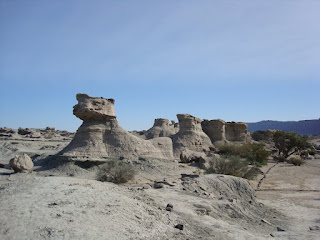
They call this as the valle de la luna ( moon valley ) because it looks like the lunar surface. It is 300 km from San Juan city in the province of San Juan. This 63000 hectare park has been declared as a world heritage site by UNESCO.
The moon valley has fossils from the Triasic period, which lasted for 45 million years from 228 million and 187 million years back. They have found fossils of the first reptiles/dinosaurs of the world. Paleontologists from all over the world do research at this site in their quest to understand and reconstruct prehistorical evolutions.
The landscape of the valley is a natural beauty. The wind and the rain have worked out some incredible sculptures on the rocks.
Here is a spinx-like rock
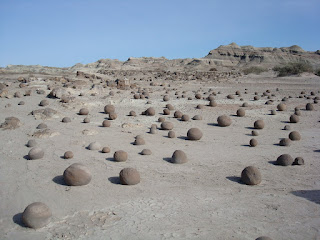
Here is a picture of the rocks formed like balls. They keep coming out of the surface like pumpkins. The outer surface is formed by manganese.
The rock formation below is called as Submarino..since it resembles a submarine

The moon valley has fossils from the Triasic period, which lasted for 45 million years from 228 million and 187 million years back. They have found fossils of the first reptiles/dinosaurs of the world. Paleontologists from all over the world do research at this site in their quest to understand and reconstruct prehistorical evolutions.
The landscape of the valley is a natural beauty. The wind and the rain have worked out some incredible sculptures on the rocks.
Here is a spinx-like rock

Here is a picture of the rocks formed like balls. They keep coming out of the surface like pumpkins. The outer surface is formed by manganese.

The rock formation below is called as Submarino..since it resembles a submarine

More fotos...in my foto gallery http://picasaweb.google.com/viswanathanifs
The valley is surrounded by hills which shine reddish in the sun due to iron content in their rocks. The valley attracted 70,000 tourists last year. The park arranges moon light trips every month. They say it is magical.
The valley is surrounded by hills which shine reddish in the sun due to iron content in their rocks. The valley attracted 70,000 tourists last year. The park arranges moon light trips every month. They say it is magical.
Although it was not in my original programme of the visit to San Juan, last week, it became possible thanks to the offer of the helicopter by the Governor Jose Luis Gioga. It took us one hour by helicopter from San Juan city and at the valley we spent an hour touring the valley with a guide, who is passionate about the valley.
San Juan is one of the most dynamic and progressive provinces of Argentina. Although it is small with a population of 800,000 and 97 percent of the area is arid and mountainous, the hardworking San Juaninos have made the province as the second largest wine producer in the country. Syra is the signature wine of the province. The province´s agro exports include wine, table grapes, olives and fruit concentrates. There is also a thriving and growing mining industry in the areas of gold, silver, copper etc. And , of course, it has the Amancay Golf club , where I played nine holes before rushing to the airport.
Sunday, April 27, 2008
El Nido vacio - Argentine film
I was there at the premiere of the film El Nido vacio - empty nest- yesterday at Village Cinema. It is a film about a couple, who find the house empty after their grown-up children leave home to be independent. The couple try to make sense of their togetherness trying to find a new meaning and bond to sustain the relationship. The man, Leonardo, who is a successful playwright, gets more introspective and gets into the usual midlife crisis. The hyperactive wife, Martha, restarts her life by resuming her university studies and having fun with social get-togethers. She also resumes shouting...to compensate for the days when she could not do so in the presence of children. Leonardo is uncomfortable among the friends of his wife and in social occasions. But his eyes follow the skirts and legs filling up his mind with fantasies. The fantasy at the clinic of a young female dentist takes the form of reality. He lets himself go after her. He is successful in getting her to reciprocate a bit and to take her to bed. But it is a one-shot affair. He feels guilty and does not proceed further.
The director and producer Daniel Burman has handled the theme very well. He has done it in an Argentine way making the story happen in the cafes. bars and restaurants through long but lively conversations. Fortunately, he has not made the film too heavy and complicated as the Argentine writers tend to do in the case of such themes. He has let the characters express their emotions and feelings in words, gestures and unspoken silences. He has let the story flow smoothly in a leisurely pace without any twists or complications.
Oscr Martinez has done justice to his role as Leonardo and so does Cecilia Roth as Martha in a realistic and credible manner.
For me, what the movie shows is what happens in the corner and sidewalk cafes of Buenos Aires every day. Couples and friends sit there for hours sipping cafe and talking..talking..and talking. It is part of the Porteno ( residents of the port city of Buenos Aires are called as portenos) culture.
The director and producer Daniel Burman has handled the theme very well. He has done it in an Argentine way making the story happen in the cafes. bars and restaurants through long but lively conversations. Fortunately, he has not made the film too heavy and complicated as the Argentine writers tend to do in the case of such themes. He has let the characters express their emotions and feelings in words, gestures and unspoken silences. He has let the story flow smoothly in a leisurely pace without any twists or complications.
Oscr Martinez has done justice to his role as Leonardo and so does Cecilia Roth as Martha in a realistic and credible manner.
For me, what the movie shows is what happens in the corner and sidewalk cafes of Buenos Aires every day. Couples and friends sit there for hours sipping cafe and talking..talking..and talking. It is part of the Porteno ( residents of the port city of Buenos Aires are called as portenos) culture.
Saturday, April 26, 2008
Paraguay elects a Leftist ex-Bishop as President
Fernando Lugo was elected in the elections held on 20 April. It was not surprising, since he had been leading in the opinion polls for the last one year. I had been predicting and talking about this to the surprise and consternation of my Paraguayan friends.
It is a historic election for Paraguay. The Colorado party which was continuously ruling the country for the last 61 years was defeated for the first time. On the contrary, Lugo is a newcomer to politics. He took to politics only in 2006. He was one of those believers and practioners of Liberation Theology and was known as the Bishop of the poor. He formed a coalition with an assortment of political parties and indigenous groups and won the elections against formidable obstacles put in his way.
Lugo is the first Leftist President of the country. He wants to change the conditions of the poor. He wants to carry out land reforms and rid the society of corruption. Paraguay is the second most poor country in South America after Bolivia and one of the most corrupt and mismanaged.
But credit must be given to Colorado party candidate and the current President who quickly conceded defeat gracefully and committed to peaceful transfer of power due on 15 August. This shows the maturity of the leaders in contrast to what happened in Mexico. Credit is also due to the government which organised free and fair elections even after knowing that they risked losing power.
The election was colourful in a latino way ! The three main candidates were a bishop, woman ( queen) and a general ( knight).
Lugo´s election completes the Circle of the Left in south america where all the countries except Colombia ( where leftist ideology has been kidnapped and held hostage by FARC) have elected leftist governments. I prefer to call this development as empowerment of the masses , rather than an ideological shift. The masses who were marginalised and excluded in the past have exercised their power to elect those who have an agenda for them...simple !
Lugo is moderate, balanced and mature. He proposes to follow the model of Tabare Vasquez of Uruguay, who is respected in his country and in the region for his pragmatic approach. The opposition had accused Lugo as a Chavista and of receiving funds from Chavez. But Lugo is independent and nationalistic. Lugo did not indulge in any anti-American rhetoric. His language is not confrontational or polarising like in the case of some south american presidents.
Lugo will face many challenges to implement his agenda for change. he does not have a cohesive majority in the congress. His coalition parners, which include communists, liberals and indigenous groups have divergent agenda. The traditional political parties have control of the Congress and many provinces.
In foreign policy, he is going to make some changes. He is going to open diplomatic relations with China. Paraguay remains as the only country in south america to have recognised Taiwan. Lugo is asking for a better deal from Mercosur, which is run by the big boys, Brazil and Argentina. He has asked for a fair price for the electricity being supplied to Brazil from the 12000 MW Itaipu dam. Although President Lula ruled out renegoiations, his foreign minister Celso Amorim has hinted that discussions were possible. Lugo has demanded a simliar fair deal from a joint hydro power project with Argentina too.
Lugo seeks partnership with new powers such as India. Of course, the outgoing government had also attached importance to India and opened embassy in newdelhi. Lugo can be expected to be more friendly. Paraguay is the fourth largest exporter of soya in the world and this is important for India. There are opportunities for investment by Indian companies in agribusiness.
It is a historic election for Paraguay. The Colorado party which was continuously ruling the country for the last 61 years was defeated for the first time. On the contrary, Lugo is a newcomer to politics. He took to politics only in 2006. He was one of those believers and practioners of Liberation Theology and was known as the Bishop of the poor. He formed a coalition with an assortment of political parties and indigenous groups and won the elections against formidable obstacles put in his way.
Lugo is the first Leftist President of the country. He wants to change the conditions of the poor. He wants to carry out land reforms and rid the society of corruption. Paraguay is the second most poor country in South America after Bolivia and one of the most corrupt and mismanaged.
But credit must be given to Colorado party candidate and the current President who quickly conceded defeat gracefully and committed to peaceful transfer of power due on 15 August. This shows the maturity of the leaders in contrast to what happened in Mexico. Credit is also due to the government which organised free and fair elections even after knowing that they risked losing power.
The election was colourful in a latino way ! The three main candidates were a bishop, woman ( queen) and a general ( knight).
Lugo´s election completes the Circle of the Left in south america where all the countries except Colombia ( where leftist ideology has been kidnapped and held hostage by FARC) have elected leftist governments. I prefer to call this development as empowerment of the masses , rather than an ideological shift. The masses who were marginalised and excluded in the past have exercised their power to elect those who have an agenda for them...simple !
Lugo is moderate, balanced and mature. He proposes to follow the model of Tabare Vasquez of Uruguay, who is respected in his country and in the region for his pragmatic approach. The opposition had accused Lugo as a Chavista and of receiving funds from Chavez. But Lugo is independent and nationalistic. Lugo did not indulge in any anti-American rhetoric. His language is not confrontational or polarising like in the case of some south american presidents.
Lugo will face many challenges to implement his agenda for change. he does not have a cohesive majority in the congress. His coalition parners, which include communists, liberals and indigenous groups have divergent agenda. The traditional political parties have control of the Congress and many provinces.
In foreign policy, he is going to make some changes. He is going to open diplomatic relations with China. Paraguay remains as the only country in south america to have recognised Taiwan. Lugo is asking for a better deal from Mercosur, which is run by the big boys, Brazil and Argentina. He has asked for a fair price for the electricity being supplied to Brazil from the 12000 MW Itaipu dam. Although President Lula ruled out renegoiations, his foreign minister Celso Amorim has hinted that discussions were possible. Lugo has demanded a simliar fair deal from a joint hydro power project with Argentina too.
Lugo seeks partnership with new powers such as India. Of course, the outgoing government had also attached importance to India and opened embassy in newdelhi. Lugo can be expected to be more friendly. Paraguay is the fourth largest exporter of soya in the world and this is important for India. There are opportunities for investment by Indian companies in agribusiness.
Friday, April 11, 2008
"India: from misery to power" - book by Patricia Campos Mello
I have just received a copy of this book in Portuguese ( India: da miseria a potencia") , which was launched on 25 March in Sao Paulo. Patricia is a journalist, curently based in Washington DC as the correspondent of Estado de Sao Paulo daily. She had visited India for three weeks in 2006 to interview people and collect materials for the book. India Brand Equity Foundation had financed and organised her visit.
Patricia has given an overview of the emergence of India as an important market, IT power and rising power. She has quoted the usual sources such as Thomas Friedman and businessmen like Nandan Nilekhani. She has quoted me too...
She contrasts India's IT skills and business boom with the poverty, caste system and problems faced by India. The photos she has put in the book are those which describe the misery and problems. She has forgotten to put the pictures which could have reflected the potencia! India seems to have given her a cultural shock from which she did not succeed in gaining her balance.
She has made the predictable comparison with China. She has earlier written a book on China called as " o mundo tem medo de china".
She has compared Brazil with India , the countries of the future. She says that while Brazil has been waiting eternally as the country of future, India has taken off. She has referred to the term "Belindia" which is used in Brazil to describe the inequality; the developed part of Brazil is compared to Belgium and the rest to India. She says while Brazil continues to be Belindia, India is no longer what India meant in the past. She has mentioned in passing the growing partnership between the two countries.
Patricia's book is a timely fill-in for the Brazilians who are puzzled and amazed by the sudden and rapid rise of India. Brazilian government and the business are curious and serious about India.There are no contemporary books on India in portuguese. Books on India available in Brazil are about culture and spiritualism. Although Patricia has not gone into the details of what has caused the paradigm shift in India and and in the mindset of Indians, the book serves its purpose by making the Brazilians to search for answers within themselves. I guess the three week stay was too short for her to understand the complexities of India.
My feeling is that the Brazilians have also reached a take off stage with a new confidence, energy and optimism. Brazilian companies are on a buying spree in neighbouring countries and outside. In 2007, Brazilian outward investment was more than the inward Foreign Direct Investment. The discovery of new oil fields, the commodity boom, leadership in fuel ethanol... are some of the factors which have strengthened the confidence of the Brazilian business. This has been complemented by the political equilibrium achieved by the government with its pragmatic policies friendly to both the Wall Street and Favelas. The government has successfully raised its profile in the region as well in the world by careful and astute diplomatic initiatives. This business- government synergy and putting their act together with a new vision and determination has made Brazil unstoppable....
Viva Brasil !
Patricia has given an overview of the emergence of India as an important market, IT power and rising power. She has quoted the usual sources such as Thomas Friedman and businessmen like Nandan Nilekhani. She has quoted me too...
She contrasts India's IT skills and business boom with the poverty, caste system and problems faced by India. The photos she has put in the book are those which describe the misery and problems. She has forgotten to put the pictures which could have reflected the potencia! India seems to have given her a cultural shock from which she did not succeed in gaining her balance.
She has made the predictable comparison with China. She has earlier written a book on China called as " o mundo tem medo de china".
She has compared Brazil with India , the countries of the future. She says that while Brazil has been waiting eternally as the country of future, India has taken off. She has referred to the term "Belindia" which is used in Brazil to describe the inequality; the developed part of Brazil is compared to Belgium and the rest to India. She says while Brazil continues to be Belindia, India is no longer what India meant in the past. She has mentioned in passing the growing partnership between the two countries.
Patricia's book is a timely fill-in for the Brazilians who are puzzled and amazed by the sudden and rapid rise of India. Brazilian government and the business are curious and serious about India.There are no contemporary books on India in portuguese. Books on India available in Brazil are about culture and spiritualism. Although Patricia has not gone into the details of what has caused the paradigm shift in India and and in the mindset of Indians, the book serves its purpose by making the Brazilians to search for answers within themselves. I guess the three week stay was too short for her to understand the complexities of India.
My feeling is that the Brazilians have also reached a take off stage with a new confidence, energy and optimism. Brazilian companies are on a buying spree in neighbouring countries and outside. In 2007, Brazilian outward investment was more than the inward Foreign Direct Investment. The discovery of new oil fields, the commodity boom, leadership in fuel ethanol... are some of the factors which have strengthened the confidence of the Brazilian business. This has been complemented by the political equilibrium achieved by the government with its pragmatic policies friendly to both the Wall Street and Favelas. The government has successfully raised its profile in the region as well in the world by careful and astute diplomatic initiatives. This business- government synergy and putting their act together with a new vision and determination has made Brazil unstoppable....
Viva Brasil !
Saturday, April 05, 2008
"Black Novel" book by Luisa Valenzuela
Luisa Valenzuela, the Argentine writer has used the setting of Manhattan for her Argentine hero to roam around, get lost and confuse himself. Augustin, the hero of the novel takes refuge in Newyork, after the military dictators smoke out free thought in Argentina. He gets a grant for the stay and write a book. One day he goes to a theatre, meets an actress in the play, goes with her to her house and kills her with a gun, for no reason and without any provocation. He runs away from the scene. He takes refuge in the house of a writer-friend Roberta and confesses to her. She cannot understand how he could have commited murder and tries to analyse how it could have happened. Both of them come to a convoluted conclusion that may be it was part of a make-believe theatre. In a sub-plot, Roberta visits her friend Lara who runs a sadomachist centre where men and women live their fantasies, sexual perversions and let themselves be tortured and punished. Lara tells the writer that her centre should give abundant materials and themes for the writers. Later Augustin also visits Lara's den and lets himslef subjected to a milder version. The book ends with a confusion in the same way it starts.
The title of the novel is self explanatory. It was all black ... after going through the dark alleys one ends up against a black wall.
There are, of course, some interesting parts in which Valenzuela gives clear and vivid touch of Argentina contrasting it with the new world of NewYork.
After having tried the other books of Luisa Valenzuela and failed to appreciate except one book, I did not want to give up. I finished this book.. but it left me with a sense of vacuum at the end of it.
Now I understand why there are so many psychologists in Argentina. Luisa Valenzuela, Luis Borges, Julio Cortazar and the other writers should be confusing the Argentines thoroughly and making them to seek psychic help.
The title of the novel is self explanatory. It was all black ... after going through the dark alleys one ends up against a black wall.
There are, of course, some interesting parts in which Valenzuela gives clear and vivid touch of Argentina contrasting it with the new world of NewYork.
After having tried the other books of Luisa Valenzuela and failed to appreciate except one book, I did not want to give up. I finished this book.. but it left me with a sense of vacuum at the end of it.
Now I understand why there are so many psychologists in Argentina. Luisa Valenzuela, Luis Borges, Julio Cortazar and the other writers should be confusing the Argentines thoroughly and making them to seek psychic help.
Wednesday, March 26, 2008
Argentine souls go to Ashrams in India and Indian bodies come to dance Tango
Thousands of Argentine souls visit India seeking greater wisdom and deeper understanding of spirit. The Argentine visitors dip in the Ganges to purify their souls and stay in Ashrams to enlighten themselves. There are hundreds of followers of Saibaba, Harekrishna and Ramakrishna Mission, among others in Argentina. The other day when I was in the restaurant of the famous resort Llao Llao in Bariloche, a waiter named Jorge greeted me with a Namaste. He is an Anandmargi and has lived in Calcutta for three months. He has assumed an Indian name and practices meditation and recites mantras. During her fashion show yesterday,Monica Socolovski, the Argentine fashion designer told me that Saibaba is her great inspiration.
While the Argentine souls have been journeying to India since many years, there is a reverse traffic now. Indian bodies have started come to dance Tango in Argentina. Sharukh Merchant, partner of the Tandoor restaurant was bitten by the Tango bug in Boston and is here since the last several months. He is an accomplished tango dancer.
In his dinner at Tandoor the other day, he introduced me to Mamta,who has come to Buenos Aires to learn Tango. She is going to be here for three months. She goes to different tango studios and practices every day. She has started going to Milongas, where a faster version of Tango is danced in clubs and where one gets chance to dance with different partners.
Mamta had started learning in India and continued it in New York and she is here to breathe and live Tango...
It may not be a big deal if she is learning salsa, samba or merengue. But Tango is a different ball game... literally...my readers might recall the reference to balls in my blog on the novel Kiss and Tango... http://latinamericanaffairs.blogspot.com/2007/12/kiss-and-tango-novel-by-marina-palmer.html#links
Tango is the most sensual dance in which sparks are emitted by the rubbing bodies. That makes it more challenging for the tradition-bound Indians who are more preoccupied with souls than bodies.
Tango is only a reflection of the amazing adventurous spirit of Mamta, who has broken several myths and streotyping of Indian women. She is a single woman ( her fiance from India will visit her soon), who has come alone to stay in a new city whose language is new to her. But she has been managing confidently and successfully the Buenos Aires Taxis, the Machos in Milongas and even the city traffic on a cycle on a weekday. Bravo..
In case the readers imagine that she is an adolescent bitten by the dance bug.. hmm .. forget it.. Her children have grown past the adolescent stage into the twenties. She has beaten the age. She is as fit, as energetic and as mad ....as any teenager.
She has started going for a spanish class so that she can understand the lyrics of Tango and interact with the Argentines.
She is by profession a graphic designer. She has studied and worked in New Zealand and then moved to NewYork from where she has come to the Tango land.
Rather than continuing with my interpretation of her, let me put the readers straight into her blog: Tango y espanol in Buenos Aires
http://tangoandspanishinba.blogspot.com/
And she has an interesting foto gallery too..
http://www.flickr.com/photos/24668244@N07/?saved=1
Felicitaciones Mamta... Felices aventuras !
Before I end, I must mention the third Indian who has come to Argentina for a month to learn tango and experience Argentina. He is Udai from Bangalore. He has taken a break from his Microsoft job to travel around for a year. He has already done a month in Brazil, before coming here. He is on a backpack trip with a Guitar and amzing spirit.
While the Argentine souls have been journeying to India since many years, there is a reverse traffic now. Indian bodies have started come to dance Tango in Argentina. Sharukh Merchant, partner of the Tandoor restaurant was bitten by the Tango bug in Boston and is here since the last several months. He is an accomplished tango dancer.
In his dinner at Tandoor the other day, he introduced me to Mamta,who has come to Buenos Aires to learn Tango. She is going to be here for three months. She goes to different tango studios and practices every day. She has started going to Milongas, where a faster version of Tango is danced in clubs and where one gets chance to dance with different partners.
Mamta had started learning in India and continued it in New York and she is here to breathe and live Tango...
It may not be a big deal if she is learning salsa, samba or merengue. But Tango is a different ball game... literally...my readers might recall the reference to balls in my blog on the novel Kiss and Tango... http://latinamericanaffairs.blogspot.com/2007/12/kiss-and-tango-novel-by-marina-palmer.html#links
Tango is the most sensual dance in which sparks are emitted by the rubbing bodies. That makes it more challenging for the tradition-bound Indians who are more preoccupied with souls than bodies.
Tango is only a reflection of the amazing adventurous spirit of Mamta, who has broken several myths and streotyping of Indian women. She is a single woman ( her fiance from India will visit her soon), who has come alone to stay in a new city whose language is new to her. But she has been managing confidently and successfully the Buenos Aires Taxis, the Machos in Milongas and even the city traffic on a cycle on a weekday. Bravo..
In case the readers imagine that she is an adolescent bitten by the dance bug.. hmm .. forget it.. Her children have grown past the adolescent stage into the twenties. She has beaten the age. She is as fit, as energetic and as mad ....as any teenager.
She has started going for a spanish class so that she can understand the lyrics of Tango and interact with the Argentines.
She is by profession a graphic designer. She has studied and worked in New Zealand and then moved to NewYork from where she has come to the Tango land.
Rather than continuing with my interpretation of her, let me put the readers straight into her blog: Tango y espanol in Buenos Aires
http://tangoandspanishinba.blogspot.com/
And she has an interesting foto gallery too..
http://www.flickr.com/photos/24668244@N07/?saved=1
Felicitaciones Mamta... Felices aventuras !
Before I end, I must mention the third Indian who has come to Argentina for a month to learn tango and experience Argentina. He is Udai from Bangalore. He has taken a break from his Microsoft job to travel around for a year. He has already done a month in Brazil, before coming here. He is on a backpack trip with a Guitar and amzing spirit.
Saturday, February 23, 2008
"Bedside manners"- novel by Luisa Valenzuela
This is the second novel of the Argentine writer Luisa Valenzuela that I have read. The first one" Clara" was a simple and straightforward story but this one is " magical realism".
It is the story of an Argentine woman who flees military dictatorship, lives in USA for ten years and returns home after the restoration of democracy. Her friend advises her to take rest in a country club outside the city of Buenos Aires to prepare herself to the new realities of the city. But her rest is constantly disturbed by a wicked maid, who takes advantage of the woman who had been out of touch with the country for ten years. The maid increases the amount to be paid for purchases she makes for the senora every five minutes ,attributing the increase to inflation. An army regiment uses the country club premises including her king size bed for exercises. A sergeant is hiding under her bed as part of the exercise and the poor starving guy steals the food supplies of the senora. The captain is planning a coup to overthrow the civilian government. He belongs to the typial Latino military school of thought which is cocky and confident that it alone knows how to govern and has contempt for the civilians. But the army detachment is mocked and teased by the slum dwellers who have nothing to look for and nothing to fear. The senora calls for a doctor and finds that the doctor doubles up as a taxi driver to supplement his income. He seduces the senora to have sex but as soon as it is over, he starts commanding her like a macho.
The story is quintessential Latin America... Argentina. It has been the reality not very long ago. Luisa has weaved magic into this reality. She has made it funny and satirical.
It is a pity that Luisa has made it as a short novel of just 120 pages, after having elaborately opened the themes of the story on all sides and raising readers' expectations.
After reading this book, I started another novel of Luisa called as " He who searches- como en la guerra"It is about a psycho analyst in Madrid who goes to study his subject, an Argentine woman, after midnight. The woman says "she awakens in men a love so intense and real that afterward they cannot bear it and abandon her".
Another typical Argentine theme.. they say Buenos Aires has more psychoanalysts per capita than any other capital!
But the novel drifts into all directions and unconnected digressions... I have now abandoned it after reading about 100 pages. It became heavy like the works of Borghes !
It is the story of an Argentine woman who flees military dictatorship, lives in USA for ten years and returns home after the restoration of democracy. Her friend advises her to take rest in a country club outside the city of Buenos Aires to prepare herself to the new realities of the city. But her rest is constantly disturbed by a wicked maid, who takes advantage of the woman who had been out of touch with the country for ten years. The maid increases the amount to be paid for purchases she makes for the senora every five minutes ,attributing the increase to inflation. An army regiment uses the country club premises including her king size bed for exercises. A sergeant is hiding under her bed as part of the exercise and the poor starving guy steals the food supplies of the senora. The captain is planning a coup to overthrow the civilian government. He belongs to the typial Latino military school of thought which is cocky and confident that it alone knows how to govern and has contempt for the civilians. But the army detachment is mocked and teased by the slum dwellers who have nothing to look for and nothing to fear. The senora calls for a doctor and finds that the doctor doubles up as a taxi driver to supplement his income. He seduces the senora to have sex but as soon as it is over, he starts commanding her like a macho.
The story is quintessential Latin America... Argentina. It has been the reality not very long ago. Luisa has weaved magic into this reality. She has made it funny and satirical.
It is a pity that Luisa has made it as a short novel of just 120 pages, after having elaborately opened the themes of the story on all sides and raising readers' expectations.
After reading this book, I started another novel of Luisa called as " He who searches- como en la guerra"It is about a psycho analyst in Madrid who goes to study his subject, an Argentine woman, after midnight. The woman says "she awakens in men a love so intense and real that afterward they cannot bear it and abandon her".
Another typical Argentine theme.. they say Buenos Aires has more psychoanalysts per capita than any other capital!
But the novel drifts into all directions and unconnected digressions... I have now abandoned it after reading about 100 pages. It became heavy like the works of Borghes !
Wednesday, February 06, 2008
Goa Carnival - Brazilian touch
This year's carnival in Goa was given a Brazilian Samba touch by the Brazilian consul general in Mumbai Paulo Pinto, who has sent me these fotos.
Here he is proudly waving the Brazilian flag and singing,
"Eram mais de mil mulheres belas, e eu só pra todas elas!!"
means- there were thousand pretty women.. and I was the only one for all of them"


I am not going to write about carnival, since it is more for seeing......
Here he is proudly waving the Brazilian flag and singing,
"Eram mais de mil mulheres belas, e eu só pra todas elas!!"
means- there were thousand pretty women.. and I was the only one for all of them"


Of course, my readers would be disappointed that these Carnival fotos are not upto their expectations ! Who knows? Paulo Pinto might succeed in Brazilianising the Goa carnaval with more samba and less Clothes......
Friday, January 18, 2008
Love in the time of Cholera - Movie
The novel " Love in the time of Cholera" was the first book of Gabriel Garcia Marquez I read. At that time, I did not know that he had won Nobel prize or that he was one of the greatest Latin American writers. I had picked up the book at a random browsing in a NewYork bookshop by sheer instinct. The title was intriguing. When I started reading, I could not stop. It was so absorbing and powerful. This great romantic story transported me to a new world..literally...the new world of Latin America. And that was how I got interested in Latin American authors and in Latin America.
So, the novel has a special significance for me as an inspiration which lead me to become "Passionate about Latin America". The passion has remained as enduring and inolvidable as Florentino's passion for Fermina.
Against the above background, I was a bit apprehensive that this English film of a Latino story and that too by Hollywood might not do justice to a great writer and story from Colombia and might reduce the great impact made on me by the book. And the reviews of the film in Argentine media were unfavourable.
With hesitation, I went to see the movie yesterday, the first day of its release in Argentina. It was released in USA in November 2007.
Hmmm... I liked the film and enjoyed it. It not only rekindled the romantic feelings generated by the book ten years back but also gave a visual dimension of enjoyment to my treasued memory of the book. The last scene in which Florentino, the hero, sails on River Magdalena with Fermina and his command to the captain of the ship to hoist the black flag ( to announce cholera in the ship - in those days) so that his love moments can go on uninterrupted is very touching.
The story is about Florentino's long wait of over fifty years to regain the heart of his beloved Fermina. The young Florentino falls in love with her at first sight and writes letters and poems to her. After initially encouraging him and responding to him, she turns him down due to pressure from her father and her own female whim. She gets married to a doctor, has the usual married life of ups and downs and reaches the age of over seventy. But he does not give up. He waits year after year with full-blooded love for her, undiminshed by time. Of course, his body lets itself indulge in carnal unions with over 600 women.. and he keeps count and an annotated diary. When Fermina's husband dies, he comes to her house on the day of the funeral. He reiterates his love saying he was waiting for that day. The 72 year-old widow shouts at at him to get out of her life. But he is persistent untill she relents. And he takes her on a cruise in the River Magdalena to celebrate the fulfillment of his passion after having waited for a life time. There, the two hearts are reunited and reignited. And the two old bodies even make love.
Javier Bardem, the Spanish actor has superbly acted as Florentino while Giovanna Mezzogiorno, the Italian actress has portrayed the role of Fermina truthfully.
Shakira, the Colombian singer has lent her voice to the background songs which go harmoniously with the mood and flow of the story taking place in Cartagena in Colombia.
So, the novel has a special significance for me as an inspiration which lead me to become "Passionate about Latin America". The passion has remained as enduring and inolvidable as Florentino's passion for Fermina.
Against the above background, I was a bit apprehensive that this English film of a Latino story and that too by Hollywood might not do justice to a great writer and story from Colombia and might reduce the great impact made on me by the book. And the reviews of the film in Argentine media were unfavourable.
With hesitation, I went to see the movie yesterday, the first day of its release in Argentina. It was released in USA in November 2007.
Hmmm... I liked the film and enjoyed it. It not only rekindled the romantic feelings generated by the book ten years back but also gave a visual dimension of enjoyment to my treasued memory of the book. The last scene in which Florentino, the hero, sails on River Magdalena with Fermina and his command to the captain of the ship to hoist the black flag ( to announce cholera in the ship - in those days) so that his love moments can go on uninterrupted is very touching.
The story is about Florentino's long wait of over fifty years to regain the heart of his beloved Fermina. The young Florentino falls in love with her at first sight and writes letters and poems to her. After initially encouraging him and responding to him, she turns him down due to pressure from her father and her own female whim. She gets married to a doctor, has the usual married life of ups and downs and reaches the age of over seventy. But he does not give up. He waits year after year with full-blooded love for her, undiminshed by time. Of course, his body lets itself indulge in carnal unions with over 600 women.. and he keeps count and an annotated diary. When Fermina's husband dies, he comes to her house on the day of the funeral. He reiterates his love saying he was waiting for that day. The 72 year-old widow shouts at at him to get out of her life. But he is persistent untill she relents. And he takes her on a cruise in the River Magdalena to celebrate the fulfillment of his passion after having waited for a life time. There, the two hearts are reunited and reignited. And the two old bodies even make love.
Javier Bardem, the Spanish actor has superbly acted as Florentino while Giovanna Mezzogiorno, the Italian actress has portrayed the role of Fermina truthfully.
Shakira, the Colombian singer has lent her voice to the background songs which go harmoniously with the mood and flow of the story taking place in Cartagena in Colombia.
Sunday, January 13, 2008
Perito Moreno Glacier in El Calafate in Argentina

Magical Realism- is not just a genre of Latin American literature. It could be a visual experience too ! This is what i felt, standing before the magical beauty of Glacier Perito Moreno. Was it magic? ..a dream ? ... an optical illusion? or real? I could not be sure. My eyes were moist with the misty with the white and blue, soft and frozen snow. My mind did not trust my eyes. My heart stopped its beat. I was swept off my feet. My soul took refuge in the heavenly abode of the glacial ambience. The only part which was conscious and did its duty.. my fingers... kept clicking and clicking..digital pictures. Welcome to view them in my photo album
I was stunned and overwhelmed by the majestic sight of Perito Moreno Glacier on 8 jan 2007. I had seen pictures and a movie about it and was expecting something. But what I saw was more than I ever imagined.

The Glacier stands majestically with its 50 metres height, like a wall, on the waters of Argentina lake. It is held on two sides by the snow-clad mountains. The area of the glacier is 250 square kilometres. There are many glaciers in the world, some bigger than Perito Moreno. What makes it distinct is its easy access at an altitude of just 1000 metres and pleasant climatic conditions surrounded by lush green scenery.
 From time to time, pieces of the glacier fall with thunderous sound causing a kind of tidal wave in the lake. The pieces float on the lake moved by the winds.
After the admiration from a distance and close up views from the boat, the climax came with the walk on the glacier. The guides took us for about a kilometre over the glacier. It was my first ice walk with crampons ( ice spikes) fitted to my shoes. During the walk, one comes across a number of tunnels, cave-like openings and streams of water rushing into the holes of the glacier. One is scared of the possibility of the surface caving in and an ice burial.
The Argentina Lake, which is 100 kms long and 5 kms wide starts from the Glacier and stretches upto the small town of El Calafate, from where the tours to Glacier are organised. I stayed in the Design Suites Hotel, which has fantastic view of the lake. El Calafate is a typical Patagonian region marked by barren lands and merciless fierce cold winds. Cattle ranches and sheep farms are the only activities.
The little village of El Calafate, with a population of just 16000 residents, has 8000 hotel rooms and hosts 400,000 visitors every year. It has a modern airport, a nine-hole golf course and plenty of restaurants serving Cordero- sheep meat which is barbecued in Asadors (open pits).
The most memorable aspect of the glacier is the bluish hue, shining and reflecting the sunlight. It has inspired a local poet to write a poem called as " El Azul " - The Blue.
Here are some excerpts of the poem..
Azul..glacial, arriesgo una palabra
glacial como alma de los hombres
glacial como la mole que lo mece
O simplemente El Azul....
Friday, January 04, 2008
Carlos Paez Vilarao - Uruguayan artist
During my visit to Punta de Leste, the Uruguayan beach resort last week, I visited Casa Pueblo ( people's house ), the studio of the famous artist Carlos Paez Vilaro.
Carlos is a prolific and multimode artist. He is primarily a painter but has tried his creativity in painting, murals, ceramics, sculpture, films, cartoons,music, writing and architecture. Below are some of his paintings:


 more about him
Carlos is a prolific and multimode artist. He is primarily a painter but has tried his creativity in painting, murals, ceramics, sculpture, films, cartoons,music, writing and architecture. Below are some of his paintings:

Casa Pueblo is a striking building and reflects the creativity of Carlos Paez. It is hanging on to the sea side of a tall cliff overlooking the sea. After entering the building at the top of the cliff, one keeps going down and down to the water level seven stories below.
He now lives in part of the Casa Pueblo and has made the other part as a hotel. He has designed and built it with local materials from the same site, with his own hands! From every room in the building, he welcomes and worships the sun, reflects over the blue waters and dialogues with the birds sitting on the bamboo stick roofs.

He has built a similiar building and a church near Buenos Aires in Argentina.
I was touched by a documentary film on him shown in the casa pueblo. Coming from a poor family, he emigrated to Argentina and started work in a printing press. He developed interest in painting and returned to uruguay. He joined the African band and played tambore. He travelled to Bahia in Brazil and studied the African traditions there. Then he visited Europe, Africa and Asia and Oceania. He had particularly relished his interaction with Africans. He has held exihibitions in cities around the world and has painted murals in many parts of the world. He has also painted many parts of women, who have been his sources of inspiration !
He is now 84 years old but is still burning with vigorous creativity. He has three Argentine children and three Uruguyan children. One of them was in a plane,with the uruguyan rugby team, which crashed into Andean mountain in 1972. While others gave up hope, he continued search for three months and found out that his son was one of the 16 who miraculously survived the crash and the exposure to snow and hunger for several weeks. They had eaten the flesh of their dead colleagues. He wrote a book ENTRE MI HIJO Y YO, LA LUNA in which he quotes Walt Whitman
"If you cannot find me immediately, don´t give up.
If I am not in a place, look for me, I´ll be waiting for you somewhere,
I wait for you, in some place I am waiting for you."
I gave him a book on India in Spanish and invited him to visit. He gifted to me a copy of his autobiography, "Arte y Parte"
 more about him
Saturday, December 22, 2007
Kiss and Tango- novel by Marina Palmer
Did I find the book or the did the book find me?... Sounds like the title of a story by the Argentine writer Luis Borges?
I was in one of my exploratory walks in the jacaranda-clad avenues, filled with the aroma coming from the side-walk cafes of the elegant city of Buenos Aires. I came across a English bookshop. I stopped when I saw the title.."Kiss and Tango- diary of a dancehall seductress". It was instant seduction.
But when I saw name of the author... I hesitated. I thought it might be another one of those Gringa ( American woman ) package with lot of marketing hype and a bit of story. But I gambled, as my Argentine amigos do in love and life, and bought the book. .... Dios Mio... When I started reading, I could not stop. And when I was nearing the last pages, I did not want it to end. I wanted it to go on like all-night tango... It was sheer enjoyment from the beginning to the end.
The story is about a young American woman,who visits Buenos Aires for a week and gets introduction to Tango. After her return to New York, she starts learning, finds it interesting and becomes obsessed. She dances all night and yawns all day in the office. She loses interest in her advertising executive job, quits it and comes back to Buenos Aires to become a professional tango dancer.
Now tango becomes life ... or life becomes a tango. She discovers the meaning of the saying " two to tango". She might be a great dancer but she needs a partner. And she starts the pursuit of an ideal partner.. a dancer who will lead her on the dance floor perfectly, a macho who will take her to orgasmic heights, a husband who will be tender, loyal and blind to the other beauties and a man with the right age, height,length and without bad breath. But she gets one disappointment after another and goes through one desencuentro ( a meet which did not materialise because the guy forgot or got the date or place mixed up..) after an encuentro.
She goes through the every day ritual of finding a partner at the milonga ( dance hall). The woman has to wait for a " cabezeo" .. a nod inviting you to dance. So she hangs around desperate for a cabezeo. After dancing with one man, she wants to do with others. But when he dances with others, she cannott take it.
What happens after the all night tango? the man invites her for a little " mate"- the bitter Argentine herbal tea at 5 am. your place or mine?. It could be climax or anti-climax, she is never sure. When she finds out, that experience makes her wait for or dread the dance partnership with that guy the next night.
One dance, one night-stand ... Then she starts seeing beyond the night and the morning sex. She wants marriage but finds it as a mirage. Compromisso( commitment in spanish) is the word missing in the vocabulary of the tango Machos. She is frustrated, desperate and goes through jealousy, rivalry, fights and heart-breaks.
Tango becomes a nightmare. Life becomes like the tango lyrics.... sad, frustrating, bitter and nostalgic.
After dancing in many Milongas and a few shows and short of funds, she ends up as a street performer in Calle Florida, the famous shopping avenue of the city. She runs out of audience when the Argentines are hit by the economic crisis of December 2001. She flees Argentina and gets away from tango. She returns in 2005 to rediscover that Tango had never left her. It has become part of her body and soul and she remembers every "body" with whom she had danced
I found the book as a window to the world of Tango, Buenos Aires and the Argentine society. The author has given an authentic flavour of the life of Portenos, as the inhabitants of Buenos Aires are called.
I enjoyed her subtle British style wit and tongue- in- cheek American upfront articulations about sex and feelings. She is provocative and hilarious.
Her website http://www.kissandtango.com/home.html is as interesting as I imagined about the author of Kiss and Tango. She lives in Buenos Aires.
Here are some excerpts from the book:
-She realises the law of physics: two bodies that rub against each other for four hours, three times a week cause friction; friction causes sparks; and sparks cause a fire. And by definition , tango is about containing the fire. you need a fire, because without it, there is nothing to contain. So tango is about playing with fire without getting burnt".
-Tango involves kicking the heels between the legs of the partner. When the the macho does not behave, he gets it up. But the machos dont flinch because either they dont have balls or they have become so numb after so many hits.
-Latin lovers love the chase more than the conquest.
I was in one of my exploratory walks in the jacaranda-clad avenues, filled with the aroma coming from the side-walk cafes of the elegant city of Buenos Aires. I came across a English bookshop. I stopped when I saw the title.."Kiss and Tango- diary of a dancehall seductress". It was instant seduction.
But when I saw name of the author... I hesitated. I thought it might be another one of those Gringa ( American woman ) package with lot of marketing hype and a bit of story. But I gambled, as my Argentine amigos do in love and life, and bought the book. .... Dios Mio... When I started reading, I could not stop. And when I was nearing the last pages, I did not want it to end. I wanted it to go on like all-night tango... It was sheer enjoyment from the beginning to the end.
The story is about a young American woman,who visits Buenos Aires for a week and gets introduction to Tango. After her return to New York, she starts learning, finds it interesting and becomes obsessed. She dances all night and yawns all day in the office. She loses interest in her advertising executive job, quits it and comes back to Buenos Aires to become a professional tango dancer.
Now tango becomes life ... or life becomes a tango. She discovers the meaning of the saying " two to tango". She might be a great dancer but she needs a partner. And she starts the pursuit of an ideal partner.. a dancer who will lead her on the dance floor perfectly, a macho who will take her to orgasmic heights, a husband who will be tender, loyal and blind to the other beauties and a man with the right age, height,length and without bad breath. But she gets one disappointment after another and goes through one desencuentro ( a meet which did not materialise because the guy forgot or got the date or place mixed up..) after an encuentro.
She goes through the every day ritual of finding a partner at the milonga ( dance hall). The woman has to wait for a " cabezeo" .. a nod inviting you to dance. So she hangs around desperate for a cabezeo. After dancing with one man, she wants to do with others. But when he dances with others, she cannott take it.
What happens after the all night tango? the man invites her for a little " mate"- the bitter Argentine herbal tea at 5 am. your place or mine?. It could be climax or anti-climax, she is never sure. When she finds out, that experience makes her wait for or dread the dance partnership with that guy the next night.
One dance, one night-stand ... Then she starts seeing beyond the night and the morning sex. She wants marriage but finds it as a mirage. Compromisso( commitment in spanish) is the word missing in the vocabulary of the tango Machos. She is frustrated, desperate and goes through jealousy, rivalry, fights and heart-breaks.
Tango becomes a nightmare. Life becomes like the tango lyrics.... sad, frustrating, bitter and nostalgic.
After dancing in many Milongas and a few shows and short of funds, she ends up as a street performer in Calle Florida, the famous shopping avenue of the city. She runs out of audience when the Argentines are hit by the economic crisis of December 2001. She flees Argentina and gets away from tango. She returns in 2005 to rediscover that Tango had never left her. It has become part of her body and soul and she remembers every "body" with whom she had danced
I found the book as a window to the world of Tango, Buenos Aires and the Argentine society. The author has given an authentic flavour of the life of Portenos, as the inhabitants of Buenos Aires are called.
I enjoyed her subtle British style wit and tongue- in- cheek American upfront articulations about sex and feelings. She is provocative and hilarious.
Her website http://www.kissandtango.com/home.html is as interesting as I imagined about the author of Kiss and Tango. She lives in Buenos Aires.
Here are some excerpts from the book:
-She realises the law of physics: two bodies that rub against each other for four hours, three times a week cause friction; friction causes sparks; and sparks cause a fire. And by definition , tango is about containing the fire. you need a fire, because without it, there is nothing to contain. So tango is about playing with fire without getting burnt".
-Tango involves kicking the heels between the legs of the partner. When the the macho does not behave, he gets it up. But the machos dont flinch because either they dont have balls or they have become so numb after so many hits.
-Latin lovers love the chase more than the conquest.
Friday, December 07, 2007
It is Jacaranda time... in Buenos Aires
 It is jacaranda season. There is a riot of jacaranda flowers in Buenos Aires. The Jacaranda trees adorn the avenues. Those inside the car peep out to see the trees. Those hurrying for work, slow down after seeing the flowers. Those sipping cafe in the outdoor cafes sit longer letting their imagination soar in the sky.
The jacarandas add to the joy of playing in the golf courses. There is a purple carpet of fallen flowers under the jacaranda trees. The golfers look up the tree and down the carpet and hit yet another bad shot!
The romantic spring season of Buenos Aires is made poetic by the jacarandas...
NOS CUBRIMOS CON FLORES
BAJO LA JACARANDA
CANTAMOS NUESTROS AMORES.
EN ESA TARDE ESTIVAL,
LOS TRINOS CANOROS,
LA BRISA DEL VIENTO,
EL RUMOR DE LA FUENTE,
TODO SE CONVIRTIÓ
EN UNA CASCADA DE BESOS,
EN ESA TARDE PASIONAL.
LA LUNA NOS ENVOLVIÓ
EN SUS RAYOS PLATEADOS,
AMANECIMOS COBIJADOS
BAJOS LOS RAYOS DORADOS.
BAJO LA JACARANDA
NOS CUBRIMOS CON FLORES,
BAJO LA JACARANDA
CANTAMOS NUESTROS AMORES.
Sunday, December 02, 2007
Homage to Maria Rene Cura, 1 December 2007

I was invited yesterday to the ceremony for paying homage to Rene Cura at Chivilcoy. Rene Cura was a friend and admirer of India till her death in July 2007. She had established Anand Bhavan ( inspired by the one in Allahabad) as a centre for Indian studies in 1977 and published a magazine " India eterna y actual" from 1982 to 2007. She had visited India and had interacted with Mrs Indira Gandhi. She was close to Victoria Ocampo another admirer of India. Rene Cura was conferred with Padmashri award in 1984.
In my speech, I paid homage to her contribution to promotion of Indian culture in Argentina and the foundation she had laid for Indo- Argentine cultural relations. I talked about the potential to build on this foundation a partnership between the modern India and the new argentina.While Rene Cura was passionate about India, I am passionate about Latin America.
The ceremony was simple and elegant. The last issue of the magazine " India eterna y actual" was released. The two ladies who read excerpts of Rene Cura's writings did it professionally and emotionally.
I was also impressed with the city of Chivilcoy, although small with a population of 70,000, has beautiful plazas and a large public library with over 100,000 books in a five-storey building.
Monday, November 26, 2007
Indian photo exihibition by Graciela Roger

 The photographer Graciela is on the right. Ambassador Biritos who was Argentine ambassador in India is on the extreme left. Ambassador Mignini from the foreign office is next to me.
Graciela has an interesting collection of fotos of faces and people of India. She has visited india four times. She has been to many parts of india, outside the conventional touristic places. She has even held an exihibition in India during the time of Ambassador Biritos in India.
The exihibtion was inagurated today and is open to the public from 27 to 30 November at the Circulo Militar, Av Santa Fe 750.
Sunday, November 25, 2007
Hunabku - New Argentine film
Last week I was invited to the premier of this film at the Recolecta Village cinema. The film is being released in theatres in Argentina on 29 November 2007.
The movie is directed by Pablo Cesar, the famous Argentine director. He is at the moment in India as a jury in the international film festival in Goa. He has earlier directed a Indo- Argentine joint production called as " Unicorn- the garden of fruits" released in 1996. The cast of this film has both Argentines and Indians.
Hunabku has been shot in the glaciers region of Patagonia in the south of Argentina close to the city of Calafate. The glacier scenes are spectacular.
The story is about Lucas a 13 - year old boy who shifts to Patagonia, with his father who is posted there to develop a tourism project. The boy is fascinated and mesmerised by the glaciers, mountains, sea and the fantastic bounties of nature. His wanderings in the magical Patagonian landscape triggers new emotions, imaginations, fears and curiosities. He decides to study anthropology. His father, immersed in his own project, thinks that the son has gone crazy. Luca's mother becomes depressed by the isolation in the desolated patagonian emptiness. Finally, the anthropology teacher Nicolas helps the whole family to come to terms with the nature and with each other.
Pablo has used sitar and santoor music from India to add to the mystery of the mountains. In fact, the theme of the movie is like an Indian one. Nicolas the anthropologist is like a Guru in the Himalayan mountain unveiling the mysteries of life in simple terms while using riddles to mystify simple things.
The movie is directed by Pablo Cesar, the famous Argentine director. He is at the moment in India as a jury in the international film festival in Goa. He has earlier directed a Indo- Argentine joint production called as " Unicorn- the garden of fruits" released in 1996. The cast of this film has both Argentines and Indians.
Hunabku has been shot in the glaciers region of Patagonia in the south of Argentina close to the city of Calafate. The glacier scenes are spectacular.
The story is about Lucas a 13 - year old boy who shifts to Patagonia, with his father who is posted there to develop a tourism project. The boy is fascinated and mesmerised by the glaciers, mountains, sea and the fantastic bounties of nature. His wanderings in the magical Patagonian landscape triggers new emotions, imaginations, fears and curiosities. He decides to study anthropology. His father, immersed in his own project, thinks that the son has gone crazy. Luca's mother becomes depressed by the isolation in the desolated patagonian emptiness. Finally, the anthropology teacher Nicolas helps the whole family to come to terms with the nature and with each other.
Pablo has used sitar and santoor music from India to add to the mystery of the mountains. In fact, the theme of the movie is like an Indian one. Nicolas the anthropologist is like a Guru in the Himalayan mountain unveiling the mysteries of life in simple terms while using riddles to mystify simple things.
Friday, November 23, 2007
Indian Culinary Engineers in Buenos Aires
 Sharukh Merchant ( extreme left) and Belliappa ( on the right) are the Culinary engineers in Buenos Aires.
Sharukh has done masters from MIT in telecom engineering. Belliappa has studied electronics engineering in USA. Both have left their engineering vocations and are in restaurant business which has become their passion. Both love Buenos Aires. They have opened an Indian restaurant " Tandoor" in Buenos Aires, since June 2007.
I had dinner in Tandoor yesterday with my Argentine friends. The food was delicious. The ambience elegant. The building in which the restaurant is located is historic. We visited the kitchen which is clean. My Argentine friends saw for the first time tandoor cooking of India.
I had pre and after dinner drinks and conversations with Sharukh and Belliappa. I found their passion for Buenos Aires as profound and infectious as mine. They speak fluent spanish.
Shahrukh has another passion- Tango. He learnt tango in Boston, formed a Tango society there and became a Tango teacher ! He does Salsa too.
Tuesday, November 13, 2007
By night in Chile - novel by Roberto Bolano
This is the story of a boy who wanted to be a poet but ended up as a Opus Dei priest Father Sebastian Urrutia. But he continues his literarary pursuits as a successful critic, although he writes poems occasionally and unsatisfactorily. He is sent to europe to study the challenges for preservation of churches. He encounters priests who consider pigeon shit as the most challenging. They keep falcons to drive away the pigeons. But then one of the priests confesses that falconry is destruction of the very symbol of the Holy Spirit.
Father Urrutia gets an assignment to teach Marxism in ten lessons to General Pinochet and his Junta secretly. He frequents the house of a literary lady Maria Canales who hosts all-night parties for the authors and artists while the city is clamped in night curfew. Later they discover that the American husband of the hostess colludes with the Chilean secret service to detain, interrogate and kill those suspected as subversives, in the basement of the house where his Chilean wife had literary soirees. This last part is based on the realife story of Mariana Callejas, a Chilean who was married to Michael Townley an American involved in the repression in Chile.
Father Urrutia describes the dilemma/excuse/explanation/ justification of those who went along with the dictatorship in these words:
"At the end of the day, we were all reasonable ,we were all Chileans, we were all normal, discreet, logical, balanced, careful, sensible people, we all knew that something had to be done, that certain things were necessary, there's a time for sacrifice and a time for thinking reasonably."Father Urrutia confesses that he has spent his entire life fleeing from the wizened youth.
The novel brings out the creative and destructive forces which had shaken and shaped the Chilean politics, literature and society in the last thirty years. The author uses magical realism to take the readers between reality and imagination; between Neruda and Pinochet; between Chile and Europe; and between the church and the state. He relishes sarcasm and satire in his powerful imageries and graphic style of writing.
Bolano himself was a victim of the military dictatorship. He was imprisoned. Later he went into exile in mexico and Europe. he died at the age of fifty in 2003.
This is the second book of Bolano for me. I have already read his other novel "Distant Star", which was also about literature caught in Chilean dictatorship.
Father Urrutia gets an assignment to teach Marxism in ten lessons to General Pinochet and his Junta secretly. He frequents the house of a literary lady Maria Canales who hosts all-night parties for the authors and artists while the city is clamped in night curfew. Later they discover that the American husband of the hostess colludes with the Chilean secret service to detain, interrogate and kill those suspected as subversives, in the basement of the house where his Chilean wife had literary soirees. This last part is based on the realife story of Mariana Callejas, a Chilean who was married to Michael Townley an American involved in the repression in Chile.
Father Urrutia describes the dilemma/excuse/explanation/ justification of those who went along with the dictatorship in these words:
"At the end of the day, we were all reasonable ,we were all Chileans, we were all normal, discreet, logical, balanced, careful, sensible people, we all knew that something had to be done, that certain things were necessary, there's a time for sacrifice and a time for thinking reasonably."Father Urrutia confesses that he has spent his entire life fleeing from the wizened youth.
The novel brings out the creative and destructive forces which had shaken and shaped the Chilean politics, literature and society in the last thirty years. The author uses magical realism to take the readers between reality and imagination; between Neruda and Pinochet; between Chile and Europe; and between the church and the state. He relishes sarcasm and satire in his powerful imageries and graphic style of writing.
Bolano himself was a victim of the military dictatorship. He was imprisoned. Later he went into exile in mexico and Europe. he died at the age of fifty in 2003.
This is the second book of Bolano for me. I have already read his other novel "Distant Star", which was also about literature caught in Chilean dictatorship.
Monday, November 05, 2007
Argentine Polo tournament
I was invited to the semifinals of Hurlingham open at the Hurlingham club today. La Dolfina beat Chapa Uno by 17-15. It was not surprising since the world number one Adolfo Cambaiazo played for El Dolfino. He is the Tiger Woods of polo. His game was indeed very impressive. He is fast on the horse and is an artist with the polo ball. He was the youngest player to win a 10 goal handicap at the age of 19. He has won every medal and tournament in polo.
This is the polo season in argentina. They have three majors: Tortuga open, Hurlingham Open, and Palermo Open.
The number of ten handicappers in the world is eleven, all of them from Argentina.
There are 2000 polo grounds in Argentina. many of them private in farm estates. Hurlingham itself has 5 polo grounds. The number of polo clubs affiliated to the Argentine Polo Association is over 150.
Pepe, the Argentine friend and player who was explaining to me the finer details of the game has two children who have been on the horse since the age of two. They have been playing polo since six years of age. Pepe's grand father was a polo champ. Like him there are many families with polo tradition.
This is the polo season in argentina. They have three majors: Tortuga open, Hurlingham Open, and Palermo Open.
The number of ten handicappers in the world is eleven, all of them from Argentina.
There are 2000 polo grounds in Argentina. many of them private in farm estates. Hurlingham itself has 5 polo grounds. The number of polo clubs affiliated to the Argentine Polo Association is over 150.
Pepe, the Argentine friend and player who was explaining to me the finer details of the game has two children who have been on the horse since the age of two. They have been playing polo since six years of age. Pepe's grand father was a polo champ. Like him there are many families with polo tradition.
Argentina is on top of the games
Yesterday, Angel Cabrera of Argentina won the Singapore Open Golf. This is his his fourth international victory this year. He had won the US Open earlier this year. He is the second Latin American to win a major, after Roberto Vincezo ( another Argentine) won the British open in the sixties.Andres Romero another Argentine, almost won the British Open this summer. He made ten birdies on the sunday and was leading untill the disastrous double bogies.
Yesterday marked another Argentine victory in Tennis. David Nalbandian won the ATP Masters after beating Federer and Nadal, the number one and two.Argentina has produced some great tennis stars in the past.
Last month Argentina came in the third place in World Rugby Championship.
In Footbal,Argentina is among the top. After the El Dies ( number ten) Maradona, now there is Lionel Messi capturing the imagination of the world footbal fans.
The rivalry between Boca and Riverplate is the most ferocious. There is also a class division here. Boca supporters are the masses while the Riverplate supporters are from the upper classes in general. This year Riverplate has won the semifinal of the World club championship and is now going to Tokyo for the finals.
Yesterday I saw a few buses full of screaming and shouting youth escorted by several police cars. They were fans of Independiente club, one among the top. They needed protection from their rival club fans! I had not seen this even in Brazil.
In Polo, Argentina is the best. They have the best nine players in the world of the top ten. There are so many polo grounds here. The horses and the game are not expensive. Kids learn horse riding during summer vacation in their farm estates.
Guess what is the national sport of Argentina.. it is Pato.. a polo game in which they used duck( pato in spanish means duck) instead of ball. The player hooks the duck from the ground and carries while the others try to stop. But these days they use a leather ball with a handle to hook and carry.
Yesterday marked another Argentine victory in Tennis. David Nalbandian won the ATP Masters after beating Federer and Nadal, the number one and two.Argentina has produced some great tennis stars in the past.
Last month Argentina came in the third place in World Rugby Championship.
In Footbal,Argentina is among the top. After the El Dies ( number ten) Maradona, now there is Lionel Messi capturing the imagination of the world footbal fans.
The rivalry between Boca and Riverplate is the most ferocious. There is also a class division here. Boca supporters are the masses while the Riverplate supporters are from the upper classes in general. This year Riverplate has won the semifinal of the World club championship and is now going to Tokyo for the finals.
Yesterday I saw a few buses full of screaming and shouting youth escorted by several police cars. They were fans of Independiente club, one among the top. They needed protection from their rival club fans! I had not seen this even in Brazil.
In Polo, Argentina is the best. They have the best nine players in the world of the top ten. There are so many polo grounds here. The horses and the game are not expensive. Kids learn horse riding during summer vacation in their farm estates.
Guess what is the national sport of Argentina.. it is Pato.. a polo game in which they used duck( pato in spanish means duck) instead of ball. The player hooks the duck from the ground and carries while the others try to stop. But these days they use a leather ball with a handle to hook and carry.
Saturday, November 03, 2007
Nueve Reinas - Argentine Film
Nueve Reinas- (nine queens) is the first Argentine film I have seen after my arrival here.
The story is about two conmen, one a pro Marcos ( role played by Ricardo Darin, a popular Argentine actor) and an amateur, Juan ( Gaston Pauls - another Argentine actor) who is the son of another conman. The two join together and pull off tricks on people stealing money and cheating them. One day a friend of Marcos comes up with a scheme to sell a set of forged rare German stamps called as nueva reinas. They see an opportunity here to make big bucks but then they are taken for a ride by many other intermediates who try to cut deals and seek commissions. The conmen get conned.
It is a delightful crime comedy. Ricardo Darin and Gaston Pauls have acted well. The movie was directed by Fabian Bielinsky. The movie has been shot in Buenos Aires. Released in 2000, it is said to be one of the best Argentine films and it has won many awards.
The story is about two conmen, one a pro Marcos ( role played by Ricardo Darin, a popular Argentine actor) and an amateur, Juan ( Gaston Pauls - another Argentine actor) who is the son of another conman. The two join together and pull off tricks on people stealing money and cheating them. One day a friend of Marcos comes up with a scheme to sell a set of forged rare German stamps called as nueva reinas. They see an opportunity here to make big bucks but then they are taken for a ride by many other intermediates who try to cut deals and seek commissions. The conmen get conned.
It is a delightful crime comedy. Ricardo Darin and Gaston Pauls have acted well. The movie was directed by Fabian Bielinsky. The movie has been shot in Buenos Aires. Released in 2000, it is said to be one of the best Argentine films and it has won many awards.
Thursday, November 01, 2007
Hotel, Soccer and Tango for gays in Buenos Aires
An exclusive hotel for gays, Axel Hotel opened today in Buenos Aires, the first of its kind in a country famed more for machismo and Catholicism than overt homosexuality.
Male tango dancers and drag queens will perform at an inauguration party tonight to which 1,000 people have been invited.
The hotel, aimed squarely at gay men, not women, is the second opened by the Axel group, a Spanish company which started its maiden one in Barcelona in 2003. Named after a former boyfriend of the founder, Juan Julia Blanch, the group plans rapid expansion.
The move to Latin America is a sign that a continent once marked by conservatism and homophobia is liberalising, albeit slowly and unevenly. Colombia has recognised gay rights and Venezuela has outlawed discrimination based on sexual orientation.
Argentina blazed the way with a law allowing civil unions among homosexuals which has helped make Buenos Aires Latin America's gay capital. Some 300,000 gay visitors are estimated to spend £300m here each year in the city.
Last month the city hosted the 10th Gay World Cup soccer tournament, a first for South America, and next month it will host the first gay tango festival, Tango Queer.
Male tango dancers and drag queens will perform at an inauguration party tonight to which 1,000 people have been invited.
The hotel, aimed squarely at gay men, not women, is the second opened by the Axel group, a Spanish company which started its maiden one in Barcelona in 2003. Named after a former boyfriend of the founder, Juan Julia Blanch, the group plans rapid expansion.
The move to Latin America is a sign that a continent once marked by conservatism and homophobia is liberalising, albeit slowly and unevenly. Colombia has recognised gay rights and Venezuela has outlawed discrimination based on sexual orientation.
Argentina blazed the way with a law allowing civil unions among homosexuals which has helped make Buenos Aires Latin America's gay capital. Some 300,000 gay visitors are estimated to spend £300m here each year in the city.
Last month the city hosted the 10th Gay World Cup soccer tournament, a first for South America, and next month it will host the first gay tango festival, Tango Queer.
Sunday, October 28, 2007
Ines of my soul - novel of Isabel Allende
It is after a long gap that I had a chance to read Isabel Allende again. In this book " Ines of my soul" Isabel has chosen a historical theme and has recreated the time of conquest and colonisation of Chile. The novel is based on a real-life Ines Suarez, who was one of the rare women who accompanied 110 conquistadores who founded Chile.
Ines is a not-so pretty daughter born in a lower middle class family. She falls in love with Juan de Malaga who teaches her the art of love-making. But Juan is given to gambling and womanising and is not meant for a quiet family life like the many characters of Jorge Amado of Brazil. He abandons Ines and goes away to the New World in search of fortune and adventure. Ines goes after him to the Americas and lands in Panama and later in Peru. The real reason is her quest for adventure rather than find the husband. Here she falls in love with Pedro de Valdivia, a war hero,who has a vision to conquer Chile and seek glory. Ines follows his expedition over the Andes and desert. Since both are already married, they live as lovers although he makes her as the Gobernadora of Chile. She gives crucial support for the expedition and later for establishing a settlement in Chile with her medical and other skills. When Pedro abandons her in order to comply with a judicial ruling, she marries Rodrigo, the loyal captain of Pedro who had been silently in love with her for several years. The story ends with the killing of Pedro by the Mapuche Indians of Chile in a battle.
Isabel has give a flavour of conquistadores, clergy, Indians and the Spanish royalty and the role they played in the conquest of Latin America. She has given fair space to the native Indians who fought against the Spanish conquerors unsuccessfully. Isabel says she did four years of research for this novel. One could see the fruits of that by the vivid accounts of the campaigns, the struggle between the Indians and the Spanish and the courage and adventurous spirit of the Spanish adventurers,who braved so much misery and suffering.
Ines has become yet another memorable adventurous and passionate latina character in my soul too. Ines says " a man does what he can; a woman does what a man cannot"... I have nothing to say....
Ines is a not-so pretty daughter born in a lower middle class family. She falls in love with Juan de Malaga who teaches her the art of love-making. But Juan is given to gambling and womanising and is not meant for a quiet family life like the many characters of Jorge Amado of Brazil. He abandons Ines and goes away to the New World in search of fortune and adventure. Ines goes after him to the Americas and lands in Panama and later in Peru. The real reason is her quest for adventure rather than find the husband. Here she falls in love with Pedro de Valdivia, a war hero,who has a vision to conquer Chile and seek glory. Ines follows his expedition over the Andes and desert. Since both are already married, they live as lovers although he makes her as the Gobernadora of Chile. She gives crucial support for the expedition and later for establishing a settlement in Chile with her medical and other skills. When Pedro abandons her in order to comply with a judicial ruling, she marries Rodrigo, the loyal captain of Pedro who had been silently in love with her for several years. The story ends with the killing of Pedro by the Mapuche Indians of Chile in a battle.
Isabel has give a flavour of conquistadores, clergy, Indians and the Spanish royalty and the role they played in the conquest of Latin America. She has given fair space to the native Indians who fought against the Spanish conquerors unsuccessfully. Isabel says she did four years of research for this novel. One could see the fruits of that by the vivid accounts of the campaigns, the struggle between the Indians and the Spanish and the courage and adventurous spirit of the Spanish adventurers,who braved so much misery and suffering.
Ines has become yet another memorable adventurous and passionate latina character in my soul too. Ines says " a man does what he can; a woman does what a man cannot"... I have nothing to say....
Saturday, October 27, 2007
Rosario Tijeras - Colombian film
I saw this film, with a hesitation that this might be yet another exaggerated drama on drug trafficking in Colombia with predictable scenes of crime and violence. But I found it different. The difference was made by the electifying performance of the charming and seductive Flora Martinez perfect in her role as the "femme fatale". She is a Canadian of Colombian origin and has acted in other films and soap operas.
Rosario Tijeras, the heroine ( Flora Martinez) is a hit-woman for the drug world of Medellin. She kisses her victims before shooting them to death. She is a merciless killer and a drug addict but has a tenderness and sentimental side. She has affairs with many men but eventually falls in love with Emilio. She has had a tormented childhood and filled with internal pain and insecurity. In the end she pays for her criminal career with her life.
The Spanish actor Unax Ugalde and Colombian actor Manolo Cardona have complimented the superb acting of Flora Martinez.The Mexican director Emilio Maillé has done a good job by portraying the reality of drugs, crime, love and death in Medellin.The film, released in 2005, is based on the novel of the same name by Jorge Franco.
Rosario Tijeras, the heroine ( Flora Martinez) is a hit-woman for the drug world of Medellin. She kisses her victims before shooting them to death. She is a merciless killer and a drug addict but has a tenderness and sentimental side. She has affairs with many men but eventually falls in love with Emilio. She has had a tormented childhood and filled with internal pain and insecurity. In the end she pays for her criminal career with her life.
The Spanish actor Unax Ugalde and Colombian actor Manolo Cardona have complimented the superb acting of Flora Martinez.The Mexican director Emilio Maillé has done a good job by portraying the reality of drugs, crime, love and death in Medellin.The film, released in 2005, is based on the novel of the same name by Jorge Franco.
Thursday, October 25, 2007
my first speech in Spanish in Buenos Aires, 25 October


I was invited today to give a talk at the Tourism workshop on India at the Marriot Hotel in Buenos Aires. It was my maiden speech in spanish here. I spoke about the emergence of India as a an economic and IT power and the growing business between India and Latin America. This has opened up Business Travel, offering opportunites for the tour opeartors. I managed to make the Argentine audience laugh a bit with my ususal jokes such as the one comparing Indian population with Latin American inflation.
There were about 60 tour operators in the audience. The event was organised by Piamonte,the wholesale tourism agency ( http://www.piamonte.com/) who have been sending tourist groups to india regularly.
A presentation on tourism to India was made by Vijay Raghavan from the Indian travel agency Amazing India Holidays Pvt Ltd, http://www.amazingindiaholidays.com/
New Delhi. Raghavan is a veteran in Argentine tourism to india for the last 15 years and has been visiting Argentina and Soth America twice a year.
Next month in November, there is going to be an International Travel Fair in Buenos Aires in which Indian travel agencies will participate in collaboration with the Embassy and the tourism department.
I am encouraged by the interest and enthusiasm of Argentines for India.
Sunday, October 21, 2007
Book on the currency board of Argentina
"Hyperinflation, currency board and bust- the case of Argentina"
book by Jutta Maute
This was the book I completed in the long flights from India to Argentina. It was like a thriller fiction.
Jutta Maute analyses in this book (published in 2006) , the Argentine experiment of the Currency Board System to rein in hyperinflation and stabilise the economy. According to the author, the currency board, an exchange rate-based stabilisation programme, is meant for buying short term stability against probable future instability. In the case of Argentina, while it achieved the twin objectives for a few years, it became unsustainable and contributed to the collapse of the economy in 2001. There was nothing wrong with the Currency Board as a short term solution. The Argentine government should have had an exit strategy and phased it out which they did not do and eventually paid a high price for the mistake.
Some of the facts highlighted in the book:
-in the period 1980-90 there were 11 finance ministers and 10 central bank governors. There were 40 finance ministers and 40 central bank governors in the period 1945-90. This is perhaps one of the main causes for the economic crises!
-the average inflation in the period 1980-89 was 750%. This was preceded by average inflation of 133% in 1970-79 period. It was 23% in 1960-69 and 30% in 1950-59. No wonder, the system burst in 2001. It was a tragedy waiting to happen.
- since 1820 Argentina had defaulted on its debt repayment five times. So, the default in 2001 was not new and the foreigners who lent money to Argentina did not read history.
- In the period july 89- dec 93, the government issued 12000 executive decrees and 308 " decrees of necessity and urgency". This exceeded the total no of decrees issued in the 130 years before. This means, the executive bypassed the legislative authorites so often by resorting to such rule by decree.
- In 2002, 56% people went below poverty line after the crisis.
The book is a clinical and objective anaysis and in the style of a research paper. Not surprising..the author is a German.
The case of creation of poverty from riches and chronic instabilty in Argentina lends itself as an interesting subject for research.
Argentina has impressed me in the last one week with its elegant buildings, stylish houses, numorous polo grounds and golf courses and world-class excellence in polo, golf, tennis, rugby and football. The country has been blessed with oil and gas, large area of fertile land, mineral and natural resources. All this.. for a small population of 40 million who speak one language, belong to one religion and one ethnic stock. Argentina was among the top ten richest countries around 1920.
The contradiction of Argentina is amazing even for an Indian used to the infinite contradictions of the large and diverse India.
book by Jutta Maute
This was the book I completed in the long flights from India to Argentina. It was like a thriller fiction.
Jutta Maute analyses in this book (published in 2006) , the Argentine experiment of the Currency Board System to rein in hyperinflation and stabilise the economy. According to the author, the currency board, an exchange rate-based stabilisation programme, is meant for buying short term stability against probable future instability. In the case of Argentina, while it achieved the twin objectives for a few years, it became unsustainable and contributed to the collapse of the economy in 2001. There was nothing wrong with the Currency Board as a short term solution. The Argentine government should have had an exit strategy and phased it out which they did not do and eventually paid a high price for the mistake.
Some of the facts highlighted in the book:
-in the period 1980-90 there were 11 finance ministers and 10 central bank governors. There were 40 finance ministers and 40 central bank governors in the period 1945-90. This is perhaps one of the main causes for the economic crises!
-the average inflation in the period 1980-89 was 750%. This was preceded by average inflation of 133% in 1970-79 period. It was 23% in 1960-69 and 30% in 1950-59. No wonder, the system burst in 2001. It was a tragedy waiting to happen.
- since 1820 Argentina had defaulted on its debt repayment five times. So, the default in 2001 was not new and the foreigners who lent money to Argentina did not read history.
- In the period july 89- dec 93, the government issued 12000 executive decrees and 308 " decrees of necessity and urgency". This exceeded the total no of decrees issued in the 130 years before. This means, the executive bypassed the legislative authorites so often by resorting to such rule by decree.
- In 2002, 56% people went below poverty line after the crisis.
The book is a clinical and objective anaysis and in the style of a research paper. Not surprising..the author is a German.
The case of creation of poverty from riches and chronic instabilty in Argentina lends itself as an interesting subject for research.
Argentina has impressed me in the last one week with its elegant buildings, stylish houses, numorous polo grounds and golf courses and world-class excellence in polo, golf, tennis, rugby and football. The country has been blessed with oil and gas, large area of fertile land, mineral and natural resources. All this.. for a small population of 40 million who speak one language, belong to one religion and one ethnic stock. Argentina was among the top ten richest countries around 1920.
The contradiction of Argentina is amazing even for an Indian used to the infinite contradictions of the large and diverse India.
Thursday, October 18, 2007
Interview published by Business Line on 10 October
‘Great potential to leverage synergies between India and Latin America’
We have two areas of serious interest with Latin America — energy security and food security. We have started investing in the oil and gas sector in the region. There is also a lot of potential in non-conventional fuels.
R. VISWANATHAN, INDIAN AMBASSADOR TO ARGENTINA
M. Ramesh
‘Passionate about Latin America’ is how his calling card describes him. After five years as Consul-General in Sao Paulo, Brazil, three years as India’s Ambassador in Venezuela, and three more as Joint Secretary, Latin American Countries, in the Ministry of External Affairs,
Mr R. Viswanathan, is perhaps the country’s best resource-person for anything relating to the landmass south of Texas and down to the South pole.
Mr Viswanathan, once an ambitious village lad who had to scrounge for school textbooks as his family could not afford to buy them, and who could not understand a word of English until he was in college, today knows Latin America like the back of his hand. He combines this knowledge with his fluency in Portuguese and Spanish that he expects will help him in his mission to bridge the distance between India and Latin America. Before he left to take up his new assignment as India’s Ambassador in Argentina on October 10, Mr Viswanathan spoke to Business Line about his first love — Latin America.
Excerpts from the interview:
You were Joint Secretary-Latin American Countries in the last three years. What changed during these three years?
I was probably the only Joint Secretary in the Ministry who was desperate to become JS-LAC. Normally, people seek high-profile jobs….
Is JS-LAC not high-profile?
It was not. I made it one. I was desperate for the job and, at the end of three years, I find it has been rewarding and fulfilling. There has been a tremendous surge of interest within India in Latin America, and vice-versa. In the last three years, the number of visits of foreign ministers from Latin America to India was more than in the previous 20 years.
From India we have taken delegations to countries never visited before, like Guatemala, Bolivia and Ecuador. We have established a strategic partnership with Brazil, with which country we have many common interests, both at bilateral and multilateral levels. These include co-operation for permanent membership on the UN Security Council, the WTO and the G-20. Brazil is regional leader, it has a voice. It also finds alliance with India useful. So, the partnership has flourished.
Today, there is a realisation across the spectrum — from political parties to business leaders, and think-tanks to chambers of commerce — that Brazil is important. Similarly, with Mexico, which we count among the ‘privileged partners’. We may not see eye to eye with it on all issues, as we do with Brazil, but trade is booming and it is the second most important country.
Argentina is the third largest. It has received less attention from both sides, because the country has gone through a nerve-wracking financial crisis in 2002. Now it has stabilised. Also, as the Argentine government was preoccupied with domestic affairs rather than foreign policy, it did not reach out to us.
Now there are going to be Presidential elections, the next President is expected to be more reaching-out, paying more attention to foreign policy. We are looking forward to that change. We can expect a lot to happen with Argentina in the next three years.
In the last few years, we have seen Left-of-Centre leaders elected to head governments in the region — like President Lula of Brazil, Hugo Chavez of Venezuela and Eva Morales of Bolivia. What does this trend mean for India?
I look at the election of Left-of-Centre Presidents as empowerment of the masses, who were excluded, neglected and marginalised by the military dictatorships and the transitional powers (that prevailed until about a decade ago.) Now people have the power to elect the person they want. They obviously go for the candidates with a clear agenda for the poor, for inclusive growth. The majority of voters are middle-class or lower-middle-class people.
Yes, but can you give examples of where this ‘empowerment of masses’ has helped Indian businesses?
There are many examples. But, first, let’s see what is happening. In the olden days, Argentina would import only from Europe and the US — it was just not interested in looking at a country like India, because the importer did not care for the masses. Now the economic agenda of Argentina is driven by the lower-middle-class people. And what do they want? They want a $10 shirt, not a $50 shirt. Where do they get it from? Not from the US or Europe, but India.
Perhaps the best example of the way empowerment of masses has opened up markets to India is in pharmaceuticals. In the past, Latin America had not heard of generic medicines.
Prices were very high, five to 50 times costlier than in India. That is why they invited Indian pharmaceutical companies to introduce generic medicines and to put pressure on MNCs and reduce the cost of medicines. Today, we do about $ 500 million of pharma exports to the region. Everyone has realised the benefits of buying from India.
What are the relative complementarities between India and Latin America?
As I said, in healthcare, Indian pharma companies are providing good value. Our IT companies add value to their human resource development.
When TCS employs 3,500 people in Latin America — the number of Indians may not be more than 35 — it provides jobs for people, but something more fundamental than that. It stimulates the imagination of the younger generation and introduces them to the age of information and the knowledge society. That is why TCS’ IT centre in Guadalajara was inaugurated personally by the President of Mexico.
What do we expect from the region?
We have two areas of serious interest with Latin America — energy security and food security. We have started investing in the oil and gas sector in the region — ONGC Videsh has already invested a billion dollars in Brazil and Colombia; it will invest another billion dollars in Venezuela and Cuba. Reliance, Videocon and Essar are also looking for opportunities there.
There is also a lot of potential in non-conventional fuels. The region has a lot of arable land, where one can grow sugarcane, jatropha and other plants. We can make bio-fuels and bring them here.
The second area is food security. In India we have a growing population and not enough land for agriculture.
So Latin America is attractive for us because it has large land area, less population and there is no restriction on foreign investments. Indian companies can invest in Latin America in agriculture and commercial forestry and bring the products back home.
Are Indian companies interested?
Many have expressed interest, have earmarked funds — like Bajaj Hindusthan, which has earmarked $500 million to buy land and sugar mills and ethanol plants in Brazil. It has already established a subsidiary there. Other companies are looking at Brazil, Argentina and even Surinam. A company from Pondicherry is looking at the possibility of acquiring 100,000 acres in Surinam to grow jatropha to make bio-diesel there.
I mentioned two areas of interest — energy security and food security. Energy and food imports are India’s two largest imports. Last year, our biggest import bill was crude oil — $55 billion — and our second largest import bill was of edible oils — $12 billion. We are already importing edible oils from Brazil, Argentina and Paraguay.
More of our companies can go there, buy farms and bring oil-seeds into India. This is likely to be done by the Solvent Extractors Association of India, whose delegation went to Brazil, Paraguay and Argentina recently. Now the Association is sending a special team to do a due diligence exercise for the purchase of 12,000 hectares of soya farm in Paraguay. The deal is likely to be concluded by the end of the year. There is plenty of scope for similar ventures.
In the race to engage with Latin America, who’s winning — India or China?
Well, China is ahead of us; it has invested far more than us, but gone mostly into extractive industries — crude oil and mining, and a bit of manufacturing. It is also a market for Latin American countries, for primary commodities. So, that is a definitely valuable partnership for both the sides.
But although we are not as big as China, the Latin Americans have a cultural empathy for India. They don’t look at India with suspicion, whereas they are worried about the competition of Chinese goods. They feel more comfortable with India.
What is your agenda for Argentina?
Economic diplomacy is my priority. Our exports last year were $290 million, I want to see that it goes up to $600 million in the next three years. Our imports are about $940 million.
I want to see that trade between two countries goes to $3 billion in the next three years.
The embassy is organising an exclusive Indian trade fair in Buenos Aires between March 26 and 29 next year. This will be the largest exclusive Indian trade fair to be organised in Argentina.
We expect over 200 Indian companies to participate. We want to send the message to the Argentines that we are not just interested in selling to you, we are keen on imports, acquisitions, joint ventures, etc., to synergise our complementarities.
We have two areas of serious interest with Latin America — energy security and food security. We have started investing in the oil and gas sector in the region. There is also a lot of potential in non-conventional fuels.
R. VISWANATHAN, INDIAN AMBASSADOR TO ARGENTINA
M. Ramesh
‘Passionate about Latin America’ is how his calling card describes him. After five years as Consul-General in Sao Paulo, Brazil, three years as India’s Ambassador in Venezuela, and three more as Joint Secretary, Latin American Countries, in the Ministry of External Affairs,
Mr R. Viswanathan, is perhaps the country’s best resource-person for anything relating to the landmass south of Texas and down to the South pole.
Mr Viswanathan, once an ambitious village lad who had to scrounge for school textbooks as his family could not afford to buy them, and who could not understand a word of English until he was in college, today knows Latin America like the back of his hand. He combines this knowledge with his fluency in Portuguese and Spanish that he expects will help him in his mission to bridge the distance between India and Latin America. Before he left to take up his new assignment as India’s Ambassador in Argentina on October 10, Mr Viswanathan spoke to Business Line about his first love — Latin America.
Excerpts from the interview:
You were Joint Secretary-Latin American Countries in the last three years. What changed during these three years?
I was probably the only Joint Secretary in the Ministry who was desperate to become JS-LAC. Normally, people seek high-profile jobs….
Is JS-LAC not high-profile?
It was not. I made it one. I was desperate for the job and, at the end of three years, I find it has been rewarding and fulfilling. There has been a tremendous surge of interest within India in Latin America, and vice-versa. In the last three years, the number of visits of foreign ministers from Latin America to India was more than in the previous 20 years.
From India we have taken delegations to countries never visited before, like Guatemala, Bolivia and Ecuador. We have established a strategic partnership with Brazil, with which country we have many common interests, both at bilateral and multilateral levels. These include co-operation for permanent membership on the UN Security Council, the WTO and the G-20. Brazil is regional leader, it has a voice. It also finds alliance with India useful. So, the partnership has flourished.
Today, there is a realisation across the spectrum — from political parties to business leaders, and think-tanks to chambers of commerce — that Brazil is important. Similarly, with Mexico, which we count among the ‘privileged partners’. We may not see eye to eye with it on all issues, as we do with Brazil, but trade is booming and it is the second most important country.
Argentina is the third largest. It has received less attention from both sides, because the country has gone through a nerve-wracking financial crisis in 2002. Now it has stabilised. Also, as the Argentine government was preoccupied with domestic affairs rather than foreign policy, it did not reach out to us.
Now there are going to be Presidential elections, the next President is expected to be more reaching-out, paying more attention to foreign policy. We are looking forward to that change. We can expect a lot to happen with Argentina in the next three years.
In the last few years, we have seen Left-of-Centre leaders elected to head governments in the region — like President Lula of Brazil, Hugo Chavez of Venezuela and Eva Morales of Bolivia. What does this trend mean for India?
I look at the election of Left-of-Centre Presidents as empowerment of the masses, who were excluded, neglected and marginalised by the military dictatorships and the transitional powers (that prevailed until about a decade ago.) Now people have the power to elect the person they want. They obviously go for the candidates with a clear agenda for the poor, for inclusive growth. The majority of voters are middle-class or lower-middle-class people.
Yes, but can you give examples of where this ‘empowerment of masses’ has helped Indian businesses?
There are many examples. But, first, let’s see what is happening. In the olden days, Argentina would import only from Europe and the US — it was just not interested in looking at a country like India, because the importer did not care for the masses. Now the economic agenda of Argentina is driven by the lower-middle-class people. And what do they want? They want a $10 shirt, not a $50 shirt. Where do they get it from? Not from the US or Europe, but India.
Perhaps the best example of the way empowerment of masses has opened up markets to India is in pharmaceuticals. In the past, Latin America had not heard of generic medicines.
Prices were very high, five to 50 times costlier than in India. That is why they invited Indian pharmaceutical companies to introduce generic medicines and to put pressure on MNCs and reduce the cost of medicines. Today, we do about $ 500 million of pharma exports to the region. Everyone has realised the benefits of buying from India.
What are the relative complementarities between India and Latin America?
As I said, in healthcare, Indian pharma companies are providing good value. Our IT companies add value to their human resource development.
When TCS employs 3,500 people in Latin America — the number of Indians may not be more than 35 — it provides jobs for people, but something more fundamental than that. It stimulates the imagination of the younger generation and introduces them to the age of information and the knowledge society. That is why TCS’ IT centre in Guadalajara was inaugurated personally by the President of Mexico.
What do we expect from the region?
We have two areas of serious interest with Latin America — energy security and food security. We have started investing in the oil and gas sector in the region — ONGC Videsh has already invested a billion dollars in Brazil and Colombia; it will invest another billion dollars in Venezuela and Cuba. Reliance, Videocon and Essar are also looking for opportunities there.
There is also a lot of potential in non-conventional fuels. The region has a lot of arable land, where one can grow sugarcane, jatropha and other plants. We can make bio-fuels and bring them here.
The second area is food security. In India we have a growing population and not enough land for agriculture.
So Latin America is attractive for us because it has large land area, less population and there is no restriction on foreign investments. Indian companies can invest in Latin America in agriculture and commercial forestry and bring the products back home.
Are Indian companies interested?
Many have expressed interest, have earmarked funds — like Bajaj Hindusthan, which has earmarked $500 million to buy land and sugar mills and ethanol plants in Brazil. It has already established a subsidiary there. Other companies are looking at Brazil, Argentina and even Surinam. A company from Pondicherry is looking at the possibility of acquiring 100,000 acres in Surinam to grow jatropha to make bio-diesel there.
I mentioned two areas of interest — energy security and food security. Energy and food imports are India’s two largest imports. Last year, our biggest import bill was crude oil — $55 billion — and our second largest import bill was of edible oils — $12 billion. We are already importing edible oils from Brazil, Argentina and Paraguay.
More of our companies can go there, buy farms and bring oil-seeds into India. This is likely to be done by the Solvent Extractors Association of India, whose delegation went to Brazil, Paraguay and Argentina recently. Now the Association is sending a special team to do a due diligence exercise for the purchase of 12,000 hectares of soya farm in Paraguay. The deal is likely to be concluded by the end of the year. There is plenty of scope for similar ventures.
In the race to engage with Latin America, who’s winning — India or China?
Well, China is ahead of us; it has invested far more than us, but gone mostly into extractive industries — crude oil and mining, and a bit of manufacturing. It is also a market for Latin American countries, for primary commodities. So, that is a definitely valuable partnership for both the sides.
But although we are not as big as China, the Latin Americans have a cultural empathy for India. They don’t look at India with suspicion, whereas they are worried about the competition of Chinese goods. They feel more comfortable with India.
What is your agenda for Argentina?
Economic diplomacy is my priority. Our exports last year were $290 million, I want to see that it goes up to $600 million in the next three years. Our imports are about $940 million.
I want to see that trade between two countries goes to $3 billion in the next three years.
The embassy is organising an exclusive Indian trade fair in Buenos Aires between March 26 and 29 next year. This will be the largest exclusive Indian trade fair to be organised in Argentina.
We expect over 200 Indian companies to participate. We want to send the message to the Argentines that we are not just interested in selling to you, we are keen on imports, acquisitions, joint ventures, etc., to synergise our complementarities.
Sunday, September 16, 2007
Buenos Aires donde el tango nacio
Buenos Aires, donde el tango nacio
tierra mia querida
quisera poderte ofrender
todo el alma en mi cantar
( Buenos Aires, where the tango was born, dear land, i offer the whole of my soul in my song).
I have been posted as Ambassador to Argentina. I will reach Buenos Aires on 10 oct. I will also be accredited to urguay and paraguay.
This is a dream come true. Another fantastic opportunity to pursue my passion for latin america! This will complement my experience in Brazil and Venezuela.
Hmm...Tango and Football, Patagonia and Pampas, Evita and Che Guevara, Borges and Cortazar, ski resorts of bariloche and vineyards of Mendoza, cafes and bars of Recoleta...and more..
Argentina has the largest number of golf courses in Latin America. Having played in almost all the courses in Brazil and Venezuela, it is going to be challenging to repeat it in Argentina !
tierra mia querida
quisera poderte ofrender
todo el alma en mi cantar
( Buenos Aires, where the tango was born, dear land, i offer the whole of my soul in my song).
I have been posted as Ambassador to Argentina. I will reach Buenos Aires on 10 oct. I will also be accredited to urguay and paraguay.
This is a dream come true. Another fantastic opportunity to pursue my passion for latin america! This will complement my experience in Brazil and Venezuela.
Hmm...Tango and Football, Patagonia and Pampas, Evita and Che Guevara, Borges and Cortazar, ski resorts of bariloche and vineyards of Mendoza, cafes and bars of Recoleta...and more..
Argentina has the largest number of golf courses in Latin America. Having played in almost all the courses in Brazil and Venezuela, it is going to be challenging to repeat it in Argentina !
Saturday, September 08, 2007
Affair with an Argentine


'Dear Gurudev, days are endless since you went away" - she wrote...
" when we were together we mostlly played with words and tried to laugh away our best opportunities. Whenever there is the least sign of the nest becoming a jealous rival of the sky .. my mind, like a migrant bird, tries to take ... flight to a distant shore." - he wrote.
She - Victoria Ocampo, the ardent Argentine admirer.
" when we were together we mostlly played with words and tried to laugh away our best opportunities. Whenever there is the least sign of the nest becoming a jealous rival of the sky .. my mind, like a migrant bird, tries to take ... flight to a distant shore." - he wrote.
She - Victoria Ocampo, the ardent Argentine admirer.
He - Rabindranath Tagore, the Indian poet
she -34 year old
he - 63 year old
It was a subtle affair, a platonic love, born on the banks of the river Plata.They spent together two unforgettable months in 1924 at the villa Miralrio of Victoria with a view of the river,in San Isidro on the outskirts of Buenos Aires. The river Plata was flowing quietly overhearing their light conversation and heavy breathing. The famous Tipa tree in the garden of the house was bending and crouching ...listening to the silence of the couple who used to sit under its shade.
He called his muse Bijaya ( victoria ).
One third of his Purabi poems are said to be inspired by this Argentine angel.
Here is a poem
" Exotic blossom, I whispered again in your ear
What is your language dear
you smiled and shook your head
and the leaves murmurred instead "
She wrote an essay " Tagore on the banks of the river Plata" and a book "Tagore en las barrancas de San Isidro"( Tagore on the ravines of San Isidro)
She gifted him the armchair in which he used to sit in her house. The chair is sitting now in the Shantiniketan museum even now cherishing and guarding the secrets of the poet and his muse. Tagore wrote a couple of poems on the chair too..
Saturday, August 18, 2007
El Cantante - movie on Salsa singer
I saw this this Hollywood film ( 2006 release) El Cantante ( means the singer) yesterday. It is based on the real life story of Puerto Rican singer Hector Lavoe, who came to New York in 1975 and became a mega star of Salsa .The singer starts his career as a vocalist in Willie Colon's band and then becomes a successful soloist. He was part of the salsa revolution of the seventies in New York. In his personal life, Hector gets addicted to drugs and gets AIDS. His father disowns him, his son dies and his relations with his wife breaks down. He tries to commit suicide by jumping off the balcony but survives to cut one more disc and dies later in 1993.
Marc Anthony plays Hector and Jenifer Lopez his wife—Puchi. The story is told as a narrative by JLo as Puchi , the wife. She has acted brilliantly and her husband Marc Anthony's performance is also impressive.
There are lots and lots of salsa music all through the film. There are dialogues in spanish in many parts of the film. I love the English spoken by the characters particularly JLo with a Latino accent.
The salsa song El cantante, which comes many times through the film is poignant.
Yo, soy el cantante
Que hoy han venido a escuchar
Lo mejor, del repertorio
A ustedes voy a brindar
Y canto a la vida
De risas y penas
De Momentos malos
Y de cosas buenas
Yo, soy el cantante
Muy popular donde quiera
Pero cuando el show se acaba
Soy otro humano cualquiera
Y sigo mi vida
Con risas y penas
Con ratos amargos
Y con cosas buenas
The fans of the real Hector Lavoe have complained that the film has inaccuracies and focusses more on the negative side such as his drug addiction at the expense of the greatness of Hector as an artist.
But the film is a treat for the fans of JLo and Salsa.
Marc Anthony plays Hector and Jenifer Lopez his wife—Puchi. The story is told as a narrative by JLo as Puchi , the wife. She has acted brilliantly and her husband Marc Anthony's performance is also impressive.
There are lots and lots of salsa music all through the film. There are dialogues in spanish in many parts of the film. I love the English spoken by the characters particularly JLo with a Latino accent.
The salsa song El cantante, which comes many times through the film is poignant.
Yo, soy el cantante
Que hoy han venido a escuchar
Lo mejor, del repertorio
A ustedes voy a brindar
Y canto a la vida
De risas y penas
De Momentos malos
Y de cosas buenas
Yo, soy el cantante
Muy popular donde quiera
Pero cuando el show se acaba
Soy otro humano cualquiera
Y sigo mi vida
Con risas y penas
Con ratos amargos
Y con cosas buenas
The fans of the real Hector Lavoe have complained that the film has inaccuracies and focusses more on the negative side such as his drug addiction at the expense of the greatness of Hector as an artist.
But the film is a treat for the fans of JLo and Salsa.
Monday, August 13, 2007
Brazilian Churrascaria restaurant in New Delhi
The new Hotel Crown Plaza in Gurgaon has opened a Brazilian churrascaria restaurant called as Wildfire. This is the first churrascaria in India. phone-124-2383401.
someone told me that they bring meat from Argentina. I have not been to the restaurant yet.
Churrascaria is a typical brazilian barbecue restaurant, where meats are served in sword-like skewers. The waiters keep bringing the skewers with different meats and cuts to each table untill the client is "fed up". Yes ..it is unlimited serving of meats at a fixed price. In some churrascarias in Brazil, there is a small wooden block with red and green colours at the top and bottom. When you want a break in eating, you need to put the red on top and the service stops. If you keep the green top, the meat keeps coming. In some places they have three colours including amber for slow service !
There is also a large spread of self-service salad buffet. the price is fixed ( ranging from 10 dollars to 40 dollars) and it includes both the meat and salad but does not include drinks. The Brazilian drink which goes with the meat eating fiesta is caipirinha, which is made of cachaza( cane liquor) and frsh lime juice and sugar... deadly!
Churrascaria is one of my favourites. I used to eat so much of meat and become vegetarian for the next one week.
Sao Paulo has the largest number of Churrascarias and best ones. Surprisingly, Rio does not have many. It is more popular in the sothern Brazilian cities like porto alegre. Brazilian churrascarias are there in many cities around the world such as NewYork and Tokyo. In NewYork there are two, of which one is in Little Brazil ( near 47th street ) and another called as Greenfield in Queens.
More than the meat, Churrascaraia is a typical Brazilian experience ! Even my vegetarian friends have been fascinated by the Churrascarias!
someone told me that they bring meat from Argentina. I have not been to the restaurant yet.
Churrascaria is a typical brazilian barbecue restaurant, where meats are served in sword-like skewers. The waiters keep bringing the skewers with different meats and cuts to each table untill the client is "fed up". Yes ..it is unlimited serving of meats at a fixed price. In some churrascarias in Brazil, there is a small wooden block with red and green colours at the top and bottom. When you want a break in eating, you need to put the red on top and the service stops. If you keep the green top, the meat keeps coming. In some places they have three colours including amber for slow service !
There is also a large spread of self-service salad buffet. the price is fixed ( ranging from 10 dollars to 40 dollars) and it includes both the meat and salad but does not include drinks. The Brazilian drink which goes with the meat eating fiesta is caipirinha, which is made of cachaza( cane liquor) and frsh lime juice and sugar... deadly!
Churrascaria is one of my favourites. I used to eat so much of meat and become vegetarian for the next one week.
Sao Paulo has the largest number of Churrascarias and best ones. Surprisingly, Rio does not have many. It is more popular in the sothern Brazilian cities like porto alegre. Brazilian churrascarias are there in many cities around the world such as NewYork and Tokyo. In NewYork there are two, of which one is in Little Brazil ( near 47th street ) and another called as Greenfield in Queens.
More than the meat, Churrascaraia is a typical Brazilian experience ! Even my vegetarian friends have been fascinated by the Churrascarias!
Subscribe to:
Posts (Atom)


