Wednesday, May 31, 2023

Chilean Neoliberalism: Born in Chicago and Buried in Santiago

“The Chile Project: The story of the Chicago Boys and the Downfall of Neoliberalism” is the title of a book just published in May this year. The author, Edwards Sebastian. has narrated the story of the genesis of neoliberalism in the academic world in Chicago, its imposition on Chile by the military dictatorship and its final burial in Santiago after the anti-neoliberal protests.  He has given an objective analysis of the experiment, the events, the cost and consequences.  


In November 1970, when Salvador Allende became the first Marxist politician to be freely elected as a head of state in any country, almost no one would have predicted that a few years later Chile would become the poster child for neoliberalism under a brutal dictator Pinochet. But after the restoration of democracy, the protestors assembled at Plaza de la Dignidad (Plaza of Dignity) in Santiago called for the end of the social injustice caused by the neoliberalism. The protests lead to the election of a leftist student union activist Gabriel Boric as president of Chile in Decemebr 2021. Boric declared, “If Chile was the cradle of neoliberalism, it will also be its grave.” So the circle has been completed. Allende should be smiling in his grave.


Chile used to be a relatively stable country politically and economically since its independence in 1810 for about 160 years. In November 1970, the Chileans created history in the world by electing Allende, a Marxist, as President in a proper democratic election. Allende had invited Fidel Castro, the icon of the Latin American Left, who spent a month in Chile in 1971. He had treasured an AK 47 gun gifted by Castro. Allende had certainly gone too far and asked for trouble by his blind idealism and provocation. He should have known that Chile was not ready for such an extreme leftist experiment at that time. The anti-communist America did not want this first democratic Marxist experiment to succeed in Latin America and set an example for others. So the Gringos set to work with their bagful of dirty tricks in collusion with the Chilean oligarchs who had much more to lose by Allende’s progressive programmes. They got the military to overthrew Allende by bombing the presidential palace. Allende used the AK 47 given by Castro to commit suicide. 


Pinochet brought in the Chicago Boys (students of the free market fundamentalism of Milton Friedman of the Chicago University) to build a fundamentalist capitalist state to protect, promote and perpetuate the interests of the oligarchy at the expense of the masses at large. At the heart of the Neoliberalism was the “subsidiarity principle” according to which the state should not be directly involved in the delivery of any services that could be provided efficiently and effectively by the market. 


CIA had financed the leading rightist daily newspaper El Mercurio whose owner was conspiring with the military and oligarchs. On September 15, 1970, barely ten days after the election of Salvador Allende, Agustín Edwards, the owner of El Mercurio met with President Richard Nixon, National Security Adviser Henry Kissinger and Central Intelligence Agency (CIA) director Richard Helms to discuss the future of Chile. These meetings were followed by significant amounts of money  transferred from the CIA to Edwards’s newspaper.


The Church provided the platform for the Chicago Boys with its Catholic University. So it was not just a military coup. It was a consortium of the Chilean Oligarchs, Catholic Church, Economists and media  on the one side and CIA, Chicago University and the State Department on the other side. It was a joint project planned and executed over a period of 35 years from 1955 to 1990. The Chilean business had colluded with the CIA to “make the Chilean economy scream”, after Allende came to power. The CIA had financed trade union strikes which paralysed the economy. It was an economic war before the airforce bombing.


Pinochet did not have to search or wait for Neoliberalists after coming to power. The US government had anticipated the need and had prepared and kept ready a group of neoliberal economists in the previous fifteen years. In 1955, during the peak of the Cold War, the US Department of State launched the “Chile Project”. The purpose was to train Chilean economists at the University of Chicago, the bastion of capitalist thought of Milton Friedman. Once they returned to Chile, the young graduates were put to work to tout the principles of free markets in the increasingly ferocious war of ideas that raged in Latin America at that time. Their adversaries in these intellectual battles were leftist economists who believed that the only way to defeat poverty and backwardness was by increasing the role of the state through nationalization, planning, and socialism. 


In June 1955, professors of the University of Chicago travelled to Chile and signed an agreement with the Pontificia Universidad Católica de Chile (Pontifical Catholic University of Chile, commonly known as Católica) in April 1956. Under this, Chilean students arrived in Chicago to study economics and after graduation went back to Chile to be the evangelicals of neoliberalism. 


In November 1970, when Allende took over as President, the Chicago Boys connected to the military and the business oligarchs and prepared a a blue print for turning the Chilean economy right. As planned, when Pinochet took over, he called the Chicago Boys, put them in positions of power and let them implement their neoliberalism. In March 1975. Milton Friedman travelled to Chile, met General Pinochet and spoke to industry groups and the military officers offering his vision of economic development. During the period of dictatorship of seventeen years, the Chicago Boys had a free hand to experiment on the Chilean economy. They privatized hundreds of state-owned enterprises, handed them over to the oligarchs close to the dictatorship, reduced the state’s role in education and healthcare and let the market have a free run.


When democracy was restored in 1990, the country looked very different from how it had looked in 1973, when President Allende was overthrown by the military. In less than two decades the Chicago Boys had created a modern capitalist economy with the highest per capita income in Latin America. Chile became a member of OECD and the country looked more like a southern European country, such as Portugal or Spain, than a Latin American nation. Chile was hailed as a ‘miracle’.


But ‘the miracle’ had an original sin: it was put in place by a bloody dictatorship, a regime that violated human rights and systematically and brutally persecuted, imprisoned, tortured, and assassinated its opponents. It was precisely for this reason that most observers were surprised when after the return to democracy in 1990 the model put together by the Chicago Boys was not scrapped by the country’s new leaders, many of whom had been persecuted by Pinochet. Instead of undoing the free-market policies, successive left-of-center governments tried to reform incrementally. For one thing, the civilians were still afraid of the barracks and the oligarchs. Secondly they learnt from the mistake of Allende and decided not to do anything too fast or revolutionary. 


But the masses were impatient and started protests against the high cost of education, transport and healthcare since 2011. They were also upset with the slow incremental loosening of neoliberalism by the leftist governments since 1990. The protests intensified and erupted violently in 2019. There were graffiti everywhere saying “ Neoliberalism was born and will die in Chile! No more Chicago Boys!”. The protests were not only about income inequality. It was also about social segregation, racism, and the way common people were treated by the elites. That’s why many of the protesters talked about “dignity” as a key goal. The protestors renamed the Plaza Baquedano, the main square in Santiago and the centre of protests as the Plaza de la Dignidad (Plaza of Dignity).


The right-wing president Sebastian Pinera agreed to the demand of the protestors to change the constitution. A new Constituent Assembly, elected in 2021 drafted a document which went overboard with idealistic aspirations and unrealistic goals with its anti-neoliberalistic draft constitution. . This was defeated in a referendum in September 2022.  There is a new council now doing the drafting. But this consists mostly of rightists, in an ironic twist.


In December 19, 2021. Gabriel Boric, a thirty-five-year-old former student activist and a member of the leftist coalition Apruebo Dignidad (Approval and Dignity), was elected as  president. Boric said, “If Chile was the cradle of neoliberalism, it will also be its grave.” Boric has pledged to reduce inequality by raising the minimum wage, reducing the cost of education and healthcare, expanding social safety net, fighting climate change and extending rights to native peoples.


Sebastian Edwards, the author of the book, is a Chilean economist himself. He had studied at the University of Chile, where he was a student activist affiliated with Salvador Allende’s Partido Socialista de Chile (Socialist Party of Chile). After the coup, the economics department was closedbecause, according to the military, it was a “nest of communist rats.” All students were suspended, some were expelled, and a handful just disappeared into the torture chambers of the dictatorship.  Edwards had emigrated to the United States and went to the University of Chicago where he had interacted with a number of Chicago Boys. He has personally interviewed a number of Chicago Boys for this book. 


Edwards clarifies that that Neoliberalism is used loosely as a catch all term for partisan perspective, either praising or criticizing. According to him it is not just black and white. There are variations and nuances. He defines neoliberalism as a set of beliefs and policy recommendations that emphasize the use of market mechanisms to solve most of society’s problems and needs. He has described how the neoliberalism had evolved in Chile sometimes as pragmatic and other times as inclusive. 


Edwards has made a point that a neoliberal economic revolution of the magnitude practised in Chile could not have been possible under a democratic regime. In 1982, Hayek, one of the fathers of neoliberalism, wrote a letter to Prime Minister Margaret Thatcher suggesting that the United Kingdom follow Chile’s path in implementing deep market-oriented reforms. The prime minister’s reply was polite but very clear in making a distinction between the United Kingdom and Chile: “I am sure you will agree that, in Britain with our democratic institutions and the need for a high degree of consent, some of the measures adopted in Chile are quite unacceptable.”


After reading the book, I saw a documentary which has live interviews of some of the Chicago Boys. https://www.youtube.com/watch?v=hXMNyFrH8jQ.  Sergio da Costa, one of the main Chicago Boys who was the finance minister of Pinochet from 1976 to 82, says in an interview, “I do not know of anyone murdered or mistreated by the dictatorship”. He goes on to say “ it was alegria infinita” (immense joy) when he watched the bombing of the presidential palace during military coup. Costa has perhaps showed the true colour of the bloody neoliberalism in Chile.


It is interesting that both the imposition of Neoliberalism and its ending have been done by the Chilean students themselves. 


Tuesday, May 23, 2023

“Muerte Cruzada (mutually assured death) in President vs Congress battle in Ecuador

  
The Ecuadorian Congress, dominated by leftist parties tried to impeach the centre-right President Guillermo Lasso last month on corruption charges.  But the amount involved was insignificant and the alleged crime did not warrant impeachment. It was clearly a Congressional coup attempt to remove the president, democratically elected by millions of voters for a four year term from May 2021 to May 2025. The Congress wanted to get rid of him because they had the power to do so. It was an attempt to undermine the presidential mandate and abuse of power causing unnecessary political instability.

This was the second impeachment attempt of the Congress. They tried one earlier but could not manage the two third majority. But this time they got the numbers. Faced with this congressional threat, President Lasso resorted to "Muerte Cruzada" (mutual death) provision of the constitution and dissolved the Congress on 17 May, before they could pass the impeachment resolution. After this, he is obliged to leave the office at the end of six months and new elections are to be held within six months both for the presidency and the congress. The newly elected Congress and President will stay in office for the remaining period of the original mandate upto 2025 when the next regular elections are due. The elections are likely to be held on 20 August. 
 
The popularity ratings of President Lasso, a centre-right businessman is very low, given the ongoing crime wave, economic problems and protests of indigenous communities. He had held a referendum earlier to push through some reforms. But the referendum was defeated and his party lost seats in the local elections. Lasso has announced that he would not stand for reelection. 


In recent years, the Ecuadorian Congress had tasted blood by impeaching two presidents. It had impeached President Abadalla Bucaram in 1997 for “mental incapacity” within six months after his assumption of office in August 1996. He was a colourful and loud leftist. But he did not commit any serious crime warranting impeachment. In 2005, the Congress had impeached President Lucio Gutierrez for “abandoning his position”. He had stayed in power for just two years.
 
Since 1979, when democracy was restored after military dictatorship, five presidents of Ecuador had their terms cut short. In view of this history, President Rafael Correa had got the constitution amended in 2008 with the new provision of Muerte Cruzada to empower the presidency against a hostile congress. President Lasso was the first one to exercise this power. 
 
Some other Latin American countries have also witnessed unfair and unjustifiable impeachment of presidents by rogue congresses.
 
The Paraguayan Congress impeached the leftist President Fernando Lugo in 2012 on a trivial charge when a few protestors were killed by police during a protest. It was a hurried 24-hour express impeachment. The real reason for the removal of President Lugo was that the rightist oligarchic Colorado party which has been ruling Paraguay continuously for the last seven decades wanted to nip in the bud emerging Leftists seeking social justice with pro-poor policies. Lugo was the first and last leftist president in the last seventy years of one party dictatorship. 
 
Brazilian President Dilma was impeached unjustly because she refused to bail out Eduardo Cunha the president of the Lower House who was caught red-handed with several million dollars of illegal deposits in a Swiss bank account. She thought she had the moral right to let him face the law while the crooked Cunha had exercised his right to gang up his corrupt Congressional colleagues to pass the impeachment resolution. Rouseff was naïve and arrogant and refused to follow the established system of presidential deals with congressional leaders. Cunha was later convicted and jailed for corruption. 
 
Pedro Castillo, the Leftist President of Peru was removed from power in December 2022 by the rightist Congress when he had just completed 18 months of his four year term. The rightwing Congress was gunning for him from day one. Frustrated by the machinations of the Congress, he made an amateurish and feeble attempt to dissolve the Congress. But the Congress was faster and removed him from power before he could dissolve it. He has been imprisoned for his constitutional crime of attempt to dissolve the Congress. Poor Castillo was naïve and did not have the skills to deal with the corrupt and crooked law makers. He was played and trapped into a wrong decision and punished. He was a mere victim of the Congressional coup. 
 
Before Castillo, three other Peruvian presidents have been impeached: Billinghurst, Fujimori and Vizcarra. Of course, the authoritarian and abusive Fujimori was the most suitable candidate for impeachment The Congress had many other unsuccessful impeachment attempts against other presidents.. 
 
In the presidential system of the Latin American countries, Congress becomes the biggest challenge for presidents who do not have their own party with majority in Congress. With the fragmentation of political parties in the region, very few Presidents have their own parties in majority in the Congress. In such cases, the Congressional members start blackmail and extortion from day one. They threaten impeachment and refuse to pass bills unless they are given back room deals. So most presidents make deals with influential Congress members and let them indulge in corruption. In the notorious Petrobras corruption scandal, it was revealed that all the major political parties and leaders had got their share of the loot, besides the ruling Workers Party of Lula. In fact, President Lula had introduced during his first term “under-the table monthly payment” to Congressional members to get their agreement to pass legislation needed for the country. This was called as the Mensalao scandal. But when this became a public scandal, Lula managed to come out of it with more bribing of the Congress.
 
The Brazilian Congress should have impeached President Bolsonaro who had committed serious crimes by subverting democracy and causing thousands of deaths by not taking action during the Covid crisis. He mocked and imposed obstacles against vaccination. But the Congress loved him because he gave them a free pass for corruption.   
 
"Muerte Cruzada” could be a solution to other Latin American countries where presidents had become victims of the rogue congresses abusing their power for impeachment. It will deter the impeachment-trigger-happy Congresses from undermining democracy by unjust impeachment of duly elected presidents. It will bring back the balance between president and the congress, prevent political instability and strengthen democracy.
 

Friday, May 12, 2023

"Optic Nerve", an art novel by Argentine writer Maria Gainza

Argentine writer Maria Gainza in her novel “Optic Nerve” offers a kind of art lesson and appreciation for the readers. The protagonist is an art connoisseur, critic and guide. She frequents the art galleries and shares her feelings from seeing the paintings and art works of Argentine, European, Japanese and American artists. She weaves narratives connecting the beauty of the art with its power over emotions.


Gainza has filled the novel with real life stories of many artists and their adventures and eccentricities. She narrates the story of Argentine artist Candido Lopez who paints bloody scenes of the Triple Alliance War (Brazil, Argentina and Uruguay against Paraguay in the 1860s resulting in the killing of two thirds of the Paraguayan males) after he loses his right hand while fighting in the war himself. 
 
According to Gainza, “all of art rests in the gap between that which is aesthetically pleasing and that which truly captivates you”. Besides the artistic protagonist, Gainzo has created some fascinating characters who are colourful, funny and intriguing. 
 
Gainza explores the impact of art on life through her own experience and the way it is felt by other characters in the novel. Here are a few examples of the emotions evoked by some paintings:
 
How does it feel seeing a painting of Courbet? One is  being gripped by the urge to go running off down the streets, to incite the people, to have sex, or to eat an apple. The viewer is sent into a pictorial fever. Pictures which saturate the senses. When you stand before his painting “The Stormy Sea”, art disappears and something else rushes in: life, in all its tempestuousness. 
 
Alfred Dreux’s works pulses with atavistic symbolism: the struggle between good and evil, light and dark.
 
The works of Hubert Robert are like a premonition: a painter seeing what’s on the horizon and transferring it to the canvas in loose, open-ended brushstrokes.
 
Rothko’s works give “a sense of work that seeps into you bodily, not so much through your eyes as like a fire at stomach level. At points it even seems to me that Rothko creates not so much works of art as smouldering, endless blocks of fire; akin to the burning bush from Exodus. Something inexhaustible”. Gainza goes on to say, “often the most powerful aspect of any work of art is its silence, and that – as they say – style is a medium in itself, its own means of emphasis. Perhaps there is something spiritual in the experience of looking at a Rothko, but it’s the kind of spiritual that resists description: like seeing a glacier, or crossing a desert. Rarely do the inadequacies of language become so patently obvious. you might reach for something meaningful to say, only to end up talking nonsense. Standing before a Rothko, All you really want to say is ‘fuck me’.
 
Forget about standing before The Dream, one of Rousseau’s great works in MoMA which is capable of making the earth move. 
 
Piero della Francesca’s Madonna del Parto in Monterchi, Italy would apparently cause a German governess to emote. 

El Greco creates a struggle with oneself. As teenagers, we fall for him. As we become more informed and cynical, El Greco's unwavering dogmatism and his sensuality exasperates us. We have difficulty accepting their coexistence in a single image; the mutual exclusivity of flesh and spirit has been drummed into us by now.

Gainza has enriched the novel with interesting quotes of a number of writers, poets and artists. She quotes T.S. Elliot, " The more perfect the artist, the more completely separate in him will be the man who suffers and the mind that creates"
 
It is interesting to know that the translation of this novel from Spanish to English (by Thomas Bunstead) has been done with the support of the Argentine Ministry of Foreign Affairs.  
 
Gainza, like most Argentine novelists, goes deep in analysing the psychology of human beings intricately and intellectually. It is a typical characteristic of Argentine writers as well as the Argentine public in general. Every Argentine is a psychiatrist by nature and economist because of the periodic cycle of economic crisis. Argentines are the most well-read in Latin America. After reading, they sit in cafes for hours reflecting over what they have read and debating fiercely and loudly with others. Argentines have solutions to all the problems of the world, except to their own dear Argentina.

When the protagonist sees painting of a girl who looks like herself, she feels like throwing her arms around the picture. She then asks herself, " Isn't all artwork a mirror? Might a great painting not even reformulate the question 'what is it about to what I am about'? Isn't theory also in some sense always autobiography?
 
The heroine in the book goes to teach Spanish to a Japanese woman living in the twentieth floor of a building overlooking the Hippodrome (race course) in Avenida del Libertador in Palermo area of Buenos Aires city.. Hmm.. I stayed in the 40th floor of the same building for four years and watched races through the front windows and polo matches from the windows on the right side. The wandering of the protagonist in the elegant parks and avenues of the city and her frequenting of the famous bars, cafes and restaurants made me feel nostalgic for Buenos Aires, the best city in Latin America.

Tuesday, May 02, 2023

Conservative Colorado party comes back to power in the elections in Paraguay

In the elections held on Sunday, Santiago Pena of the ruling Colorado party got elected as president of Paraguay with 43% votes. The opposition party candidates Efrain Alegre got 27% and Paraguay Cubas got 23%. 
 
The elections were peaceful and the results were accepted by the losers promptly unlike what happened in US or Brazil. 
 
Pena, relatively young at 44,  was finance minister from 2013 to 2018 when his mentor Horacio Cartes was President. He was a member of the board of the Central Bank of Paraguay. He was also in the board of a bank owned by Cartes who is the current chairman of the Colorado party. He had taught economics in a university in Paraguay and had worked in IMF. He went to Columbia University, New York for his post graduation.


Pena’s Colorado party has got majority in the senate with 23 out of 45 seats and in the lower house as well with 47 out of 80. The party has also won 15 of the 17 governorship of the provinces. This means that President Pena will rule comfortably for the next five years without any fear of impeachment by opposition parties in the Congress, as has happened in some Latin American countries including in Paraguay. President Fernando Lugo, the leftist president was impeached by the Congress dominated by Colorados in 2012 on a flimsy charge. He was the first and last outsider to be elected in 2008 as president of Paraguay which has been ruled by the Colorado party for the last seven decades. The Colorado party is a rightist conservative party of the oligarchs which has perpetuated inequality in the society. 
 
Paraguay, with a population of 6.7 million, is relatively a poor backward country. Its economy is stable with a vibrant agribusiness sector. It has surplus electricity from the Itaipu dam jointly owned with Brazil. It exports electricity to Brazil.
 
The victory of the ruling Colorado party stands out against the recent trend of anti-incumbency results in Latin America. The right-wing Colorado party’s win also goes against the regional trend of election of Leftists to presidencies of many countries in the region. 
 
The United States had publicly accused Cartes as corrupt and banned entry for him and his family into USA. The accusations include money laundering and links to Hezbolla terrorist organization. Although this had come in handy for the opposition campaign, it did not make any difference to the voters who are used to the corrupt political system of the country. 
 
Paraguay is the only South American country which continues to recognize Taiwan. The opposition candidate Alegre had promised to change recognition from Taiwan to China.  In early April, the outgoing president had inaugurated a Taiwan-financed road project for 24 million dollars. 
 
Paraguay is a member of the regional group Mercosur whose members include Brazil, Argentina and Uruguay. India has signed PTA (Preferential Trade Agreement) with Mercosur. 
Last year, India’s exports to Paraguay were 211 million dollars and imports 16 million. The trade will go up in the coming years with the recent opening of Indian embassy in Paraguay.  
 

Saturday, March 11, 2023

Latin America Study Centre in the University of Kerala

Last week I was invited to give a series of lectures on Latin American politics, markets, culture and Indo-Latin American relations at the Centre for Latin American Studies, University of Kerala, Thiruvananthapuram.

The brain behind the Centre for Latin America Studies is Mr Balagopal who is the current Finance Minister of Kerala. He was the one who persuaded the University of Kerala to open the Centre. When he was member of the Rajya Sabha, he had donated his MP fund for building a hall for the Centre in 2015. As Finance Minister now, he has allocated 2 crores of Rupees to the Centre. During my meeting on Friday, he expressed his interest in promotion of relations with Latin America.


Mr Balagopal has visited Brazil, Venezuela and Cuba when he was an MP. He has fond memories of the visit. As a Marxist, he is, of course, fascinated by the Pink Tide in Latin America. 

Prof Girish Kumar, the first Director of the Centre, is enthusiastic about Latin America. He is in the process of working out strategies for research, student and faculty exchanges and seminars. There are already some PhD students doing research on Latin America. Soon, the Centre will offer Spanish language courses. The Centre offers grants for translations from Malayalam to Spanish and vice versa. The Centre proposes to hold a Latin America Fiesta with seminars, cultural programs, film festival among other events.

Kerala is an apt place for the Latin America Study Centre. The Malayalees have have a Triple M connection to Latin America: Marquez, Marx and Messi. 

The book "One Hundred Years of Solitude" by Gabriel Garcia Marquez of Colombia was a bestseller in the state some years back and had fifteen editions in MalayalamLatin American authors are familiar to Keralite readers thanks to prolific translations. Marquez is a household name in the state. When he was diagnosed with cancer, about 200 people in Kozhikode had held a prayer meeting.  When Marquez died,  the Keralite media paid homage saying," Marquez leaves an indelible mark in Malayalee hearts". Some even claim that "Magical Realism was invented by O V Vijayan in ‘Khasakkinte Itihasam’, much before Garcia Marquez had published a word". Khasak in Vijyan's novel is similar to the mythical place Macondo in Marquez's works. 


"Latin America is my favorite destination for travel", says Dr Natarajan Pillai, the ENT surgeon from Kochi, who has made six trips to the region. Dr Pillai has been to Brazil, Argentina, Chile, Paraguay, Uruguay, Ecuador, Peru, Bolivia, Mexico, Costa Rica and Nicaragua. He has spent a total of around 130 days in the region. He has plans to visit the remaining eight Latin Americans in the future. He has written three books in Malayalam on his Latin American journeys: 

1. Dakshinaayana Kaalam ( Southward Bound ') - about his trip to Sao Paulo and Santos in Brazil. Published in December 2010. 

2 Samkrama sooryante Nizhal (The shadow of Transiting Sun), March 2012. It covers Rio and Foz de Iguazu in Brazil besides Ciudad del Este and a Guarani village in Paraguay

3.Ven Samkholikalude Pranaya Theeram ( echoes from the white conch in the shore of love) -  about his journey through Chile and his 'love affair with poems of Pablo Neruda and Hispanic literature'. Published in July 2014, this book got him the ' KV Surendranath ' Award of Achutha Menon Foundation for the Best Travelogue.


During football World Cups, Keralites are divided in their rivalry for support to Argentina or Brazil.  Flags of Brazil and Argentina and posters and banners of Messi and Neymar go up on roadsides and rooftops. There are quite a few Latin Americans who play for the Keralite football teams.


Maradona had visited Kerala in 2012 at the invitation of Bobby Chemmanur Group of Kannur which had made him as their brand ambassador. The Chemmanur Jewellery released a gold coin with Maradona’s picture on one side and his signature on the other. The suite number 399 of Hotel Blue Nile in Kannur, where Mardaona had stayed, has become so famous that the management has converted it into a museum.  


The CPI(M) puts up posters of Fidel Castro, Che Guavara and Chavez in their party conferences. 


The party members keep track of developments in Cuba and Venezuela. They cheer the Left which has come back to power in the leading countries of Latin America.


Despite the political, literary and sporting connections, Malayalees have not ventured out to settle in the region except for about a hundred catholic priests settled in the region. They connect the Latin Americans to Jesus in fluent Portuguese and Spanish across the region. There are a few professionals married to Latinas and settled there. The most prominent is Mathew Kodath, who has become a leading producer of Honduran films. He has married a Honduran and settled there. I liked his film "Amor y frijoles"( love and beans).


Cardamom, exported from Kerala, has a competition in global markets with the Guatemalan cardamom. Guatemala, which got the plant from Kerala in the early twentieth century, now exports more cardamom than India.


Rubber had come to Kerala from Brazil. Recently, a Keralite company exported natural rubber to Brazil. 


UST, a prominent IT company from Thiruvananthapuram, has operations in Mexico, Brazil, Colombia and Peru. Some years back UST had brought ex-Mexican president Vincent Fox on a trip to India. He was helping the company to enter and expand in Mexico.


Muthoot Finance group from Kerala has invested in a beach resort in Costa Rica.


Ayurveda is becoming popular in Latin America. A number of Latin Americans visit Kerala for Ayurvedic treatments. The Latin American doctors who practice Ayurveda are keen to have exchange programmes for training.


A former Venezuelan ambassador Walter Marquez is among the many Latin American followers of "Amma" from Kerala.


Given these already existing connections and the intellectual interest of Keralites in Latin America, the Centre for Latin America Studies can do much useful work.


There are over sixty Latin America Study Centers in China which does ten times more trade with the region. China remains an influential and important partner and presence across the region. The Thiruvananthapuram Latin America Centre is the only one in India. 


Sunday, March 05, 2023

External dimensions of Peruvian political crisis

Mexican President Lopez Obrador has refused to recognize the government of the Peruvian interim president Dina Boluarte. He calls the new government as unconstitutional and  Boluarte as a puppet of the oligarchs which plunder the country’s natural resources. He has criticized the imprisonment of ex-president Pedro Castillo as a farce and injustice. He has given asylum to the family of Castillo. He has confirmed that he would continue to support Castillo who was “unjustly and illegally removed from office” in December. 

The strong language of Obrador is surprising. He never used such words against Trump who threatened American democracy and disparaged Mexican immigrants.
 
Boluarte has reacted understandably accusing Obrador of interfering in the internal affairs of Peru. She has withdrawn Peru’s ambassador to Mexico and has declared Mexican ambassador in Lima as persona non grata.


President Obrador has refused to pass on the presidency of Pacific Alliance to Peru. He says he will let the Rio Group to decide on the matter. When President Castillo was to travel to Mexico to take over the presidency of Pacific Alliance, the Peruvian Congress refused to permit the travel of Castillo. Yes..in some countries of Latin America, the president needs the approval of the Congress for foreign travel. 
 
The Colombian and Argentine governments have also been critical of the removal of President Castillo. Bolivia’s ex-president Evo Morales has expressed solidarity with Castillo and has refused to recognize Boluarte government. In response, the Peruvian authorities have banned the entry of Morales into Peru.
 
President Lula, the iconic leader of the Latin American left has taken a moderate and neutral position. He is conscious of the similarity of the removal of President Dilma Rouseff by the Brazilian Congress through a constitutional coup. Gabriel Boric, the fresh face of the Latino Left has followed Lula’s lead in neutrality. They are unable to defend Castillo who made the unpardonable mistake of proclamations to dissolve Congress and Judiciary. 
 
I believe that Castillo was wrongly advised, mislead and trapped into political suicide by others. Castillo is not a typical caudillo like Fujimori or Bolsonaro to pull off a coup. He did not have the competence, courage or network to do a coup. He did not make proper plans for a coup by lining up support from military or political parties or leaders. With his background as a school teacher from a remote rural area he had no understanding of the power brokers of Lima. He was simply naïve and clueless.
 
The US is having fun watching the removal of a leftist president in Latin America which has seen a resurgence of the Left. For the first time in the history of the region, all the six major countries (Brazil, Mexico, Argentina, Colombia, Venezuela and Chile) are ruled by leftist presidents. Theoretically even Peru is in this list since President Dina Boluarte belongs to the same leftist party of Castillo. But she has made a deal with the rightists in the Congress for her own survival.

The only consolation is that there is no existential threat to Peruvian democracy as there was in Brazil from Bolsonaro and in USA by Trump. There is no dangerous political extremism in Peru as we see even now in Brazil and US. 
 
In any case, it is an internal matter of Peru which needs to be resolved by its Congress and the President of the country. There have been widespread protests calling for early elections and constitutional reforms. But the Congress is not in a hurry for elections or reforms. They hope that the protestors will get exhausted after some time. So the stalemate will continue through this year and hopefully there might be elections next year. Meanwhile President Boluarte will continue to struggle on three fronts: the protestors, the Congress and the external pressure from Mexico, Colombia and Argentina. 
 
Bolivia had undergone a similar crisis when the leftist president Evo Morales was overthrown in a coup in 2019 and was replaced by a rightist government. Evo Morales had invited the trouble for himself by his own hubris when he tried to hang on to power beyond the constitutional limit of two-term mandates. Mexican President Obrador gave him asylum and helped him. In the elections held in 2020 Luis Arce, the candidate of Morales' party MAS was elected as president. The country has regained its political stability under the pragmatic rule of President Arce. 


Sunday, December 11, 2022

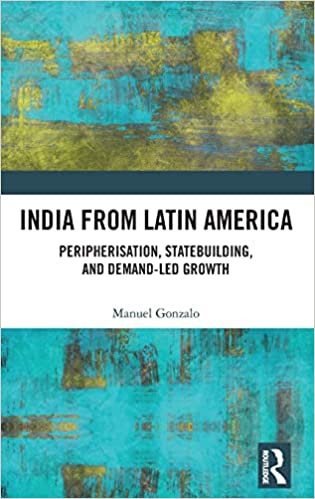
India from Latin America: Peripherisation, State Building and Demand-led growth- book by Manuel Gonzalo

Latin America and India have been emerging as significant trade, investment and political partners to each other since the beginning of the new century. The old assumption that these two are marginal to each other because of distance and other barriers is no longer valid. India exports more to the distant Guatemala than to the nearby Cambodia. Brazil takes more exports from India than Thailand or Japan. Latin America is the destination for one third of India’s global exports of vehicles. Mexico is the second largest market for India’s car exports while Colombia is the # 2 destination for motorcycle exports. India’s trade with Latin America was 45 billion dollars in 2021-22 and is poised to reach 100 billion in the next five years. India was the third largest market for Latin America’s exports in 2014 and was the seventh in 2021. A Mexican company Cinepolis is the fourth largest operator of multiplexes in India and another Mexican firm Grupo Bimbo is one of the top bread makers in India. UPL, the largest Indian agrochemical company does more business in Latin America than in India. Latin America and India have many common development challenges and aspirations. The two sides work together on many global issues of interest to each other.


But the Indians and Latin Americans have been getting information and opinion about each other through western channels such as CNN, BBC, New York Times and Financial Times as well as through books and article of western authors who give biased and condenscending picture. There is need for direct study and exchange of opinions about each other. It is in this context, I welcome the book “ India from Latin America: Peripherisation, State Building and Demand-led growth”  by Manuel Gonzalo, the Argentine author and Professor of Development Economics. Gonzalo gives a Latin American perspective of the history of India’s economic development. This is the first academic work of its kind. Gonzalo has seen India with his own eyes and read Indian books. He has direct experience of having lived in India and working with Indian scholars. He was visiting researcher at the Center for Development Studies, Jawaharlal Nehru University, Kerala. Gonzalo’s book has a Foreword from Dr. K.J. Joseph Director, Gulati Institute of Finance and Taxation and President of Globelics, Thiruvananthapuram, Kerala.

Gonzalo’s view of India is shaped largely based on the Latin American Structuralist theory of a fellow Argentine economist Raul Prebisch, who was also known for the Dependence Theory of the 1950s. Gonzalo has looked at India from three angles: Peripherisation, State Building and Demand-led growth. He has narrated the development path of India comprehensively with extensive research and detailed data. He has placed the economic development within the context of historical, political and social history as well as the foreign policy of India.

Peripherisation
Centre-Periphery divide is the essence of the Latin American Structuralist theory with focus on the consequences of the external sector constraints: the relevance of terms of trade, the structural inflation dynamic and “import” inflation and the challenge of achieving industrial competitiveness. 
India was the second-most important manufacturer with 25% share of global manufacturing and the main textile producer of the world. The British reduced India into a periphery during the colonisation. But since independence, India is moving steadily back to the centre with increasing emphasis on manufacturing. On the other hand, Latin America has been turned peripheral since its independence by a process of forced peripherisation. India’s per capita endowment of natural resources is extremely low unlike Latin America which has pursued an export-led model of growth
During colonization, the European powers had structured the global trade network determining the peripheral role of the Southern Hemisphere in line with their financial and trade needs. They inserted Latin America into their global trade network  as a  mineral exporter. These minerals went first to Europe but were then re-oriented in the form of bullion to Asia, to pay for the Chinese tea and porcelain and the Indian textiles. it was silver from the Americas that greatly contributed to the making of Asian trade. The Spanish conquest had made silver cheaper in Europe than in Asia. These events, together with the almost inexhaustible demand for silver from India, made it possible to continue the purchases of Asian goods until the mid-eighteenth century. 

State Building
The second part of the book analyses the emergence of the Indian state and the Indian National System of Innovation.  These are divided into three phases: Nehruvian phase, Indira Gandhi’s phase and the third by her son, Rajiv Gandhi.  
The author has highlighted the direct interest taken by Nehru in science and innovation. Nehru had created the Ministry of Scientific Research and Cultural Affairs in 1948 and took on the portfolio himself. The building of Science and Technology infrastructure with new universities, science agencies and national laboratories came under the control of this ministry. Nehru had used his annual full-day attendance at the Indian Science Congress every year to strengthen his association with the scientific community. Some of the main science agencies created and expanded were the Council of Scientific and Industrial Research (CSIR), with a network of 38 national laboratories in physical, biological, mechanical, and chemical sciences; the Department of Atomic Energy; the Defence Research and Development Organisation (DRDO), the Indian Space Research Organisation and the Indian Institutes of Technology (IITs). Gonzalo says, quoting some experts, that such large number of institutions for science and technology had no rival in the third world and even among several developed countries. 

Demand-led growth
The third part deals with the period since liberalization of 1991. The author has done a scholarly analysis of the different dimensions of India’s higher growth based on consumption, global capital inflows and government and private investment in infrastructure factors. He has also highlighted the revolution in the IT and Telecom sectors and their contribution the  economy. 

More India-Latin America studies
Gonzalo’s book is an eye-opener for Latin American policy makers and academics to see India based on their own experience and perspectives. It would be good if it gets translated into Spanish and Portuguese to reach out to a larger audience. I hope this book would inspire more Indian books on Latin America and vice versa. India and Latin America, faced with many common developmental problems have much to exchange experience and learn from each other. For example, India could learn from Brazil’s success with the use of sugar cane ethanol as fuel and the country’s iconic firm Embraer which has become the third largest passenger aircraft manufacturer in the world. Latin America could get inspiration from India’s space research and IT success. 

 Global South
Gonzalo hopes that his book will help not only to a better understanding of India by Latin Americans but will also contribute towards the development of a common economics development research agenda oriented to the Global South. The Ukraine crisis has highlighted the need for a louder neutral voice of the Global South in these days of repolarisation of the world by US, Europe, China and Russia. The election of Lula in Brazil and India’s G-20 presidency are timely for the Global South to advance its own agenda.

The book is available from Amazon, India.
Also from the publisher 


Wednesday, December 07, 2022

Peruvian Congress impeaches President Pedro Castillo

The Peruvian Congress has impeached President Pedro Castillo and made his vice president Dina Boluarte as the new president. Castillo had tried to dissolve the Congress in a desperate and unconstitutional bid after the Congress made a third attempt to impeach him. He declared a state of emergency and announced that he would close Congress, convene a new one with powers to write a new constitution, and reorganise the judiciary and the prosecutor’s office. But the Congress convened a quick emergency session and voted by 101 votes to six, with ten abstentions, to dismiss him. Thereafter he was arrested.  
 
This is not a surprise. The Congress, dominated by the centre-right party of Keiko Fujimori, has been threatening impeachment since the beginning of the term of President Castillo in July 2021. The Congress had earlier made two impeachment attempts but did not get enough votes. It has been relentless in obstructing the functioning of President Castillo. They vetoed even his foreign travels in recent months. 

Since Keiko Fujimori has been narrowly beaten three times in the past presidential elections, her party in the Congress keeps giving hell to the elected presidents. According to analysts, it was the anti-Keiko Fujimori sentiment which made people vote for Castillo, who was a new comer to politics. She is still identified and stigmatized with the authoritarian and abusive rule of her father Alberto Fujimori.

Castillo is a political outsider and is naïve. He was a school teacher and came from a rural poor family. He lead a teachers’ strike and that’s how he came to national attention. Castillo did not have the personal political skills nor party strength to survive the treacherous Congressional politics of Lima. 


Castillo promised to give priority to rural development and address the chronic issues of inequality and poverty in the country. But he had no clue how to go about it. He did not have competent advisors or political allies to help him implement his agenda. He changed ministers several times but it did not help.
 
The reason for Congressional impeachment was corruption charges against President Castillo besides his attempt to dissolve the Congress in an institutional way. He might have been involved in some small corruption cases but nothing serious enough to warrant an impeachment. Simply, he was not smart enough to indulge in big time corruption. In any case his alleged corruption is nothing in comparison to those of many members of the Congress. It is important to note that Keiko Fujimori herself faces corruption charges and was arrested and jailed for some time in 2018.
 
Some media commentators have accused President Castillo of having tried a coup through his attempt to dissolve the Congress. But the fact is that he was driven to the wall and had no other alternative. He would have been impeached in any case..It was just a matter of time. . President Martin Vizcarra had dissolved the Peruvian Congress on 30 September 2019, when he faced a similar situation of Congressional impeachment. The Congress retaliated by refusing to recognize the president's actions and declared Vizcarra as suspended from the presidency. It named Vice President Merceds Araoz as the interim president of Peru. But she resigned later. The Congress took its revenge on Vizcarra on 9 November 2020 by impeaching and removing him from office on the grounds of "moral incapacity". Vizcarra’s successor Manuel Merino, who was the president of the Congress and the prime mover of impeachment, lasted as President just for six days.
 
The real presidential coup was done by Keiko’s father Fujimori on 5 April 1992 when he shut down Congress, suspended the constitution and ruled as a dictator. He changed the constitution, got reelected in 1993 and continued as President till 2001 when he was forced to resign after a huge scandal. Later he was convicted for corruption and abuses of human rights and is in jail.
 
Congressional impeachment is a familiar story in some of the Latin American countries. The Paraguayan Congress had impeached the politically naïve Fernando Lugo in 2012 in a constitutional coup. Brazilian President Dilma Rousseff was yet another victim of a Congressional coup in 2016. She also paid a price for her lack of political skills. Ecuador's President Guillermo Lasso has survived an attempt by opposition lawmakers to oust him in June 2022.
 
Dina Boluarte is the sixth president of Peru in six years since 2016. But despite the political volatility, the country’s economy is relatively stable and growing with solid macroeconomic fundamentals. It is interesting to know that the chairman of the Peruvian Central Bank Julio Emilio Velarde Flores has remained in his post for the last sixteen years since 2006 despite the frequent changes of governments. 

From the country's larger perspective, the removal of President Castillo is not at all a bad development. He does not have the administrative competence or political skills to implement his political agenda for which he was elected. Nor does he have much support from the mainstream public which is disappointed with his failure to govern or deliver on his development agenda. If he had continued, his presidency would have continued to be mired in constant fight with the Congress. His administration would not have been able to achieve anything positive. So the country is better off without Castillo as President. 


Tuesday, November 01, 2022

Lula’s win is a victory for Brazil’s Democracy and good for Latin America and India

Lula’s win is a victory for Brazil’s Democracy and good for Latin America and India
 
 
By electing Luiz Inacio de Lula as President, the Brazilians have restored the country from the aberrations of the last four years. Brazil is back to civilization. Vulgar and crude words will no longer be heard in the Presidential remarks and cabinet meetings.
 
President Lula will resume his pragmatic and balanced mix of pro-poor and market-friendly policies. He will bring out many more millions of people from under the poverty line, as he did before with his signature Bolsa Familia program.  The amazon can now breathe freely. The indigenous people will feel safer. 
 
The young Brazilian democracy -restored after the end of military dictatorship in 1985- has been saved from the coup- mongering Bolsonaro who did not hide his yearning for the bad old days of brutal dictatorship. The country’s democracy has now become stronger after having successfully withstood his anti-democratic attacks. This is an inspiration for the other democracies of Latin America.


Although 49.1% of the electorate has voted for Bolsonaro it is to be noted that these are the constituents of Bible, Beef and Bullet. The evangelicals, who form about 30 percent of the population, have been indoctrinated by their partisan pastors on issues such as abortion and gender equity. The landed interests and the security forces, who have benefitted from Bolsonaro’s policies of encroaching of Amazon forest and easy access to guns, have forced lot of people under their influence to vote for their benefactor. These conservative forces will continue to be a force in Brazilian politics with or without Bolsonaro. And many from these constituencies do not like the leftist agenda as it is happening in US and Europe.
 
What about political polarization? In contrast to Bolsonaro, the army captain who was trained to fight and kill, Lula, as a trade unionist, had practiced and mastered the art of negotiation. As President, he had got many bills passed in the legislature through deal-making with the opposition. So this time too, Lula will work with the other parties and succeed in implementing his progressive policies.
 
Clearly, Brazil has got a second chance to realize its potential and reemerge as a regional and global leader. Brazil has the largest population, land area and economy in Latin America. It has world’s largest surplus land available for agriculture and is blessed with abundant fresh water reserves. It has a strong manufacturing and technological base with a sizeable young population. Despite having borders with ten countries, it does not have a single dispute. It is the only major power which has not fought a war with another country in the last 150 years. It is free from the curse of terrorism unlike most of the other major powers of the world.
 
For the first time in the history of Latin America, the seven largest economies of Latin America- Brazil, Mexico, Argentina, Colombia, Peru, Venezuela and Chile- have gone Left together. This is relief for the millions of poor who were ignored by the rightist governments of the past. Latin America, which has the highest disparity in the world, has a chance to bring down inequality.
 
With Lula’s leadership, Latin America will resume its process of regional integration which was disrupted by Bolsonaro’s divisive discourse.  The region will regain collective strength through groups such as MERCOSUR, UNASUR and CELAC which will move forward integrating their markets and facilitating more intra-regional trade and investment. Through these forums, the leaders of the region will coordinate their positions on external issues. 
 
The leftist leaders of Latin America will put up a strong united front against the traditional US hegemony. There are no more significant countries or leaders in the region who will be the proxies for Uncle Sam. Colombia and Mexico used to bat for US in the past. Latin America will voice its interests and concerns on regional and global issues assertively in the coming years. 
 
Lula’s voice will strengthen the neutral and independent position of many of the developing countries who do not want to take sides with the US and NATO which are trying to repolarize the world on the Ukraine issue. 
 
Lula’s victory is great news for India. It was President Lula  who took many initiatives seeking strategic partnership with India. He had encouraged his government officials and businessmen to visit India and explore collaboration and joint ventures. Even after leaving the presidency Lula had visited India with business delegations and promoted trade and investment. But the bilateral interaction was subdued during the term of Lula’s successors. India did not figure in the narrow worldview  of Bolsonaro. Although PM Modi had invited Bolsonaro to visit India and had interacted with him, he was uncomfortable with the isolationist approach of Bolsonaro.
 
Under Lula, the Indo-Brazil relations will get a new momentum. Business and partnership will grow more in the coming years. Brazil is India’s largest trading partner in Latin America. India’s exports in 2021-22 were 6.5 billion US Dollars and imports 5.7 bn. Indian companies have invested in Brazil in sectors such as oil fields, pharmaceuticals, chemicals, aluminum plants, autoparts and IT. Brazilian companies have also invested in India in electrical motors, autoparts and IT. 
 
President Lula shares wholeheartedly India’s vision for South-South cooperation and a multipolar world. Brazil will now restart working with India in UN, WTO and other multilateral fora. 


Friday, September 23, 2022

Ecuador restructures Chinese debt

Ecuador has reached a deal with China this week to restructure $4.4 billion of outstanding debt. The period of repayment has been extended with some discounts on the amount due.
 
The deal was reached directly with China’s policy banks, China Development Bank and the Export-Import Bank of China, which together have provided over $18 billion in loans to Ecuador since 2010.
 
The loans were used to build roads, hospitals, schools and hydroelectric projects, often by Chinese construction companies. Most of the loans were taken by the leftist president Rafael Correa during his term between 2007 and 2017. 


President Correa had refused to honour some of the debt incurred by his predecessors on the ground that they were illegitimate loans taken by corrupt politicians for non-productive purposes from greedy bankers. Calling foreign creditors "monsters, he declared a default in 2008 on his country's foreign bonds and called for a restructuring of Ecuador's foreign debt. So the international financial mafia ostracized Ecuador. Thereafter Correa had no other option but to turn to China which had seized the opportunity quickly with large loans. But the centre-right government which succeeded President Correa had accused him and his officials of violating public debt regulations by negotiating up-front payments for future oil deliveries without registering the operations as indebtedness. There are also allegations of defects  and poor quality in the hydroelectric dams built by China. The largest portion of the Chinese credit has gone into six hydroelectric projects amounting to three billion dollars.
 
Some of the debt was also tied to future oil sales. PetroEcuador, the government company has been supplying oil to China’s state-run PetroChina at a discount towards debt settlement. Last week, PetroEcuador announced a deal with China on the price formula and got extension of the remaining oil deliveries to 2027 from 2024. This allows Ecuador to sell more of its crude on the spot market.
 
Ecuador is negotiating a Free Trade Agreement (FTA) with China and aims to sign it during the China-LAC business summit in December. Ecuador’s exports to China were 3.64 billion dollars and imports 6 billion in 2021. China is the second largest trading partner of Ecuador and the #1 source of imports.
 
The centre-right but pragmatic President Guillermo Lasso is trying his best to reduce overdependence on China. He has called for transparency in the terms of Chinese contracts and projects. He has expressed interest in a FTA with US, the largest trading partner of Ecuador.  
 
Details of the Chinese loans to Ecuador are in the link…https://www.thedialogue.org/map_list/
 
Ecuador is the third largest recipient of Chinese credit to Latin America after Venezuela ($62.5 bn) and Brazil ($30.5 bn). Argentina is the fourth largest recipient with 17 billion dollars.
 
The Ecuador restructuring will be noted carefully by the other countries in Latin America which has received a total of 138 billion dollars of Chinese credit. Argentina and Venezuela will be the next candidates for restructuring. Argentina, which owes 17 billion dollars to China, will be the next country to look for restructuring. Argentina is currently struggling to repay its  bigger debt of 40 billion dollars owed to IMF. The country faces shortage of foreign exchange reserves besides high inflation and currency depreciation. Venezuela, which is in a worse economic situation than Argentina, will have a greater challenge to repay the Chinese debt.

Saturday, September 10, 2022

  
Santa Evita – Argentine TV serial
 
The new Argentine Television serial “Santa Evita” has just been made available in India by Hot Star+ Disney. It was released on 26 July which marks the seventieth anniversary of Eva Peron’s death. She is worshipped as a Santa (saint) by her followers who call her affectionately as Evita.
 
The serial narrates the bizarre story of the corpse of Evita, wife of President Peron, who died in 1952 due to cancer at the age of 33. Her body was kept waiting for three years for the construction of a monumental memorial, which was never built. In 1955, the military overthrew Peron and hid the body for nineteen years to prevent the use of her ‘martyrdom’ as a rallying cry to overthrow the military regime. 


The serial is based on a novel “Santa Evita” by an Argentine writer Tomas Eloy Martinez, published in 1995. I have read this novel as well as some other books of Martinez. He has used ¨magical realism¨ to tell the story. He weaves facts and fiction in and out and one does not know what is real and what is imagined. In any case, the way Evita´s body was dealt with by her supporters and opponents is like a mystery thriller fiction. Martinez has added more mystery by his fantastic story-telling.
 
Colonel Moori Koenig from the military intelligence service is given the responsibility to hide and make the body disappear. He moves it from one hiding place to another in Buenos Aires city. But he and his colleagues involved in this macabre venture, as well as their families meet with one disaster after another. He and his accomplices, who hated the power wielded by Evita as first lady, are hypnotized by the body and become obsessed with it. Even the embalmer Dr Ara spends a lot of time alone with the body taking care of it possessively and intimately. He makes wax replicas of the body to confuse others. The Colonel discovers the embalmer’s trick and sends the original and the copies to different places for burial to mislead the Peronists who were tracking the body.
 
Here are some real-life facts which followed Evita’s death:
 
- Her body was kept for public homage for fifteen days after her death on 26 july 1952.
- The timing of evening state news broadcast was changed from 8.30 pm to 8.25 pm, the exact time when she passed into "immortality"
-Primary school children recited prayer songs from their text books, "Evita, I promise to be as good as you wish me to be "
-The military regime, which overthrew Peron in September 1955 was afraid of the subversive influence of the body. They banned the "possession of photos of Evita or Peron or use of the expressions Peronism or Peronist" and made them a punishable offence with imprisonment. 
-They sent it secretly to be buried in a cemetery in Italy. The whereabouts of the body were written and put in sealed envelope by president Aramburu who gave it to his lawyer with instructions that it should be opened only after his death. To confuse investigators, many dummy coffins were sent to Argentine embassies in other European countries to be buried.
-Monteneros, the left wing guerillas, kidnapped Aramburu in 1970, tried to get the information on Evita's body unsuccessfully and executed him. In 1974 the same group kidnapped the cadaver of Aramburu from his family's vault and demanded the return of Evita's body as ransom. Eventually, in November 1974 the body was brought back to Argentina.
-The body found its final resting place in the Recoleta cemetry in Buenos Aires. The coffin was put behind two trap doors with the only key given to Evita's sister.
Both the novel and the serial bring out vividly the politics and culture of the Argentines. Evita's real life story was inspiration for the masses. It is the story of a girl born outside marriage from a poor village family, running away to the city and trying to earn living as an actress. Her life is transformed after her chance encounter with Peron. With her organizational, oratorical and acting skills, she mobilized the masses to support and vote for Peron as president. As the first lady, she ran a foundation to help the poor people with money, housing and healthcare. There were large crowds queuing up in front of her office daily seeking her help and intervention. She empowered the Descamisados (shirtless- meaning lumpen workers) and became a champion of the poor, women and the underprivileged. She got the right to vote for women and fought for the rights of the workers. She was the first political leader to reach out to the poor, respect them and help them. She received lepers and diseased, showed affection and kissed them without batting an eyelid. This is the  reason why the masses worship her as a Santa (saint) and she has become a political legend and icon. Peronism has taken full advantage of this legacy to get the votes of the masses in the elections in the last five decades. The legacy of Evita continues to be a vital and potent political force even today. The two-time President and current vice-president of the country Cristina Fernandez Kirchner fancies herself as the inheritor of the legacy of Evita with her pro-poor policies.
 
Evita has been the most polarizing figure of Argentina for the last seven decades. She is scorned, hated and demonized by the military and the right-wing political elements and critics who use the choicest abusive words against Evita.  The oligarchic society of the country had treated the upstart Evita with contempt and condescension. The right wing accuses the Peronists of perpetuating the vote bank of the poor with populist policies which have hindered the growth of the country. The visceral hatred of Evita is brought out in a scene in the serial in which the military officers celebrate the death of Evita with champagne and the cheering words "Long live cancer".
 
It is a pity that the serial is so short with just seven episodes. There is so  much more story and legend from the life and afterlife of Evita which could be fascinating. I wish the producers consider making more episodes to bring out the rest of the drama and impact of Evita. 
 
I am delighted to see that the Argentine serial has emerged as a Latin American project with the Uruguayan Natalia Oreiro acting as Evita, Mexican actress Salma Hayek as coproducer and the Colombian Rodrigo Garcia, the son of Gabriel Garcia Marquez, as one of the directors.