Young Indian men are excited by the ¨Intel inside¨ sign on the computers which have opened a new window of opportunity for them to connect to, compete with and conquer the world.
The Latin American young women want to excite men with ¨Implant Inside¨to connect to, compete with and conquer the silly guys.
Costa Rica caters both to the ambitions of the up and coming young Indian men and the up and booming bosoms of the Latino women.
Intel Corporation has two plants in Costa Rica and is responsible for a shift in the country's top exports, from coffee and bananas to electric and electronic products. Electronics is now Costa Rica's largest sector with Intel as the largest player. The industry employs 12,000 and exports US$1.65 billion in products a year. The local support industry for Intel alone reflects a base of 460 suppliers and US$50-150 million in local purchases of goods and services per year. The relatively small size of Costa Rica to receive an investment of the dimension of Intel's (US$300 million or equivalent to 2.1 percent of Costa Rican GDP), over two years in 1997 with a total committed investment of about US$600 million, made Bob Perlman, one of Intel's vice presidents, declare that bringing his company to Costa Rica was like "putting a whale in a swimming pool".
After the success of Intel Inside, the next slogan coming out of Costa Rica is Implant Inside. In the first six months of this year, the country exported 134 million dollars worth of silicon implants, seventy percent of which are used to enlarge women´s breasts. Allergan, the silicon implant maker in Costa Rica is the second largest exporter of the country.
According to a report in today´s Argentine newspaper Clarin, the average age of women in the country seeking breast implant is 25. The increase in imports of breast implants last year was forty percent. In a night club called as Sunset in the Olivos suburb of Buenos Aires, they have raffles to choose the winner who gets a free breast implant. Such raffles are becoming popular in other cities too. The name of the Raffle is ¨Quiero mas lolas¨which means ¨want more lolas¨. The original organizers of the event has got this title even patented. Lola was the name of a popular Argentine soap opera in which the heroine is endowed amply.
¨Sin tetas no hay paraiso¨( without tits there is no paradise ) is the title of a Colombian soap opera currently being released in Argentina. The heroine Catalina finds it necessary to increase the size of her breasts to engage the attention of the men.
There is a debate on this subject in Argentina among plastic surgeons, psychologists and social scientists. There are those who are against this practice of cheap raffles encouraging young women to go under the knife to get men under their influence. But someone took the view that this is social justice, which provide opportunities for the have-nots to ¨have more¨. Otherwise it was the haves who had the means to have more. The entry fees, the women pay in these night clubs is between 4 and 10 dollars while the cost of breast implant is between 2300 and 4000 dollars.
The craze for silicon implants is the same story across the region, although Argentina is in the vanguard of social justice for the have-nots to have-more through cheap raffles. Latin America leads the world in breast implants and cosmetic surgery. Even American and European women come to Brazil, Venezuela and Argentina for front enlargements.
So here is something common between India and Latin America... silicon.
Indian men seek faster chips to conquer the silicon valley while the Latino women ask for bigger silicones to conquer the silly men.
Silicon has helped India succeed in the back-end work outsourcing, while it has made Latin America leader in the front end operations.
Sunday, September 28, 2008


Saturday, September 20, 2008
Ciudad del Este
Ciudad del Este.. ?????......hmm ...
Most Indians have never heard of this city nor would they know where it is located.
But there are about 80 Indian families which have made this city in Paraguay as their home. Some of them are there for more than fifteen years and other have arrived in recent years.
What took them there?
Trade
Who are they?
obviously Sindhis ... Wherever there are free trade zones .. they are part of them. Panama, , Iqique, Punta Arenas, Aruba, Curacao, St Martin, Manaus...
There are some Gujratis and a few Telugu- speaking too. I attended a reception on 18 september which was organised by Prakash, who is a hard working and self effacing natural and popular leader of the community.
Indians are a tiny part of this melting pot in South America. There are people of Lebanese, Syrian, Chinese, Korean, Japanese and Brazilian origin. The heart of the city which is just four by four blocks buzzes with so many languages, colours and one cannot miss the aroma of the food from different parts of the world. Sony, JVC, Panasonic, Samsung, Nokia ... these branded names scream out from shops,boxes and billboards. Ciudad del Este is home not only to people from around the world but is also temporary home to the electronic goods ,before they are sent across to Brazil.
In the narrow dividing point between the incoming and outgoing traffic of the city, there are so many people waving you to stop. Not for parking... but with Gurani, Real, Peso, Dollar and Euro currency notes for changing.
Informal Trade is the name of the game in Ciudad del Este. The informal trade is said to be more than the official imports and exports of the country. Everything is informal in the city; trade, economy, book- keeping and transactions. The authorities have started making them more formal and proper.
There is a free flow of goods, tourists and shoppers in the city which borders Brazil and Argentina and most importantly the magnificent Iguassu Falls. Imports are mostly from China and Hongkong while the main destination of exports is Brazil. People, cars and trucks carry loads and loads of electronic and other goods from the city crossing the Friendship Bridge to Foz de Iguassu , the city on the Brazilian side.
In recent times, Brazilians are getting into Soya farming in this fertile region. Paraguay is the fourth largest exporter of soya in the world
I fell in love with the pretty, curvaceous, inviting and challenging.... golf course.. what else?
The Parana Country club surprised me with all these features. It is located on the right bank of Parana river, overlooking the city. A three wood shot will carry the ball to Brazil over the river !!
The fairways are guarded by lines of trees and the ball rolls over when it is thirsty... lot of water. Here are some pictures


There are about 800 beautiful houses ( a smaller version of Punta del Este, in Uruguay ) in the country club around the fairways of the golf course. Most of the golfers are Chinese and Koreans. I was happy to see two Indians, Vinod and Vikrant living ( and playing too!) in the golf club.
Most Indians have never heard of this city nor would they know where it is located.
But there are about 80 Indian families which have made this city in Paraguay as their home. Some of them are there for more than fifteen years and other have arrived in recent years.
What took them there?
Trade
Who are they?
obviously Sindhis ... Wherever there are free trade zones .. they are part of them. Panama, , Iqique, Punta Arenas, Aruba, Curacao, St Martin, Manaus...
There are some Gujratis and a few Telugu- speaking too. I attended a reception on 18 september which was organised by Prakash, who is a hard working and self effacing natural and popular leader of the community.
Indians are a tiny part of this melting pot in South America. There are people of Lebanese, Syrian, Chinese, Korean, Japanese and Brazilian origin. The heart of the city which is just four by four blocks buzzes with so many languages, colours and one cannot miss the aroma of the food from different parts of the world. Sony, JVC, Panasonic, Samsung, Nokia ... these branded names scream out from shops,boxes and billboards. Ciudad del Este is home not only to people from around the world but is also temporary home to the electronic goods ,before they are sent across to Brazil.
In the narrow dividing point between the incoming and outgoing traffic of the city, there are so many people waving you to stop. Not for parking... but with Gurani, Real, Peso, Dollar and Euro currency notes for changing.
Informal Trade is the name of the game in Ciudad del Este. The informal trade is said to be more than the official imports and exports of the country. Everything is informal in the city; trade, economy, book- keeping and transactions. The authorities have started making them more formal and proper.
There is a free flow of goods, tourists and shoppers in the city which borders Brazil and Argentina and most importantly the magnificent Iguassu Falls. Imports are mostly from China and Hongkong while the main destination of exports is Brazil. People, cars and trucks carry loads and loads of electronic and other goods from the city crossing the Friendship Bridge to Foz de Iguassu , the city on the Brazilian side.
In recent times, Brazilians are getting into Soya farming in this fertile region. Paraguay is the fourth largest exporter of soya in the world
I fell in love with the pretty, curvaceous, inviting and challenging.... golf course.. what else?
The Parana Country club surprised me with all these features. It is located on the right bank of Parana river, overlooking the city. A three wood shot will carry the ball to Brazil over the river !!
The fairways are guarded by lines of trees and the ball rolls over when it is thirsty... lot of water. Here are some pictures


There are about 800 beautiful houses ( a smaller version of Punta del Este, in Uruguay ) in the country club around the fairways of the golf course. Most of the golfers are Chinese and Koreans. I was happy to see two Indians, Vinod and Vikrant living ( and playing too!) in the golf club.
Within the golf club there is a boutique hotel Casa Blanca, straddling the right bank of the Parana river, with a view of the Brazil on the other side.
Sunday, September 14, 2008
Borges – a life, biography by Edwin Williamson
This is the biography of Jorge Luis Borges, the iconic writer of Argentina and one of the preeminent Latin American authors whose works have intrigued me. I had tried reading some of his fictions, essays and poems in the past but did not manage to reach the same wavelength of the author. But I found the lifestory of Borges more interesting than his fictions. I am now more fascinated with him and plan to reread his works.
Borges´s writings and life were influenced by three things; the sword , the dagger and the third one.. even more deadly.. women.
His mother Doña Leonor, a strong-willed woman had burdened him with the ¨sword of honour¨. She brainwashed him with the historic and heroic tales of the family ancestors who fought against the Argentine dictator Rosas in the beginning of the ninetieth century. He was under pressure to live upto the expectations of this noble and historical legacy or feel unworthy. His mother had interfered in his love life too. She would approve girl friends for him only those from the high society and wrecked his relationship with women from lesser class. Borges lived with his mother even untill his sixties.
The dagger was a contribution from his father, who kept advising the Bohemian, timid and shy young boy to be a ¨man¨ and take the dagger to stand upto those who challenged him. The father, who himself wanted to be a writer but never made it, also instilled this fear of failure in the son.
The women … inspired and frustrated him throughout his long life. His writings and life were influenced by the bloomings of love and the doomed affairs.. by his ¨anxiety to find love¨ and his eternal search for a Beatrice from the Divine Comedy of Dante. Nora Lange, Haydee Lange, Maria Esther Vasquez, Margot Guerrero, Ëstela Canto and finally Maria Kodama were some of the women who made his story. Norah Lange, the redhaired Scandinavian- origin beauty was the one who inspired his defining writings and tormented him the most. After initial interest in him, she chose to become the lover and later wife of Oliverio Girondo, his rival also in the literary movement of Argentina in that era. She went beyond Girondo when she published a book ¨45 days and 30 sailors¨. During the launching celebration in 1933, she was dressed like a mermaid surrounded by other writers including Girondo in sailor´s costumes. Borges, the pobrecito, never recovered from this.
Then there is Estela Cantes, who plays games with Borges. After several months of courting in the parks, streets and cinema halls, when Borges proposes timidly to her, she says ¨Jorgie, don’t forget that I am a disciple of Bernard Shaw. We cannot get married without first going to bed with each other.¨ Borges mother wrecks this relationship by banning the entry of Estela in her house.
Borges ends up with an Indian-style arranged marriage to Elsa Astete, chosen by his mother when was at the age of 68. But the marriage did not last and the couple separated in a few years.
Towards the end of his journey of frustrated love life, Maria Kodama, junior to him by several decades, fulfills his life by reciprocating love unconditionally. She rekindles love and romance and new creativity in him. She felt attracted to him when she was twelve years old as a student when he was in his fifties. While being fond of Borges, she valued her own independence and resisted being tied in marriage when Borges proposed. Eventually she relented and agreed to marry him at his ripe age of 87 and when she was 41. Maria Kodama, born to Japanese father and Argentine- German mother, gave to Borges fulfillment of love, which eluded him in his whole life.
The end of the life of Borges was like a typical Borgesian fiction. He left Buenos Aires in November 1985, somewhat secretly without telling anyone that he would never return. He settled down in Geneva and married Maria Kodama. Since Argentine law did not allow him to divorce his former wife, he got the marriage papers done in a Paraguay court. His marriage was on 26 April 1986 and he died within two months on 14 June 1986. He was buried in Geneva itself.
Borges ended his life outside Argentina, like the other Argentine iconic figures. Exile, asylum and sad ending seem to be part of the history of Argentine heroes. The liberator of Argentina and the founder and Father of nation San Martin ended his life as an exile in Europe. Che Guevara, the other icon of Argentina died in the jungles of Bolivia. Peron, who left Peronism as a heritage which continues to influence the politics of the country even now, spent two decades in exile in Europe. Even Evita´s corpse was on exile incognito in a cemetry in Milan for two decades. And Carlos Gardel, the Tango idol died away from the motherland in a plane crash in Colombia. Do I see too much of Borgesian coincidence here or am I influenced by the lyrics of Tango which are mostly about bitterness and betrayal; anguish and sadness.
Borges deserved Nobel prize but his political alignment and pronouncements came in the way. He hated Peronism, after the Peron administration humiliated him by transferring from his library assistantship to the post of Inspector of Poultry and Rabbits in the Public Markets of the Municipality. Blinded by his hatred of Peronism, he went overboard in supporting the Argentine military dictatorship which overthrew Peron and he also supported the Chilean military regime of Pinochet. This political indiscretion cost him dearly and deprived him of the Nobel prize..
Borges had a seminal influence on the up and coming Latin American writers of his era and inspired the movement of ¨Magical Realism¨which is a contribution of the region to world literature. Borges was an intellectual giant and was one of the most cosmopolitan personalities. He spoke and wrote in English fluently and had read a lot of Eurpean and American literature, although he never had any collegiate education.
Borges left behind a Borgesian genre of writing….inventive and intriguing, fabulous and fantastic, labyrinthine and puzzling, speculative and metaphysical, weird and witty… Some of his writings are like the pronouncement of wisdom by Indian sages.. never direct. The Argentine judges who denied a literary prize to him in 1941 called his work¨obscure and arbitrary cerebral game¨.
The author of the biography, Edwin Williamson (Spanish professor from Oxford) has done justice in this book( published in 2002) to the greatness of Borges with his vast knowledge of Latin American literature and his objective observations of the politics and society of Argentina during Borges´s life time.
Here is a line from Borges´s poem ¨El amenazado¨
..Being with you, or not with you, is the measure of my time..
Borges defied age and blindness. He got married for the first time at the age of 68. Later, he married Maria Kodama when he was 87. Borges became blind in his fifties and needed help for reading among other things. When he became the Director of Buenos Aires Public Library after his blindness, he wrote ¨I speak of God’s splendid irony in granting me at one time 800,000 books and darkness.” It is extraordinary that Borges not only overcame the handicap after losing his eyesight but in fact he flourished and bloomed with his writings, giving lectures, international travel and even fell in love !!
Did someone say Love is Blind….
Borges´s writings and life were influenced by three things; the sword , the dagger and the third one.. even more deadly.. women.
His mother Doña Leonor, a strong-willed woman had burdened him with the ¨sword of honour¨. She brainwashed him with the historic and heroic tales of the family ancestors who fought against the Argentine dictator Rosas in the beginning of the ninetieth century. He was under pressure to live upto the expectations of this noble and historical legacy or feel unworthy. His mother had interfered in his love life too. She would approve girl friends for him only those from the high society and wrecked his relationship with women from lesser class. Borges lived with his mother even untill his sixties.
The dagger was a contribution from his father, who kept advising the Bohemian, timid and shy young boy to be a ¨man¨ and take the dagger to stand upto those who challenged him. The father, who himself wanted to be a writer but never made it, also instilled this fear of failure in the son.
The women … inspired and frustrated him throughout his long life. His writings and life were influenced by the bloomings of love and the doomed affairs.. by his ¨anxiety to find love¨ and his eternal search for a Beatrice from the Divine Comedy of Dante. Nora Lange, Haydee Lange, Maria Esther Vasquez, Margot Guerrero, Ëstela Canto and finally Maria Kodama were some of the women who made his story. Norah Lange, the redhaired Scandinavian- origin beauty was the one who inspired his defining writings and tormented him the most. After initial interest in him, she chose to become the lover and later wife of Oliverio Girondo, his rival also in the literary movement of Argentina in that era. She went beyond Girondo when she published a book ¨45 days and 30 sailors¨. During the launching celebration in 1933, she was dressed like a mermaid surrounded by other writers including Girondo in sailor´s costumes. Borges, the pobrecito, never recovered from this.
Then there is Estela Cantes, who plays games with Borges. After several months of courting in the parks, streets and cinema halls, when Borges proposes timidly to her, she says ¨Jorgie, don’t forget that I am a disciple of Bernard Shaw. We cannot get married without first going to bed with each other.¨ Borges mother wrecks this relationship by banning the entry of Estela in her house.
Borges ends up with an Indian-style arranged marriage to Elsa Astete, chosen by his mother when was at the age of 68. But the marriage did not last and the couple separated in a few years.
Towards the end of his journey of frustrated love life, Maria Kodama, junior to him by several decades, fulfills his life by reciprocating love unconditionally. She rekindles love and romance and new creativity in him. She felt attracted to him when she was twelve years old as a student when he was in his fifties. While being fond of Borges, she valued her own independence and resisted being tied in marriage when Borges proposed. Eventually she relented and agreed to marry him at his ripe age of 87 and when she was 41. Maria Kodama, born to Japanese father and Argentine- German mother, gave to Borges fulfillment of love, which eluded him in his whole life.
The end of the life of Borges was like a typical Borgesian fiction. He left Buenos Aires in November 1985, somewhat secretly without telling anyone that he would never return. He settled down in Geneva and married Maria Kodama. Since Argentine law did not allow him to divorce his former wife, he got the marriage papers done in a Paraguay court. His marriage was on 26 April 1986 and he died within two months on 14 June 1986. He was buried in Geneva itself.
Borges ended his life outside Argentina, like the other Argentine iconic figures. Exile, asylum and sad ending seem to be part of the history of Argentine heroes. The liberator of Argentina and the founder and Father of nation San Martin ended his life as an exile in Europe. Che Guevara, the other icon of Argentina died in the jungles of Bolivia. Peron, who left Peronism as a heritage which continues to influence the politics of the country even now, spent two decades in exile in Europe. Even Evita´s corpse was on exile incognito in a cemetry in Milan for two decades. And Carlos Gardel, the Tango idol died away from the motherland in a plane crash in Colombia. Do I see too much of Borgesian coincidence here or am I influenced by the lyrics of Tango which are mostly about bitterness and betrayal; anguish and sadness.
Borges deserved Nobel prize but his political alignment and pronouncements came in the way. He hated Peronism, after the Peron administration humiliated him by transferring from his library assistantship to the post of Inspector of Poultry and Rabbits in the Public Markets of the Municipality. Blinded by his hatred of Peronism, he went overboard in supporting the Argentine military dictatorship which overthrew Peron and he also supported the Chilean military regime of Pinochet. This political indiscretion cost him dearly and deprived him of the Nobel prize..
Borges had a seminal influence on the up and coming Latin American writers of his era and inspired the movement of ¨Magical Realism¨which is a contribution of the region to world literature. Borges was an intellectual giant and was one of the most cosmopolitan personalities. He spoke and wrote in English fluently and had read a lot of Eurpean and American literature, although he never had any collegiate education.
Borges left behind a Borgesian genre of writing….inventive and intriguing, fabulous and fantastic, labyrinthine and puzzling, speculative and metaphysical, weird and witty… Some of his writings are like the pronouncement of wisdom by Indian sages.. never direct. The Argentine judges who denied a literary prize to him in 1941 called his work¨obscure and arbitrary cerebral game¨.
The author of the biography, Edwin Williamson (Spanish professor from Oxford) has done justice in this book( published in 2002) to the greatness of Borges with his vast knowledge of Latin American literature and his objective observations of the politics and society of Argentina during Borges´s life time.
Here is a line from Borges´s poem ¨El amenazado¨
..Being with you, or not with you, is the measure of my time..
Borges defied age and blindness. He got married for the first time at the age of 68. Later, he married Maria Kodama when he was 87. Borges became blind in his fifties and needed help for reading among other things. When he became the Director of Buenos Aires Public Library after his blindness, he wrote ¨I speak of God’s splendid irony in granting me at one time 800,000 books and darkness.” It is extraordinary that Borges not only overcame the handicap after losing his eyesight but in fact he flourished and bloomed with his writings, giving lectures, international travel and even fell in love !!
Did someone say Love is Blind….
Saturday, August 30, 2008
Report on Latin American economic situation
The economic survey of 28 August 2008 issued by the Economic Commission for Latin America and Caribbean ( ECLAC) is positive and optimistic about the prospects of the region. Highlights as follows
- the growth of the region in 2008 is estimated to be 4.7 %, making this year as the sixth consecutive year of growth, a record in the last forty years. Although the growth has come down from 5.7 % in 2007 and is expected to decline to 4% in 2009, the growth figures are good considering the current global scenario of slower world growth and increased volatility and incertainty in the financial markets.
- Brazil´s growth in 2008 is projected as 4.8% in 2008 and 4% in 2009; Mexico´s growth 2.5 % in 2008 and in 2009; Argentina´s 7% in 2008 and 5% in 2009; Colombia´s 5.3% in 2008 and 4.5% in 2009. Peru will have the highest growth in the region with 8.3% in 2008 and 7% in 2009.
- For the fifth consecutive year, the region showed current account surplus which stood at 0.5% of GDP in 2007.
- One of the outstanding points of the region´s macroeconomic performance in 2007 was strong growth in investment, which stood at 21.1% of the GDP.
- External debt dropped to 19.9% of GDP in 2007 from 21.8% in 2006. The total external debt of the region was 720 billion dollars in December 207. The governments have paid off their debt and restructured and improved the terms of their debt with better rates and currency composition.
- Average inflation increased to 8.4% in 2008 from 6.4% in 2007.
- The region has developed greater capacity to withstand external shocks due to its strong macroeconomic fundamentals, fiscal solvency and external surplus.
- Foreign exchange reserves increased by 43% to 460 billion dollars in December 2007.
- Foreign Direct Investment increased by 46% in 2007 reaching a record 106 billion dollars.
- Unemployment has been steadily decreasing since 2003 reaching 8% in 2007 and is expected to go down to 7.5% in 2008.
- the growth of the region in 2008 is estimated to be 4.7 %, making this year as the sixth consecutive year of growth, a record in the last forty years. Although the growth has come down from 5.7 % in 2007 and is expected to decline to 4% in 2009, the growth figures are good considering the current global scenario of slower world growth and increased volatility and incertainty in the financial markets.
- Brazil´s growth in 2008 is projected as 4.8% in 2008 and 4% in 2009; Mexico´s growth 2.5 % in 2008 and in 2009; Argentina´s 7% in 2008 and 5% in 2009; Colombia´s 5.3% in 2008 and 4.5% in 2009. Peru will have the highest growth in the region with 8.3% in 2008 and 7% in 2009.
- For the fifth consecutive year, the region showed current account surplus which stood at 0.5% of GDP in 2007.
- One of the outstanding points of the region´s macroeconomic performance in 2007 was strong growth in investment, which stood at 21.1% of the GDP.
- External debt dropped to 19.9% of GDP in 2007 from 21.8% in 2006. The total external debt of the region was 720 billion dollars in December 207. The governments have paid off their debt and restructured and improved the terms of their debt with better rates and currency composition.
- Average inflation increased to 8.4% in 2008 from 6.4% in 2007.
- The region has developed greater capacity to withstand external shocks due to its strong macroeconomic fundamentals, fiscal solvency and external surplus.
- Foreign exchange reserves increased by 43% to 460 billion dollars in December 2007.
- Foreign Direct Investment increased by 46% in 2007 reaching a record 106 billion dollars.
- Unemployment has been steadily decreasing since 2003 reaching 8% in 2007 and is expected to go down to 7.5% in 2008.
Monday, August 18, 2008
Santa Evita - Argentine novel by Tomas Eloy Martinez
This is the story of Eva Peron after her death. Yes, it is about the life-story of her corpse. The embalmed body of Evita had an eventful journey for 22 years as she had in her real life journey of 33 years. She was a political figure for six years as the wife of Peron but her corpse had influenced Argentine politics for over two decades and created a bizarre history, becoming part of the Argentine mythology. Evita died in 1952 but her body was kept waiting for three years for the construction of a monument, which was never built. In 1955 the military overthrew Peron and hid the body for ninteen years. It was brought back from a cemetry in Milan for proper burial in Recoleta cemetry in Buenos Aires in 1974.
The military dictatorship tried to hide the embalmed body to prevent it from becoming a rallying point against the regime. Col Moori Koenig from the military intelligence service is given the responsibility. He moves it from one hiding place to another in Buenos Aires city. But he and his colleagues involved in this venture, as well as their families meet with one disaster after another. He, as well his accomplices, who hated Evita when she was with Peron , are hipnotised by the body and become obsessed with it. They get emotionally attached to the corpse and reach a stage when they cannot live without the body.
The Spanish embalmer Dr Ara, who is contracted to embalm the body of Evita is also obesessed with the body in another sense. He considers the embalmed corpse as his master piece of art and is more possessive of it than the family of Evita. He makes some extra copies of the wax body to mislead others. This was the first challenge for col Koenig to identify the correct one.
The miltary dictatorship forbade any public reference to Peron or Evita. How did they call Evita´s corpse and refer to her in their internal conversations and correspondence.. mare, the person, deceased, that woman...
At the same time, fanatic supporters of Evita, calling themselves as the Commando of Vengence, manage to track down the hiding points and put flowers and candles next to the coffin, despite the extraordinary security cordon.
Finally the body is sent out of the country to a cemetry in Milan, while copies of the body are sent to other European cities to mislead those trying to track it.
The author Tomas Eloy Martinez has used ¨magical realism¨to tell the story. He weaves facts and fiction in and out and one does not know what is real and what is imagined. In any case, the way Evita´s body was dealt with by her supporters and opponents is like a mystery thriller fiction. Martinez has added more mystery by his story-telling. Sometimes it reads like the compilation of his own real efforts to uncover the secrets of disappearance of the body. Besides the corpse story, the author has also brought out excerpts from the life of Evita based on interviews with her butler, hair dresser and others associated with her closely. But one is not sure whether these were factual or fictional.
The author, like many other Argentine and Latin American writers, was forced to exile in 1975. He lives in USA.
Does the story of the afterlife of Evita sound like the incarnation belief in India ? Sure.. there is as much mystery and magic in this real life story as in the Indian mythologies. No wonder there are thousands of Argentines who are followers of Indian Gurus and spiritualism. I do not get surprised when some of them tell me seriously that perhaps their last incarnation was in India !
Tomas Eloy Martinez has revived my interest in Argentine literature. My experience with the other Argentine authors is mixed. Or to put it more candidly, I got confused after reading some of the works of Borges, Julio Cortazar and Luisa Valenzuela and could not finish some of them.
Now, for the real story of Evita´s corpse, the readers can see my 2006 blog entry,
http://latinamericanaffairs.blogspot.com/2006/05/evita.html#links
The military dictatorship tried to hide the embalmed body to prevent it from becoming a rallying point against the regime. Col Moori Koenig from the military intelligence service is given the responsibility. He moves it from one hiding place to another in Buenos Aires city. But he and his colleagues involved in this venture, as well as their families meet with one disaster after another. He, as well his accomplices, who hated Evita when she was with Peron , are hipnotised by the body and become obsessed with it. They get emotionally attached to the corpse and reach a stage when they cannot live without the body.
The Spanish embalmer Dr Ara, who is contracted to embalm the body of Evita is also obesessed with the body in another sense. He considers the embalmed corpse as his master piece of art and is more possessive of it than the family of Evita. He makes some extra copies of the wax body to mislead others. This was the first challenge for col Koenig to identify the correct one.
The miltary dictatorship forbade any public reference to Peron or Evita. How did they call Evita´s corpse and refer to her in their internal conversations and correspondence.. mare, the person, deceased, that woman...
At the same time, fanatic supporters of Evita, calling themselves as the Commando of Vengence, manage to track down the hiding points and put flowers and candles next to the coffin, despite the extraordinary security cordon.
Finally the body is sent out of the country to a cemetry in Milan, while copies of the body are sent to other European cities to mislead those trying to track it.
The author Tomas Eloy Martinez has used ¨magical realism¨to tell the story. He weaves facts and fiction in and out and one does not know what is real and what is imagined. In any case, the way Evita´s body was dealt with by her supporters and opponents is like a mystery thriller fiction. Martinez has added more mystery by his story-telling. Sometimes it reads like the compilation of his own real efforts to uncover the secrets of disappearance of the body. Besides the corpse story, the author has also brought out excerpts from the life of Evita based on interviews with her butler, hair dresser and others associated with her closely. But one is not sure whether these were factual or fictional.
The author, like many other Argentine and Latin American writers, was forced to exile in 1975. He lives in USA.
Does the story of the afterlife of Evita sound like the incarnation belief in India ? Sure.. there is as much mystery and magic in this real life story as in the Indian mythologies. No wonder there are thousands of Argentines who are followers of Indian Gurus and spiritualism. I do not get surprised when some of them tell me seriously that perhaps their last incarnation was in India !
Tomas Eloy Martinez has revived my interest in Argentine literature. My experience with the other Argentine authors is mixed. Or to put it more candidly, I got confused after reading some of the works of Borges, Julio Cortazar and Luisa Valenzuela and could not finish some of them.
Now, for the real story of Evita´s corpse, the readers can see my 2006 blog entry,
http://latinamericanaffairs.blogspot.com/2006/05/evita.html#links
Saturday, August 16, 2008
un novio para mi mujer - Argentine film
I saw today the film ¨Un novio para mi mujer ¨- a boyfriend for my wife, which was released on 14 august.
This is the story of the misery of the married life of a young couple in their thirties. El Tenso, the man is trying to cope with his wife La Tana who cannot stop talking, complaining and grumbling. She finds fault with the newspaper headlines, government, weather, friends of Tenso, party life and everything in general. She rains down the choicest abusive words to criticise and make cynical comments. El Tenso pays a radio station to hire her for the talk show. Her non-stop critical comments on everything and everybody becomes a hit.
Tenso wants separation but does not have the courage to tell her. He hires a man El Cuervo Flores to seduce her and make it as an excuse for seeking divorce. It works. She falls for the charm of the seducer and enjoys his company. She changes her attitude and starts to appreciate the good things of life. While Tenso is happy with the changes in Tana, he becomes jealous and asks Flores to stop the seduction. Tana becomes depressed and Tenso confesses to her that he was the one who hired Flores. She explodes and seeks separation. Both go to the shrink and fight there also. They go to the court for divorce. When the court delays their case for an hour, they go to a cafe separately. There they rediscover each other and reunite.
Valeria Bertuccelli has brilliantly acted as Tana while Adrián Suar has also fit in well as Tenso. The movie was directed by Juan Taratuto. This is the third film of this young director who started his directorial career in 2004.
The dialogue between the husband and wife, or more precisely the monologue of the wife has been animated with lot of humour. These hilarious dialogues are the best part of the film. A delightful romantic comedy ..with a typical Argentine psychiatric touch....
This is the story of the misery of the married life of a young couple in their thirties. El Tenso, the man is trying to cope with his wife La Tana who cannot stop talking, complaining and grumbling. She finds fault with the newspaper headlines, government, weather, friends of Tenso, party life and everything in general. She rains down the choicest abusive words to criticise and make cynical comments. El Tenso pays a radio station to hire her for the talk show. Her non-stop critical comments on everything and everybody becomes a hit.
Tenso wants separation but does not have the courage to tell her. He hires a man El Cuervo Flores to seduce her and make it as an excuse for seeking divorce. It works. She falls for the charm of the seducer and enjoys his company. She changes her attitude and starts to appreciate the good things of life. While Tenso is happy with the changes in Tana, he becomes jealous and asks Flores to stop the seduction. Tana becomes depressed and Tenso confesses to her that he was the one who hired Flores. She explodes and seeks separation. Both go to the shrink and fight there also. They go to the court for divorce. When the court delays their case for an hour, they go to a cafe separately. There they rediscover each other and reunite.
Valeria Bertuccelli has brilliantly acted as Tana while Adrián Suar has also fit in well as Tenso. The movie was directed by Juan Taratuto. This is the third film of this young director who started his directorial career in 2004.
The dialogue between the husband and wife, or more precisely the monologue of the wife has been animated with lot of humour. These hilarious dialogues are the best part of the film. A delightful romantic comedy ..with a typical Argentine psychiatric touch....
The Sandal Revolution of Paraguay
Fernando Lugo wore sandals and a simple white shirt and trouser for the ceremony of his inaguration as President of Paraguay on 15 August, which I attended. Somebody called it as Revolucion Sandalia- Sandal Revolution !
Lugo said he would forego the presidential salary of 40,000 dollars per year. He would continue to live in his own modest house during his presidential tenure. His sister will be the official hostess in his household.
Lugo, popularly called as the Bishop of the Poor, had worked as priest in the poor parts of Paraguay and Ecuador. After initial hesitation, Vatican let him leave the church to pursue his political career in 2007. Many priests in Latin America had embraced Liberation Theology and had fought on the side of the poor against repressive regimes and sacrified their lives in some cases. Lugo is the first priest to get a chance as president to practise Liberation Theology.
Lugo has created history in Paraguay by singlehandedly defeating the Colorado party which had ruled the country for the last sixty years ! He entered politics only in 2006 and got himself supported by a coalition of leftist and liberal parties. Pitted against almost impossible barriers, he got elected with an overwhelming majority.
In his emotional inagural address, he outlined his Agenda for Change. He promised to change not only the politics of the country but also the culture of the society. Change is not going to be easy...but it is not impossible, he said. This was reflected in the song of the Sembrador group, which followed the oath-taking ceremony. Here is part of the lyric..
la lluvia y el viento
me llaman amigo
la noche y la luna
me quiren besar
Despiertate hermano
ya llega la aurora
(the rain and the wind
call me as friend
the night and the moon
want to kiss me
wake up my brother
the dawn has come)
Poverty alleviation, land reforms, education and health would be his priorities. He made part of his speech in Guarani, the native tongue of the indigenous people and paid tribute to them. Paraguay is the only Latin American country where the indigenous language is spoken by the settlers and the whole population.
While the world media is obsessed with labelling him and making comparisons with others, Lugo said he will go his own pragmatic way. He has no revolution to export nor agenda to change the world. He has a limited domestic agenda to change the lives of the poor and the excluded. This is obvious from the fact that he did not make any reference to foreign policy or regional affairs in his hour-long speech.
It is not only the politics of Latin America which is changing.. the Presidential attire too is undergoing a revolution. While Lugo is on the top of this change with his sandals and whiteshirt, suits and tie have been discarded by the presidents of Bolivia and Ecuador. Both were wearing colourful traditional shirts without tie. While Correa had put on a jacket over his shirt, Evo Morales had his trade-mark casual jacket on.
During my call on Lugo on 17 July, I gifted to him Mahatma Gandhi´s autobiography in spanish. And Gandhi too wore sandals....Gandhi went further by foregoing even the shirt...and achieving independance for India. Lugo´s assumption of power on 15 August coincides with the Independence Day of India on the same day.
Lugo said he would forego the presidential salary of 40,000 dollars per year. He would continue to live in his own modest house during his presidential tenure. His sister will be the official hostess in his household.
Lugo, popularly called as the Bishop of the Poor, had worked as priest in the poor parts of Paraguay and Ecuador. After initial hesitation, Vatican let him leave the church to pursue his political career in 2007. Many priests in Latin America had embraced Liberation Theology and had fought on the side of the poor against repressive regimes and sacrified their lives in some cases. Lugo is the first priest to get a chance as president to practise Liberation Theology.
Lugo has created history in Paraguay by singlehandedly defeating the Colorado party which had ruled the country for the last sixty years ! He entered politics only in 2006 and got himself supported by a coalition of leftist and liberal parties. Pitted against almost impossible barriers, he got elected with an overwhelming majority.
In his emotional inagural address, he outlined his Agenda for Change. He promised to change not only the politics of the country but also the culture of the society. Change is not going to be easy...but it is not impossible, he said. This was reflected in the song of the Sembrador group, which followed the oath-taking ceremony. Here is part of the lyric..
la lluvia y el viento
me llaman amigo
la noche y la luna
me quiren besar
Despiertate hermano
ya llega la aurora
(the rain and the wind
call me as friend
the night and the moon
want to kiss me
wake up my brother
the dawn has come)
Poverty alleviation, land reforms, education and health would be his priorities. He made part of his speech in Guarani, the native tongue of the indigenous people and paid tribute to them. Paraguay is the only Latin American country where the indigenous language is spoken by the settlers and the whole population.
While the world media is obsessed with labelling him and making comparisons with others, Lugo said he will go his own pragmatic way. He has no revolution to export nor agenda to change the world. He has a limited domestic agenda to change the lives of the poor and the excluded. This is obvious from the fact that he did not make any reference to foreign policy or regional affairs in his hour-long speech.
It is not only the politics of Latin America which is changing.. the Presidential attire too is undergoing a revolution. While Lugo is on the top of this change with his sandals and whiteshirt, suits and tie have been discarded by the presidents of Bolivia and Ecuador. Both were wearing colourful traditional shirts without tie. While Correa had put on a jacket over his shirt, Evo Morales had his trade-mark casual jacket on.
During my call on Lugo on 17 July, I gifted to him Mahatma Gandhi´s autobiography in spanish. And Gandhi too wore sandals....Gandhi went further by foregoing even the shirt...and achieving independance for India. Lugo´s assumption of power on 15 August coincides with the Independence Day of India on the same day.
Wednesday, August 13, 2008
skiing in Bariloche
I skiied in Bariloche last weekend. The Catedral mountain ski resort of Bariloche is a different experience from Las Lenas, where i had gone last month.


Here in Bariloche, the scenery is breath-taking. The Nahuel Huappi Lake contrasts the shining white snow of the slopes with its distant,and deep, mystical and magical blue waters. The bushes and trees onthe slopes catch the fresh snow and offers you like flowers, as seen from the picture below...

Some of the slopes are somewhat narrow but are thrilling as one goes gliding on the shoulders of the mountain with snow-clad bushes and trees on both sides as in the picture below..

The other difference is that Bariloche is for families and even non-skiers. Those who do not ski can go up in the chairlifts to the top of the slopes, enjoy the view, walk and play around in the snow, have lunch in the restaurants on top and watch their friends and families skiing down.

The last difference is that the ski resort is part of the charming city of Bariloche, which has many attractions. There is plenty to see, feel and experience.

The last difference is that the ski resort is part of the charming city of Bariloche, which has many attractions. There is plenty to see, feel and experience.
Hmm.. one can also here a lot of the Brazilian expressions.. cafezinho, amorzinho ..There are hordes of brazilians descending on the slopes here. It is, of course, a different experience to see the Brazilian garotas fully clothed.. unlike in Copacabana.
We went for dinner to a resturant called as Naan- which means Indian bread. When we reached there, the door was opened by the 5 year- old Uma, the daughter of the owner Erika, who makes the guests feel homely with her cooking and serving. They play Indian fusion music in the restaurant. Oops.. there is no indian food there.. just the names ...

Sunday, August 03, 2008
Olga - Brazilian film
I saw this 2004 release yesterday. This film is based on the real-life story of Olga Benário, a German whose destiny is linked to Brazil.
Olga, born in a bourgeois German Jewish family becomes a revolutionary and goes to Soviet Union, where she is given army training. In 1935, she is assigned to protect the Brazilian communist leader Luis Carlos Prestes, who is returning to Brazil to raise a revolutionary movement against the dictator Getúlio Vargas. They travel to Brazil, pretending to be a married couple but during the long journey fall in love with each other. The Communist upraising fails and both are arrested and put in jail. As an act of personal vengeance against Prestes, Vargas deports Olga, seven months pregnant, to Nazi Germany, as a gift to Hitler. The Nazis put her in a Gestapo women's prison, where she gives birth to Anita, who is given back to the mother of Prestes. Later, Benario is taken to a Nazi concentration camp where she is killed in a gas chamber in 1942.
The movie is about politics, war, persecution and revolutionary spirit. It gives a glimpse of the communist movement and its repression by the military dictatorship in Brazil. The Nazi atrocities are portrayed graphically.
The movie is also about love which blossoms between the ideologically strong and disciplined Olga and the idealistic but sensitive and fragile Prestes, who knits a dress for Olga.
Camila Morgado has excelled in her role as Olga while Caco Ciocler has tried to be like Prestes.
Although one does not see much of Brazil in the film, it is one of the best to come out of the Brazilian cinema, which produces occasional hits. Jayme Monjardim, the director has done a good job although the critics have not been very generous to him on this film.
Olga, born in a bourgeois German Jewish family becomes a revolutionary and goes to Soviet Union, where she is given army training. In 1935, she is assigned to protect the Brazilian communist leader Luis Carlos Prestes, who is returning to Brazil to raise a revolutionary movement against the dictator Getúlio Vargas. They travel to Brazil, pretending to be a married couple but during the long journey fall in love with each other. The Communist upraising fails and both are arrested and put in jail. As an act of personal vengeance against Prestes, Vargas deports Olga, seven months pregnant, to Nazi Germany, as a gift to Hitler. The Nazis put her in a Gestapo women's prison, where she gives birth to Anita, who is given back to the mother of Prestes. Later, Benario is taken to a Nazi concentration camp where she is killed in a gas chamber in 1942.
The movie is about politics, war, persecution and revolutionary spirit. It gives a glimpse of the communist movement and its repression by the military dictatorship in Brazil. The Nazi atrocities are portrayed graphically.
The movie is also about love which blossoms between the ideologically strong and disciplined Olga and the idealistic but sensitive and fragile Prestes, who knits a dress for Olga.
Camila Morgado has excelled in her role as Olga while Caco Ciocler has tried to be like Prestes.
Although one does not see much of Brazil in the film, it is one of the best to come out of the Brazilian cinema, which produces occasional hits. Jayme Monjardim, the director has done a good job although the critics have not been very generous to him on this film.
Monday, June 16, 2008
The Honorary Consul- novel by Graham Greene
The reason why Graham Greene is coming into this blog, rather than in my other blog " Floating Weed" is because this novel, "Honorary Consul" is about Latin America. I reread this novel with greater interest and curiosity last week since the location of the story is Argentina and Paraguay. I wanted to experience these countries through the eyes, ears and senses of Graham Greene, who has also spent time here.
The main character is Charley Fortnum the honorary consul of Britain in Paraguay. Although he is of British origin, his character has been tropicalised as a Latino. He imports cars dutyfree every two years and sells in the local market, although he is not entitled as a honorary consul. He is a bachelor in his sixties and floats on scotch whisky to get over his loneliness. One day the sixty year- old Charley falls in love with a twenty one year- old Clara, the girl from the puteria of senora sanchez. After this, his main obsession is to keep her happy and is thrilled when she becomes pregnant. Clara, while enjoying the unexpected affection of Charley, has an affair with her husband´s friend Doctor Eduardo Plarr,also of English origin. Eduardo´s father, a revolutionary, is jailed by the Paraguayan dictator and is killed while trying to escape from the prison.
Eduardo helps the guerillas to kidnap the American ambassador to Argentina while visiting Paraguay. But the amateurish guerillas bungle it and kidnap Charley by mistake. The guerillas do not want to give up even after discovering their mistake. They ask for the release of political prisoners in exchange for freeing Charley. But the British govenrment does not care for the life of an alcoholic and unscrupulous honorary consul. The revolutionary guerillas prefer to die rather than surrender. The Paraguayan police discover the hiding place of the kidnappers and kill them including Eduardo and free Charley.
The novel has got everything of the south america of the sixties and seventies; repressive military dictatorship, corrupt and decadent governments, guerilla war by revolutionaries of the Cuban vintage, role of United States in those days in the region, the vestiges of British presence in the region, catholic bishops turning into leftist radicals, poets living out lives of magical realism and the puterias, the refuge of the machos and poets.
The novel gives a glimpse of the conditions of the society caught between the traumas of the violent conflict between the dictatorship and leftists. Greene has captured the Porteno spirit of the elegant city of Buenos Aires, gossips and leisurely conversations in its cafes and shopping in Florida street. Eduardo´s mother tries to sink the depression caused by the disappearance of her husband by consuming packs and packs of Alfajores, the typical Argentine chocolate candies in Cafe Richmond in Florida street.
The kidnapping takes place in the Corrientes province of Argentina bordering paraguay, separated by Parana river. Greene has portrayed the situation in Paraguay, one of the most backward countries of south america, which has started changing only now. The story of the catholic priest Father Rivas, a product of "liberation theology" who leaves the church to become a revolutionary, has come true now. The catholic priest- turned leftist political leader Father Fernando Lugo has just been elected to become the President of Paraguay in August 2008. Lugo wears only sandals and leads an austere life, as part of his solidarity with the poor.
Greene has vividly brought out the Latino characteristics of Clara, the doctor and the honorary consul, with their ambiguous and tentative approach to relationships. Clara is a typical young and naive puta who adjusts herself smoothly and professionally to please her clients with absolute emotional detachment. The novelist Saavedra leads a bohemian life in a latino setting along with the revolutionary poet Aquino. With all these typical latino characters, Greene has been able to caputre the latino spirit and their way of interpretation of love and lust, hope and betrayal, illusions and dreams, in those times of dictatorship and ideologies. Greene has explored the theme of love through the characters of his novel. Dr Plarr thinks cynically that love is nothing but a bargain used by those offering love to demand reciprocal afection or obligation. For Charley, love blossoms when he meets Clara and wants to give so much without expecting any return. Father Rivas´s indian wife sees love as devotion to him despite his ambiguous approach to her.
Graham Greene had lived in Buenos Aires for sometime and that is how he had absorbed the comedies and tragedies of the Argentine society. He had stayed at Lancaster hotel in Cordoba avenue.
Greene has dedicated this novel to Victoria Ocampo and in memory of the many happy weeks he had passed at San Isidro and Mar del Plata. Victoria had hosted Rabindranath Tagore for two months in her houses in the same two cities.
The main character is Charley Fortnum the honorary consul of Britain in Paraguay. Although he is of British origin, his character has been tropicalised as a Latino. He imports cars dutyfree every two years and sells in the local market, although he is not entitled as a honorary consul. He is a bachelor in his sixties and floats on scotch whisky to get over his loneliness. One day the sixty year- old Charley falls in love with a twenty one year- old Clara, the girl from the puteria of senora sanchez. After this, his main obsession is to keep her happy and is thrilled when she becomes pregnant. Clara, while enjoying the unexpected affection of Charley, has an affair with her husband´s friend Doctor Eduardo Plarr,also of English origin. Eduardo´s father, a revolutionary, is jailed by the Paraguayan dictator and is killed while trying to escape from the prison.
Eduardo helps the guerillas to kidnap the American ambassador to Argentina while visiting Paraguay. But the amateurish guerillas bungle it and kidnap Charley by mistake. The guerillas do not want to give up even after discovering their mistake. They ask for the release of political prisoners in exchange for freeing Charley. But the British govenrment does not care for the life of an alcoholic and unscrupulous honorary consul. The revolutionary guerillas prefer to die rather than surrender. The Paraguayan police discover the hiding place of the kidnappers and kill them including Eduardo and free Charley.
The novel has got everything of the south america of the sixties and seventies; repressive military dictatorship, corrupt and decadent governments, guerilla war by revolutionaries of the Cuban vintage, role of United States in those days in the region, the vestiges of British presence in the region, catholic bishops turning into leftist radicals, poets living out lives of magical realism and the puterias, the refuge of the machos and poets.
The novel gives a glimpse of the conditions of the society caught between the traumas of the violent conflict between the dictatorship and leftists. Greene has captured the Porteno spirit of the elegant city of Buenos Aires, gossips and leisurely conversations in its cafes and shopping in Florida street. Eduardo´s mother tries to sink the depression caused by the disappearance of her husband by consuming packs and packs of Alfajores, the typical Argentine chocolate candies in Cafe Richmond in Florida street.
The kidnapping takes place in the Corrientes province of Argentina bordering paraguay, separated by Parana river. Greene has portrayed the situation in Paraguay, one of the most backward countries of south america, which has started changing only now. The story of the catholic priest Father Rivas, a product of "liberation theology" who leaves the church to become a revolutionary, has come true now. The catholic priest- turned leftist political leader Father Fernando Lugo has just been elected to become the President of Paraguay in August 2008. Lugo wears only sandals and leads an austere life, as part of his solidarity with the poor.
Greene has vividly brought out the Latino characteristics of Clara, the doctor and the honorary consul, with their ambiguous and tentative approach to relationships. Clara is a typical young and naive puta who adjusts herself smoothly and professionally to please her clients with absolute emotional detachment. The novelist Saavedra leads a bohemian life in a latino setting along with the revolutionary poet Aquino. With all these typical latino characters, Greene has been able to caputre the latino spirit and their way of interpretation of love and lust, hope and betrayal, illusions and dreams, in those times of dictatorship and ideologies. Greene has explored the theme of love through the characters of his novel. Dr Plarr thinks cynically that love is nothing but a bargain used by those offering love to demand reciprocal afection or obligation. For Charley, love blossoms when he meets Clara and wants to give so much without expecting any return. Father Rivas´s indian wife sees love as devotion to him despite his ambiguous approach to her.
Graham Greene had lived in Buenos Aires for sometime and that is how he had absorbed the comedies and tragedies of the Argentine society. He had stayed at Lancaster hotel in Cordoba avenue.
Greene has dedicated this novel to Victoria Ocampo and in memory of the many happy weeks he had passed at San Isidro and Mar del Plata. Victoria had hosted Rabindranath Tagore for two months in her houses in the same two cities.
Saturday, May 31, 2008
La historia oficial - Argentine film
This is the first and only Argentine film which has won an Oscar award . It won in the foreign language category in 1986. I had been looking for this and finally got to see yesterday.
Alicia, a high school history teacher is happily married to a successful lawyer Roberto and they have an adopted daughter, the five year old Gaby. Her contented and innocent life takes a turn when one of her students asks if she believed in what the history books say. This wake up call is followed by the revelations of her childhood friend Ana ,who returns from exile. Ana recounts how she was detained and tortured on the suspicion that her husband was a subversive. She tells the horror stories of atrocities and disappearance of people and the handing over of children of disappeared parents to families related to the military junta. This makes Alicia to question and find out how Gaby came to be adopted by her husband. Her husband is evasive and denies any wrongdoing. But Alicia is determined to find out the truth and embarks on a mission to find out if Gaby is the daughter of a disappeared mother. She goes to search hospital records and finally gets to meet Gaby´s grand mother whose daughter had disappeared during the repression of the dictatorship.
The director of the film, Luis Puenzo, has vividly brought out the trauma suffered by Argentine society during the the years of dirty war waged by the military against leftists and their sympathisers. Rather than dramatising the crimes of the dictatorship, the director has used a middle class family to tell the sufferings subtly but poignantly.
The mothers whose children had " disappeared" continue even now their mourning and walking around the Plaza of May in Buenos Aires. They are known as the Mothers of Plaza of May.
Norma Aleandro ( Alicia) and Hector Alterio ( Roberto) and the other actors have portrayed their role realistically . The actress Norma Aleandro herself had gone into exile in Uruguay and Spain and returend to Argentina only after the restoration of democracy.
The movie was started in 1983, after the fall of the military dictatorship but had to be suspended and resumed secretly after the director and actors received threats from the military officers.
Argentina has still not got over the nightmare of the suffering under the military dictatorship. Military officers involved in killings are even now brought to justice and the scars have not healed yet. This is a reminder of the historical stain in the otherwise sofisicated, refined and cultured society of Argentina.
This film certainly merited an Oscar and the other awards it won.
Alicia, a high school history teacher is happily married to a successful lawyer Roberto and they have an adopted daughter, the five year old Gaby. Her contented and innocent life takes a turn when one of her students asks if she believed in what the history books say. This wake up call is followed by the revelations of her childhood friend Ana ,who returns from exile. Ana recounts how she was detained and tortured on the suspicion that her husband was a subversive. She tells the horror stories of atrocities and disappearance of people and the handing over of children of disappeared parents to families related to the military junta. This makes Alicia to question and find out how Gaby came to be adopted by her husband. Her husband is evasive and denies any wrongdoing. But Alicia is determined to find out the truth and embarks on a mission to find out if Gaby is the daughter of a disappeared mother. She goes to search hospital records and finally gets to meet Gaby´s grand mother whose daughter had disappeared during the repression of the dictatorship.
The director of the film, Luis Puenzo, has vividly brought out the trauma suffered by Argentine society during the the years of dirty war waged by the military against leftists and their sympathisers. Rather than dramatising the crimes of the dictatorship, the director has used a middle class family to tell the sufferings subtly but poignantly.
The mothers whose children had " disappeared" continue even now their mourning and walking around the Plaza of May in Buenos Aires. They are known as the Mothers of Plaza of May.
Norma Aleandro ( Alicia) and Hector Alterio ( Roberto) and the other actors have portrayed their role realistically . The actress Norma Aleandro herself had gone into exile in Uruguay and Spain and returend to Argentina only after the restoration of democracy.
The movie was started in 1983, after the fall of the military dictatorship but had to be suspended and resumed secretly after the director and actors received threats from the military officers.
Argentina has still not got over the nightmare of the suffering under the military dictatorship. Military officers involved in killings are even now brought to justice and the scars have not healed yet. This is a reminder of the historical stain in the otherwise sofisicated, refined and cultured society of Argentina.
This film certainly merited an Oscar and the other awards it won.
Friday, May 23, 2008
U.S.-Latin America Relations - A New Direction for a New Reality
U.S.-Latin America Relations - A New Direction for a New Reality
This is the title of a report published in May 2008 by the Council on Foreign Relations. The task force which brought out the report includes among others Charlene Barshefsky former USTR.
Here are some highlights of the report:
-For over 150 years, the Monroe Doctrine provided the guiding principles for U.S. policy toward Latin America, asserting U.S. primacy in the foreign affairs of the region. Over the past two decades, those principles have become increasingly obsolete. Washington’s basic policy framework, however, has not changed sufficiently to reflect the new reality. U.S. policy can no longer be based on the assumption that the United States is the most important outside actor in Latin America. If there was an era of U.S. hegemony in Latin America, it is over.
-the era of the United States as the dominant influence in Latin America is over. Countries in the region have not only grown stronger but have expanded relations with others, including China and India.
-Latin America hasbenefited greatly in recent years from democratic opening, stable economic policies, and increasing growth. Many countries are taking advantage of these developments to
consolidate democratic institutions, broaden economic opportunities, and better serve their citizens.
-The region has undergone a historic transformation politically, with military authoritarian rule giving way to vibrant, if imperfect, democracy in almost every nation. Economically, Latin America is now one of the more open market regions in the world and a crucial global provider of energy, minerals, and food.
-U.S. policymakers must change the way they think about the region. Latin America is not Washington’s to lose; nor is it Washington’s to save. Latin America’s fate is largely in Latin America’s hands.
-Latin American states,especially the larger ones, do not consider their interests to be primarily determined by diplomatic, trade, or security ties with the United States.
-Latin America already supplies more oil to the United States than does the Middle East, and the
region has great potential to be a major provider of alternative fuel sources, increasing U.S. and regional energy security through diversification.
These highlights are reproductions from the report itself....
Full report in uncorrected version
http://www.cfr.org/content/publications/attachments/LatinAmerica_TF.pdf
This is the title of a report published in May 2008 by the Council on Foreign Relations. The task force which brought out the report includes among others Charlene Barshefsky former USTR.
Here are some highlights of the report:
-For over 150 years, the Monroe Doctrine provided the guiding principles for U.S. policy toward Latin America, asserting U.S. primacy in the foreign affairs of the region. Over the past two decades, those principles have become increasingly obsolete. Washington’s basic policy framework, however, has not changed sufficiently to reflect the new reality. U.S. policy can no longer be based on the assumption that the United States is the most important outside actor in Latin America. If there was an era of U.S. hegemony in Latin America, it is over.
-the era of the United States as the dominant influence in Latin America is over. Countries in the region have not only grown stronger but have expanded relations with others, including China and India.
-Latin America hasbenefited greatly in recent years from democratic opening, stable economic policies, and increasing growth. Many countries are taking advantage of these developments to
consolidate democratic institutions, broaden economic opportunities, and better serve their citizens.
-The region has undergone a historic transformation politically, with military authoritarian rule giving way to vibrant, if imperfect, democracy in almost every nation. Economically, Latin America is now one of the more open market regions in the world and a crucial global provider of energy, minerals, and food.
-U.S. policymakers must change the way they think about the region. Latin America is not Washington’s to lose; nor is it Washington’s to save. Latin America’s fate is largely in Latin America’s hands.
-Latin American states,especially the larger ones, do not consider their interests to be primarily determined by diplomatic, trade, or security ties with the United States.
-Latin America already supplies more oil to the United States than does the Middle East, and the
region has great potential to be a major provider of alternative fuel sources, increasing U.S. and regional energy security through diversification.
These highlights are reproductions from the report itself....
Full report in uncorrected version
http://www.cfr.org/content/publications/attachments/LatinAmerica_TF.pdf
Sunday, May 04, 2008
Boca vs River super classic
According to Observer newspaper of UK, one of the fifty sport events one should watch in life is a super classic game between Boca Juniors and Riverplate teams of Argentina. In fact, this event is the top in the list of fifty. I watched it today at the stadium of Boca called as La Bombonera.
More than the game, the most exciting thing to watch was the Boca fans. The stadium, which was packed with 61,000 spectators was a riot of colour, noise and energy. There was almost non-stop singing, drum beating, throwing of paper rolls and insults hurled at River. The Boca fans call themselves as the number 12 ( La doce), which means they are the twelth player.
La Bombonera was vibrating when the fans started to jump in rhythm.. They say "La Bombonera no tiembla. Late" ("the Bombonera does not tremble. It beats.")
The fans, irrespective of their ages get into a frenzy and are transformed into totally different creatures inside the stadium. Grandmother, father, son and kids were shouting the most abusive and colourful words together against River players and the coach. It might be more appropriate to call it as a game of "Putas" (bitch ), since it was the word most used with many prefixes and suffixes.
There were so many songs praising Boca and damning River. Here is their Hymn.
Boca es nuestro grito de amor.
Boca nunca teme luchar,
Boca es entusiasmo y valor,
Boca Juniors. . . a triunfar. .
 The rivalry between Boca and River Plate is the most intense in Argentine football and, perhaps, in the whole of Latin America. There is no equivalent even in Brazil, where the rivalry is dispersed among many teams unlike the intense bipolar rivalry between Boca and River which divides the whole country vertically.

More than the game, the most exciting thing to watch was the Boca fans. The stadium, which was packed with 61,000 spectators was a riot of colour, noise and energy. There was almost non-stop singing, drum beating, throwing of paper rolls and insults hurled at River. The Boca fans call themselves as the number 12 ( La doce), which means they are the twelth player.
La Bombonera was vibrating when the fans started to jump in rhythm.. They say "La Bombonera no tiembla. Late" ("the Bombonera does not tremble. It beats.")
The fans, irrespective of their ages get into a frenzy and are transformed into totally different creatures inside the stadium. Grandmother, father, son and kids were shouting the most abusive and colourful words together against River players and the coach. It might be more appropriate to call it as a game of "Putas" (bitch ), since it was the word most used with many prefixes and suffixes.
There were so many songs praising Boca and damning River. Here is their Hymn.
Boca es nuestro grito de amor.
Boca nunca teme luchar,
Boca es entusiasmo y valor,
Boca Juniors. . . a triunfar. .
 The rivalry between Boca and River Plate is the most intense in Argentine football and, perhaps, in the whole of Latin America. There is no equivalent even in Brazil, where the rivalry is dispersed among many teams unlike the intense bipolar rivalry between Boca and River which divides the whole country vertically.
La Bombonera ( means chocolate box) stadium in La Boca area of Buenos Aires is like chocolate boxes stacked up together.

Boca fans are more from the working class while River has an affluent fanbase, hence their nickname, Los Millionarios. Boca Juniors claims to be the club of "half plus one" ("la mitad mas uno") of Argentina's population, but a 2006 survey placed its following at 40%, still the largest share.

Boca fans are more from the working class while River has an affluent fanbase, hence their nickname, Los Millionarios. Boca Juniors claims to be the club of "half plus one" ("la mitad mas uno") of Argentina's population, but a 2006 survey placed its following at 40%, still the largest share.
Maradona, who had played for Boca has a special balcony in the stadium and whenever he is there, a banner says " El Juancito esta presente". Today he was there.
In today´s game Boca won 1-0 to the delight of my hosts Francisco Okecki, his mother Maria and his two sons, who are hardcore fans.
Boca and River have played 182 games so far. Boca has won 66 times, River 61 times and rest were draws.
valle de la luna ( moon valley)- visit on 3 May 2008
They call this as the valle de la luna ( moon valley ) because it looks like the lunar surface. It is 300 km from San Juan city in the province of San Juan. This 63000 hectare park has been declared as a world heritage site by UNESCO.
The moon valley has fossils from the Triasic period, which lasted for 45 million years from 228 million and 187 million years back. They have found fossils of the first reptiles/dinosaurs of the world. Paleontologists from all over the world do research at this site in their quest to understand and reconstruct prehistorical evolutions.
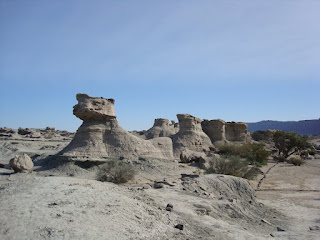
The landscape of the valley is a natural beauty. The wind and the rain have worked out some incredible sculptures on the rocks.
Here is a spinx-like rock
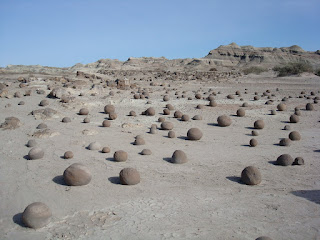
Here is a picture of the rocks formed like balls. They keep coming out of the surface like pumpkins. The outer surface is formed by manganese.
The rock formation below is called as Submarino..since it resembles a submarine

The moon valley has fossils from the Triasic period, which lasted for 45 million years from 228 million and 187 million years back. They have found fossils of the first reptiles/dinosaurs of the world. Paleontologists from all over the world do research at this site in their quest to understand and reconstruct prehistorical evolutions.
The landscape of the valley is a natural beauty. The wind and the rain have worked out some incredible sculptures on the rocks.
Here is a spinx-like rock

Here is a picture of the rocks formed like balls. They keep coming out of the surface like pumpkins. The outer surface is formed by manganese.

The rock formation below is called as Submarino..since it resembles a submarine

More fotos...in my foto gallery http://picasaweb.google.com/viswanathanifs
The valley is surrounded by hills which shine reddish in the sun due to iron content in their rocks. The valley attracted 70,000 tourists last year. The park arranges moon light trips every month. They say it is magical.
The valley is surrounded by hills which shine reddish in the sun due to iron content in their rocks. The valley attracted 70,000 tourists last year. The park arranges moon light trips every month. They say it is magical.
Although it was not in my original programme of the visit to San Juan, last week, it became possible thanks to the offer of the helicopter by the Governor Jose Luis Gioga. It took us one hour by helicopter from San Juan city and at the valley we spent an hour touring the valley with a guide, who is passionate about the valley.
San Juan is one of the most dynamic and progressive provinces of Argentina. Although it is small with a population of 800,000 and 97 percent of the area is arid and mountainous, the hardworking San Juaninos have made the province as the second largest wine producer in the country. Syra is the signature wine of the province. The province´s agro exports include wine, table grapes, olives and fruit concentrates. There is also a thriving and growing mining industry in the areas of gold, silver, copper etc. And , of course, it has the Amancay Golf club , where I played nine holes before rushing to the airport.
Sunday, April 27, 2008
El Nido vacio - Argentine film
I was there at the premiere of the film El Nido vacio - empty nest- yesterday at Village Cinema. It is a film about a couple, who find the house empty after their grown-up children leave home to be independent. The couple try to make sense of their togetherness trying to find a new meaning and bond to sustain the relationship. The man, Leonardo, who is a successful playwright, gets more introspective and gets into the usual midlife crisis. The hyperactive wife, Martha, restarts her life by resuming her university studies and having fun with social get-togethers. She also resumes shouting...to compensate for the days when she could not do so in the presence of children. Leonardo is uncomfortable among the friends of his wife and in social occasions. But his eyes follow the skirts and legs filling up his mind with fantasies. The fantasy at the clinic of a young female dentist takes the form of reality. He lets himself go after her. He is successful in getting her to reciprocate a bit and to take her to bed. But it is a one-shot affair. He feels guilty and does not proceed further.
The director and producer Daniel Burman has handled the theme very well. He has done it in an Argentine way making the story happen in the cafes. bars and restaurants through long but lively conversations. Fortunately, he has not made the film too heavy and complicated as the Argentine writers tend to do in the case of such themes. He has let the characters express their emotions and feelings in words, gestures and unspoken silences. He has let the story flow smoothly in a leisurely pace without any twists or complications.
Oscr Martinez has done justice to his role as Leonardo and so does Cecilia Roth as Martha in a realistic and credible manner.
For me, what the movie shows is what happens in the corner and sidewalk cafes of Buenos Aires every day. Couples and friends sit there for hours sipping cafe and talking..talking..and talking. It is part of the Porteno ( residents of the port city of Buenos Aires are called as portenos) culture.
The director and producer Daniel Burman has handled the theme very well. He has done it in an Argentine way making the story happen in the cafes. bars and restaurants through long but lively conversations. Fortunately, he has not made the film too heavy and complicated as the Argentine writers tend to do in the case of such themes. He has let the characters express their emotions and feelings in words, gestures and unspoken silences. He has let the story flow smoothly in a leisurely pace without any twists or complications.
Oscr Martinez has done justice to his role as Leonardo and so does Cecilia Roth as Martha in a realistic and credible manner.
For me, what the movie shows is what happens in the corner and sidewalk cafes of Buenos Aires every day. Couples and friends sit there for hours sipping cafe and talking..talking..and talking. It is part of the Porteno ( residents of the port city of Buenos Aires are called as portenos) culture.
Saturday, April 26, 2008
Paraguay elects a Leftist ex-Bishop as President
Fernando Lugo was elected in the elections held on 20 April. It was not surprising, since he had been leading in the opinion polls for the last one year. I had been predicting and talking about this to the surprise and consternation of my Paraguayan friends.
It is a historic election for Paraguay. The Colorado party which was continuously ruling the country for the last 61 years was defeated for the first time. On the contrary, Lugo is a newcomer to politics. He took to politics only in 2006. He was one of those believers and practioners of Liberation Theology and was known as the Bishop of the poor. He formed a coalition with an assortment of political parties and indigenous groups and won the elections against formidable obstacles put in his way.
Lugo is the first Leftist President of the country. He wants to change the conditions of the poor. He wants to carry out land reforms and rid the society of corruption. Paraguay is the second most poor country in South America after Bolivia and one of the most corrupt and mismanaged.
But credit must be given to Colorado party candidate and the current President who quickly conceded defeat gracefully and committed to peaceful transfer of power due on 15 August. This shows the maturity of the leaders in contrast to what happened in Mexico. Credit is also due to the government which organised free and fair elections even after knowing that they risked losing power.
The election was colourful in a latino way ! The three main candidates were a bishop, woman ( queen) and a general ( knight).
Lugo´s election completes the Circle of the Left in south america where all the countries except Colombia ( where leftist ideology has been kidnapped and held hostage by FARC) have elected leftist governments. I prefer to call this development as empowerment of the masses , rather than an ideological shift. The masses who were marginalised and excluded in the past have exercised their power to elect those who have an agenda for them...simple !
Lugo is moderate, balanced and mature. He proposes to follow the model of Tabare Vasquez of Uruguay, who is respected in his country and in the region for his pragmatic approach. The opposition had accused Lugo as a Chavista and of receiving funds from Chavez. But Lugo is independent and nationalistic. Lugo did not indulge in any anti-American rhetoric. His language is not confrontational or polarising like in the case of some south american presidents.
Lugo will face many challenges to implement his agenda for change. he does not have a cohesive majority in the congress. His coalition parners, which include communists, liberals and indigenous groups have divergent agenda. The traditional political parties have control of the Congress and many provinces.
In foreign policy, he is going to make some changes. He is going to open diplomatic relations with China. Paraguay remains as the only country in south america to have recognised Taiwan. Lugo is asking for a better deal from Mercosur, which is run by the big boys, Brazil and Argentina. He has asked for a fair price for the electricity being supplied to Brazil from the 12000 MW Itaipu dam. Although President Lula ruled out renegoiations, his foreign minister Celso Amorim has hinted that discussions were possible. Lugo has demanded a simliar fair deal from a joint hydro power project with Argentina too.
Lugo seeks partnership with new powers such as India. Of course, the outgoing government had also attached importance to India and opened embassy in newdelhi. Lugo can be expected to be more friendly. Paraguay is the fourth largest exporter of soya in the world and this is important for India. There are opportunities for investment by Indian companies in agribusiness.
It is a historic election for Paraguay. The Colorado party which was continuously ruling the country for the last 61 years was defeated for the first time. On the contrary, Lugo is a newcomer to politics. He took to politics only in 2006. He was one of those believers and practioners of Liberation Theology and was known as the Bishop of the poor. He formed a coalition with an assortment of political parties and indigenous groups and won the elections against formidable obstacles put in his way.
Lugo is the first Leftist President of the country. He wants to change the conditions of the poor. He wants to carry out land reforms and rid the society of corruption. Paraguay is the second most poor country in South America after Bolivia and one of the most corrupt and mismanaged.
But credit must be given to Colorado party candidate and the current President who quickly conceded defeat gracefully and committed to peaceful transfer of power due on 15 August. This shows the maturity of the leaders in contrast to what happened in Mexico. Credit is also due to the government which organised free and fair elections even after knowing that they risked losing power.
The election was colourful in a latino way ! The three main candidates were a bishop, woman ( queen) and a general ( knight).
Lugo´s election completes the Circle of the Left in south america where all the countries except Colombia ( where leftist ideology has been kidnapped and held hostage by FARC) have elected leftist governments. I prefer to call this development as empowerment of the masses , rather than an ideological shift. The masses who were marginalised and excluded in the past have exercised their power to elect those who have an agenda for them...simple !
Lugo is moderate, balanced and mature. He proposes to follow the model of Tabare Vasquez of Uruguay, who is respected in his country and in the region for his pragmatic approach. The opposition had accused Lugo as a Chavista and of receiving funds from Chavez. But Lugo is independent and nationalistic. Lugo did not indulge in any anti-American rhetoric. His language is not confrontational or polarising like in the case of some south american presidents.
Lugo will face many challenges to implement his agenda for change. he does not have a cohesive majority in the congress. His coalition parners, which include communists, liberals and indigenous groups have divergent agenda. The traditional political parties have control of the Congress and many provinces.
In foreign policy, he is going to make some changes. He is going to open diplomatic relations with China. Paraguay remains as the only country in south america to have recognised Taiwan. Lugo is asking for a better deal from Mercosur, which is run by the big boys, Brazil and Argentina. He has asked for a fair price for the electricity being supplied to Brazil from the 12000 MW Itaipu dam. Although President Lula ruled out renegoiations, his foreign minister Celso Amorim has hinted that discussions were possible. Lugo has demanded a simliar fair deal from a joint hydro power project with Argentina too.
Lugo seeks partnership with new powers such as India. Of course, the outgoing government had also attached importance to India and opened embassy in newdelhi. Lugo can be expected to be more friendly. Paraguay is the fourth largest exporter of soya in the world and this is important for India. There are opportunities for investment by Indian companies in agribusiness.
Friday, April 11, 2008
"India: from misery to power" - book by Patricia Campos Mello
I have just received a copy of this book in Portuguese ( India: da miseria a potencia") , which was launched on 25 March in Sao Paulo. Patricia is a journalist, curently based in Washington DC as the correspondent of Estado de Sao Paulo daily. She had visited India for three weeks in 2006 to interview people and collect materials for the book. India Brand Equity Foundation had financed and organised her visit.
Patricia has given an overview of the emergence of India as an important market, IT power and rising power. She has quoted the usual sources such as Thomas Friedman and businessmen like Nandan Nilekhani. She has quoted me too...
She contrasts India's IT skills and business boom with the poverty, caste system and problems faced by India. The photos she has put in the book are those which describe the misery and problems. She has forgotten to put the pictures which could have reflected the potencia! India seems to have given her a cultural shock from which she did not succeed in gaining her balance.
She has made the predictable comparison with China. She has earlier written a book on China called as " o mundo tem medo de china".
She has compared Brazil with India , the countries of the future. She says that while Brazil has been waiting eternally as the country of future, India has taken off. She has referred to the term "Belindia" which is used in Brazil to describe the inequality; the developed part of Brazil is compared to Belgium and the rest to India. She says while Brazil continues to be Belindia, India is no longer what India meant in the past. She has mentioned in passing the growing partnership between the two countries.
Patricia's book is a timely fill-in for the Brazilians who are puzzled and amazed by the sudden and rapid rise of India. Brazilian government and the business are curious and serious about India.There are no contemporary books on India in portuguese. Books on India available in Brazil are about culture and spiritualism. Although Patricia has not gone into the details of what has caused the paradigm shift in India and and in the mindset of Indians, the book serves its purpose by making the Brazilians to search for answers within themselves. I guess the three week stay was too short for her to understand the complexities of India.
My feeling is that the Brazilians have also reached a take off stage with a new confidence, energy and optimism. Brazilian companies are on a buying spree in neighbouring countries and outside. In 2007, Brazilian outward investment was more than the inward Foreign Direct Investment. The discovery of new oil fields, the commodity boom, leadership in fuel ethanol... are some of the factors which have strengthened the confidence of the Brazilian business. This has been complemented by the political equilibrium achieved by the government with its pragmatic policies friendly to both the Wall Street and Favelas. The government has successfully raised its profile in the region as well in the world by careful and astute diplomatic initiatives. This business- government synergy and putting their act together with a new vision and determination has made Brazil unstoppable....
Viva Brasil !
Patricia has given an overview of the emergence of India as an important market, IT power and rising power. She has quoted the usual sources such as Thomas Friedman and businessmen like Nandan Nilekhani. She has quoted me too...
She contrasts India's IT skills and business boom with the poverty, caste system and problems faced by India. The photos she has put in the book are those which describe the misery and problems. She has forgotten to put the pictures which could have reflected the potencia! India seems to have given her a cultural shock from which she did not succeed in gaining her balance.
She has made the predictable comparison with China. She has earlier written a book on China called as " o mundo tem medo de china".
She has compared Brazil with India , the countries of the future. She says that while Brazil has been waiting eternally as the country of future, India has taken off. She has referred to the term "Belindia" which is used in Brazil to describe the inequality; the developed part of Brazil is compared to Belgium and the rest to India. She says while Brazil continues to be Belindia, India is no longer what India meant in the past. She has mentioned in passing the growing partnership between the two countries.
Patricia's book is a timely fill-in for the Brazilians who are puzzled and amazed by the sudden and rapid rise of India. Brazilian government and the business are curious and serious about India.There are no contemporary books on India in portuguese. Books on India available in Brazil are about culture and spiritualism. Although Patricia has not gone into the details of what has caused the paradigm shift in India and and in the mindset of Indians, the book serves its purpose by making the Brazilians to search for answers within themselves. I guess the three week stay was too short for her to understand the complexities of India.
My feeling is that the Brazilians have also reached a take off stage with a new confidence, energy and optimism. Brazilian companies are on a buying spree in neighbouring countries and outside. In 2007, Brazilian outward investment was more than the inward Foreign Direct Investment. The discovery of new oil fields, the commodity boom, leadership in fuel ethanol... are some of the factors which have strengthened the confidence of the Brazilian business. This has been complemented by the political equilibrium achieved by the government with its pragmatic policies friendly to both the Wall Street and Favelas. The government has successfully raised its profile in the region as well in the world by careful and astute diplomatic initiatives. This business- government synergy and putting their act together with a new vision and determination has made Brazil unstoppable....
Viva Brasil !
Saturday, April 05, 2008
"Black Novel" book by Luisa Valenzuela
Luisa Valenzuela, the Argentine writer has used the setting of Manhattan for her Argentine hero to roam around, get lost and confuse himself. Augustin, the hero of the novel takes refuge in Newyork, after the military dictators smoke out free thought in Argentina. He gets a grant for the stay and write a book. One day he goes to a theatre, meets an actress in the play, goes with her to her house and kills her with a gun, for no reason and without any provocation. He runs away from the scene. He takes refuge in the house of a writer-friend Roberta and confesses to her. She cannot understand how he could have commited murder and tries to analyse how it could have happened. Both of them come to a convoluted conclusion that may be it was part of a make-believe theatre. In a sub-plot, Roberta visits her friend Lara who runs a sadomachist centre where men and women live their fantasies, sexual perversions and let themselves be tortured and punished. Lara tells the writer that her centre should give abundant materials and themes for the writers. Later Augustin also visits Lara's den and lets himslef subjected to a milder version. The book ends with a confusion in the same way it starts.
The title of the novel is self explanatory. It was all black ... after going through the dark alleys one ends up against a black wall.
There are, of course, some interesting parts in which Valenzuela gives clear and vivid touch of Argentina contrasting it with the new world of NewYork.
After having tried the other books of Luisa Valenzuela and failed to appreciate except one book, I did not want to give up. I finished this book.. but it left me with a sense of vacuum at the end of it.
Now I understand why there are so many psychologists in Argentina. Luisa Valenzuela, Luis Borges, Julio Cortazar and the other writers should be confusing the Argentines thoroughly and making them to seek psychic help.
The title of the novel is self explanatory. It was all black ... after going through the dark alleys one ends up against a black wall.
There are, of course, some interesting parts in which Valenzuela gives clear and vivid touch of Argentina contrasting it with the new world of NewYork.
After having tried the other books of Luisa Valenzuela and failed to appreciate except one book, I did not want to give up. I finished this book.. but it left me with a sense of vacuum at the end of it.
Now I understand why there are so many psychologists in Argentina. Luisa Valenzuela, Luis Borges, Julio Cortazar and the other writers should be confusing the Argentines thoroughly and making them to seek psychic help.
Wednesday, March 26, 2008
Argentine souls go to Ashrams in India and Indian bodies come to dance Tango
Thousands of Argentine souls visit India seeking greater wisdom and deeper understanding of spirit. The Argentine visitors dip in the Ganges to purify their souls and stay in Ashrams to enlighten themselves. There are hundreds of followers of Saibaba, Harekrishna and Ramakrishna Mission, among others in Argentina. The other day when I was in the restaurant of the famous resort Llao Llao in Bariloche, a waiter named Jorge greeted me with a Namaste. He is an Anandmargi and has lived in Calcutta for three months. He has assumed an Indian name and practices meditation and recites mantras. During her fashion show yesterday,Monica Socolovski, the Argentine fashion designer told me that Saibaba is her great inspiration.
While the Argentine souls have been journeying to India since many years, there is a reverse traffic now. Indian bodies have started come to dance Tango in Argentina. Sharukh Merchant, partner of the Tandoor restaurant was bitten by the Tango bug in Boston and is here since the last several months. He is an accomplished tango dancer.
In his dinner at Tandoor the other day, he introduced me to Mamta,who has come to Buenos Aires to learn Tango. She is going to be here for three months. She goes to different tango studios and practices every day. She has started going to Milongas, where a faster version of Tango is danced in clubs and where one gets chance to dance with different partners.
Mamta had started learning in India and continued it in New York and she is here to breathe and live Tango...
It may not be a big deal if she is learning salsa, samba or merengue. But Tango is a different ball game... literally...my readers might recall the reference to balls in my blog on the novel Kiss and Tango... http://latinamericanaffairs.blogspot.com/2007/12/kiss-and-tango-novel-by-marina-palmer.html#links
Tango is the most sensual dance in which sparks are emitted by the rubbing bodies. That makes it more challenging for the tradition-bound Indians who are more preoccupied with souls than bodies.
Tango is only a reflection of the amazing adventurous spirit of Mamta, who has broken several myths and streotyping of Indian women. She is a single woman ( her fiance from India will visit her soon), who has come alone to stay in a new city whose language is new to her. But she has been managing confidently and successfully the Buenos Aires Taxis, the Machos in Milongas and even the city traffic on a cycle on a weekday. Bravo..
In case the readers imagine that she is an adolescent bitten by the dance bug.. hmm .. forget it.. Her children have grown past the adolescent stage into the twenties. She has beaten the age. She is as fit, as energetic and as mad ....as any teenager.
She has started going for a spanish class so that she can understand the lyrics of Tango and interact with the Argentines.
She is by profession a graphic designer. She has studied and worked in New Zealand and then moved to NewYork from where she has come to the Tango land.
Rather than continuing with my interpretation of her, let me put the readers straight into her blog: Tango y espanol in Buenos Aires
http://tangoandspanishinba.blogspot.com/
And she has an interesting foto gallery too..
http://www.flickr.com/photos/24668244@N07/?saved=1
Felicitaciones Mamta... Felices aventuras !
Before I end, I must mention the third Indian who has come to Argentina for a month to learn tango and experience Argentina. He is Udai from Bangalore. He has taken a break from his Microsoft job to travel around for a year. He has already done a month in Brazil, before coming here. He is on a backpack trip with a Guitar and amzing spirit.
While the Argentine souls have been journeying to India since many years, there is a reverse traffic now. Indian bodies have started come to dance Tango in Argentina. Sharukh Merchant, partner of the Tandoor restaurant was bitten by the Tango bug in Boston and is here since the last several months. He is an accomplished tango dancer.
In his dinner at Tandoor the other day, he introduced me to Mamta,who has come to Buenos Aires to learn Tango. She is going to be here for three months. She goes to different tango studios and practices every day. She has started going to Milongas, where a faster version of Tango is danced in clubs and where one gets chance to dance with different partners.
Mamta had started learning in India and continued it in New York and she is here to breathe and live Tango...
It may not be a big deal if she is learning salsa, samba or merengue. But Tango is a different ball game... literally...my readers might recall the reference to balls in my blog on the novel Kiss and Tango... http://latinamericanaffairs.blogspot.com/2007/12/kiss-and-tango-novel-by-marina-palmer.html#links
Tango is the most sensual dance in which sparks are emitted by the rubbing bodies. That makes it more challenging for the tradition-bound Indians who are more preoccupied with souls than bodies.
Tango is only a reflection of the amazing adventurous spirit of Mamta, who has broken several myths and streotyping of Indian women. She is a single woman ( her fiance from India will visit her soon), who has come alone to stay in a new city whose language is new to her. But she has been managing confidently and successfully the Buenos Aires Taxis, the Machos in Milongas and even the city traffic on a cycle on a weekday. Bravo..
In case the readers imagine that she is an adolescent bitten by the dance bug.. hmm .. forget it.. Her children have grown past the adolescent stage into the twenties. She has beaten the age. She is as fit, as energetic and as mad ....as any teenager.
She has started going for a spanish class so that she can understand the lyrics of Tango and interact with the Argentines.
She is by profession a graphic designer. She has studied and worked in New Zealand and then moved to NewYork from where she has come to the Tango land.
Rather than continuing with my interpretation of her, let me put the readers straight into her blog: Tango y espanol in Buenos Aires
http://tangoandspanishinba.blogspot.com/
And she has an interesting foto gallery too..
http://www.flickr.com/photos/24668244@N07/?saved=1
Felicitaciones Mamta... Felices aventuras !
Before I end, I must mention the third Indian who has come to Argentina for a month to learn tango and experience Argentina. He is Udai from Bangalore. He has taken a break from his Microsoft job to travel around for a year. He has already done a month in Brazil, before coming here. He is on a backpack trip with a Guitar and amzing spirit.
Saturday, February 23, 2008
"Bedside manners"- novel by Luisa Valenzuela
This is the second novel of the Argentine writer Luisa Valenzuela that I have read. The first one" Clara" was a simple and straightforward story but this one is " magical realism".
It is the story of an Argentine woman who flees military dictatorship, lives in USA for ten years and returns home after the restoration of democracy. Her friend advises her to take rest in a country club outside the city of Buenos Aires to prepare herself to the new realities of the city. But her rest is constantly disturbed by a wicked maid, who takes advantage of the woman who had been out of touch with the country for ten years. The maid increases the amount to be paid for purchases she makes for the senora every five minutes ,attributing the increase to inflation. An army regiment uses the country club premises including her king size bed for exercises. A sergeant is hiding under her bed as part of the exercise and the poor starving guy steals the food supplies of the senora. The captain is planning a coup to overthrow the civilian government. He belongs to the typial Latino military school of thought which is cocky and confident that it alone knows how to govern and has contempt for the civilians. But the army detachment is mocked and teased by the slum dwellers who have nothing to look for and nothing to fear. The senora calls for a doctor and finds that the doctor doubles up as a taxi driver to supplement his income. He seduces the senora to have sex but as soon as it is over, he starts commanding her like a macho.
The story is quintessential Latin America... Argentina. It has been the reality not very long ago. Luisa has weaved magic into this reality. She has made it funny and satirical.
It is a pity that Luisa has made it as a short novel of just 120 pages, after having elaborately opened the themes of the story on all sides and raising readers' expectations.
After reading this book, I started another novel of Luisa called as " He who searches- como en la guerra"It is about a psycho analyst in Madrid who goes to study his subject, an Argentine woman, after midnight. The woman says "she awakens in men a love so intense and real that afterward they cannot bear it and abandon her".
Another typical Argentine theme.. they say Buenos Aires has more psychoanalysts per capita than any other capital!
But the novel drifts into all directions and unconnected digressions... I have now abandoned it after reading about 100 pages. It became heavy like the works of Borghes !
It is the story of an Argentine woman who flees military dictatorship, lives in USA for ten years and returns home after the restoration of democracy. Her friend advises her to take rest in a country club outside the city of Buenos Aires to prepare herself to the new realities of the city. But her rest is constantly disturbed by a wicked maid, who takes advantage of the woman who had been out of touch with the country for ten years. The maid increases the amount to be paid for purchases she makes for the senora every five minutes ,attributing the increase to inflation. An army regiment uses the country club premises including her king size bed for exercises. A sergeant is hiding under her bed as part of the exercise and the poor starving guy steals the food supplies of the senora. The captain is planning a coup to overthrow the civilian government. He belongs to the typial Latino military school of thought which is cocky and confident that it alone knows how to govern and has contempt for the civilians. But the army detachment is mocked and teased by the slum dwellers who have nothing to look for and nothing to fear. The senora calls for a doctor and finds that the doctor doubles up as a taxi driver to supplement his income. He seduces the senora to have sex but as soon as it is over, he starts commanding her like a macho.
The story is quintessential Latin America... Argentina. It has been the reality not very long ago. Luisa has weaved magic into this reality. She has made it funny and satirical.
It is a pity that Luisa has made it as a short novel of just 120 pages, after having elaborately opened the themes of the story on all sides and raising readers' expectations.
After reading this book, I started another novel of Luisa called as " He who searches- como en la guerra"It is about a psycho analyst in Madrid who goes to study his subject, an Argentine woman, after midnight. The woman says "she awakens in men a love so intense and real that afterward they cannot bear it and abandon her".
Another typical Argentine theme.. they say Buenos Aires has more psychoanalysts per capita than any other capital!
But the novel drifts into all directions and unconnected digressions... I have now abandoned it after reading about 100 pages. It became heavy like the works of Borghes !
Subscribe to:
Posts (Atom)


